


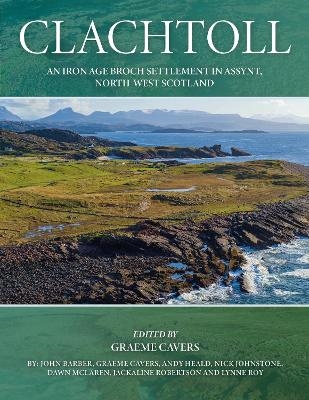
Clachtoll
An Iron Age Broch Settlement in Assynt, North-west Scotland
Seiten
2022
Oxbow Books (Verlag)
978-1-78925-847-9 (ISBN)
Oxbow Books (Verlag)
978-1-78925-847-9 (ISBN)
Results of a major, community-based excavation of an Iron Age broch that collapsed in on itself after a fire, sealing a unique and undisturbed domestic assemblage.
Clachtoll broch is one of the most spectacular Iron Age settlements on the northern mainland of Scotland. When it became clear that the structure was threatened by coastal erosion, community heritage group Historic Assynt launched a major programme of conservation and excavation works designed to secure the vulnerable structure and recover the archaeological evidence of its occupation and use. The resulting excavation provided evidence of a long and complex history of construction and rebuilding, with the final, middle Iron Age occupation phase ending in a catastrophic fire and collapse of the tower by the early years of the first century AD. The internal deposits span perhaps 50 years of the broch’s final occupation and were remarkably well preserved, with no evidence for secondary re-use or disturbance after the fire. As a result, the excavation provides a remarkable snapshot of life in Iron Age Scotland, with an artefact assemblage attesting to daily agricultural life as well as long-range contacts that sets the broch within a wider Atlantic community. Specialist analysis of the artefactual and palaeoenvironmental evidence coupled with detailed analysis of the structure in its local geographical context combine to provide a major new contribution to the archaeology of north-west Scotland, with wider implications for our understanding of late prehistoric society in northern Britain.
This report comprises the results of the archaeological investigations at Clachtoll, compiled by a team of archaeologists and specialists from AOC Archaeology Group, and brings together evidence from a range of specialist analyses as well as environmental and landscape investigations.
Clachtoll broch is one of the most spectacular Iron Age settlements on the northern mainland of Scotland. When it became clear that the structure was threatened by coastal erosion, community heritage group Historic Assynt launched a major programme of conservation and excavation works designed to secure the vulnerable structure and recover the archaeological evidence of its occupation and use. The resulting excavation provided evidence of a long and complex history of construction and rebuilding, with the final, middle Iron Age occupation phase ending in a catastrophic fire and collapse of the tower by the early years of the first century AD. The internal deposits span perhaps 50 years of the broch’s final occupation and were remarkably well preserved, with no evidence for secondary re-use or disturbance after the fire. As a result, the excavation provides a remarkable snapshot of life in Iron Age Scotland, with an artefact assemblage attesting to daily agricultural life as well as long-range contacts that sets the broch within a wider Atlantic community. Specialist analysis of the artefactual and palaeoenvironmental evidence coupled with detailed analysis of the structure in its local geographical context combine to provide a major new contribution to the archaeology of north-west Scotland, with wider implications for our understanding of late prehistoric society in northern Britain.
This report comprises the results of the archaeological investigations at Clachtoll, compiled by a team of archaeologists and specialists from AOC Archaeology Group, and brings together evidence from a range of specialist analyses as well as environmental and landscape investigations.
Graeme Cavers is a director at AOC with responsibility for survey and geomatics. He has been involved in research on Iron Age Scotland for almost 20 years, with a particular focus on wetland and drystone settlements of the Atlantic west.
Preface
Introduction and research context
The structure and excavations
Chronology
Artefacts
-Ceramics
-Residues
-Organics
-Metals
-Slag
-Stone
-Worked bone
-Wood
Environmental evidence
-Animal bone
-Fish bone
-Bird bone
-Marine shell
-Plant macrofossils
Soil micromorphology
Intrasite analysis
Environmental context
Clashnessie dun
Split Rock dun
Loch na Claise crannog
Discussion and conclusion
| Erscheinungsdatum | 19.08.2022 |
|---|---|
| Zusatzinfo | B/w and colour |
| Verlagsort | Oxford |
| Sprache | englisch |
| Maße | 210 x 297 mm |
| Themenwelt | Geisteswissenschaften ► Archäologie |
| Geschichte ► Allgemeine Geschichte ► Vor- und Frühgeschichte | |
| Geisteswissenschaften ► Geschichte ► Regional- / Ländergeschichte | |
| ISBN-10 | 1-78925-847-2 / 1789258472 |
| ISBN-13 | 978-1-78925-847-9 / 9781789258479 |
| Zustand | Neuware |
| Informationen gemäß Produktsicherheitsverordnung (GPSR) | |
| Haben Sie eine Frage zum Produkt? |
Mehr entdecken
aus dem Bereich
aus dem Bereich
auf den Spuren der frühen Zivilisationen
Buch | Hardcover (2023)
C.H.Beck (Verlag)
CHF 27,95
Erkennen. Bestimmen. Beschreiben
Buch | Softcover (2022)
Deutscher Kunstverlag
CHF 27,85


