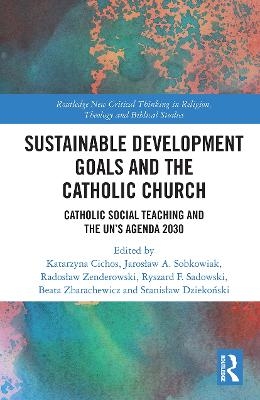
Sustainable Development Goals and the Catholic Church
Routledge (Verlag)
978-0-367-51384-9 (ISBN)
The ongoing involvement of the Catholic Church in social matters makes it a significant potential partner in issues around development. Therefore, with the use of the comparative method, this book brings together authors from multiple disciplines to assess how the political and legal aspects of each of the UN’s 17 SDGs are addressed by Catholic Social Teaching. Chapters answer the question of how the Catholic Church evaluates the concept of sustainable development as defined by the Agenda 2030 Goals, as well as assessing how and if it can contribute to shaping the contemporary concept of global development.
Examining the potential level of cooperation between the international community and the Catholic Church in the implementation of the Agenda 2030 Goals, this volume will be of keen interest to scholars of Catholic Studies, Religious Studies and the Sociology of Religion, as well as Environmental Studies and Development Studies.
Katarzyna Cichos works as Researcher and Lecturer at the Cardinal Stefan Wyszyński University (CSWU) in Warsaw. Her research interests focus on public international law, with a specific emphasis on the legal and institutional aspects of the Sustainable Development Goals and good governance. She is also an active member of local community initiatives connected to good governance and sustainable development. She holds a PhD in Law. Jarosław A. Sobkowiak is Associate Dean of the Department of Theology and a lecturer in the Institute of Media, Education and Journalism at the CSWU. He is also a board member of the Moral Theologians Association and the Head of the Social and Digital Communication Centre of CSWU. He is the Chief Editor of the scientific half-yearly magazine Studia Theologica Varsaviensia. Radosław Zenderowski is Professor at CSWU (since 1999), Head of Chair of International Relations and European Studies, and Director of Institute of Political Science and Public Administration. He is a member of the Scientific Board for PhD Studies in Silesian University in Opava (Czech Republic), a member of the Scientific Board of Polish Association of European Studies, and a member of the Committee on Political Science, Polish Academy of Sciences. He is the author of several books and articles on national identities in Central Eastern Europe (CEE), relations between nationalism and religion, ethnic conflicts, especially in the Balkan region, ethic policies of CEE states, and public diplomacy in the cross-border regions. Ryszard F. Sadowski is Head of Department of Ecophilosophy at CSWU. He is also an editor-in-chief of the scientific journal Studia Ecologiae et Bioethicae, published by the Cardinal Stefan Wyszyński University Press. His main research interests focus on environmental philosophy, environmental anthropology, ecophilosophical reflection on environmental crisis, and the role of religions in causing and overcoming the crisis. Beata Zbarachewicz is Lecturer at the Department of Informatics Law and the Faculty of Law and Administration at CSWU. She is also a member of the University Council. Stanisław Dziekoński, is Professor, has been Rector of UKSW since 2012, as well as the Head of the Department of the Psychological and Pedagogical Foundations of Catechetics. His other work includes acting as a consultant for the Catholic Education Commission and the Scientific Council of the Polish Bishops’ Conference and being an active member of scientific councils for various theological and pedagogical magazines.
Introduction
Chapter 1. Agenda 2030, SDG 1, Catholic social teaching, poverty, social security, solidarity - Tomasz Szyszka, Piotr Broda-Wysocki and Radosław Mędrzycki
Chapter 2. Agenda 2030, SDG 2, Catholic social teaching, hunger, food production, FAO - Waldemar Cisło, Katarzyna Góralczyk and Mariusz Sulkowski
Chapter 3. Agenda 2030, SDG 3, Catholic social teaching, health care, life protection, health prevention - Jan Kazimierz Przybyłowski, Katarzyna Kucharska and Sebastian Sikorski
Chapter 4. Agenda 2030, SDG 4, Catholic social teaching, education, ESD, missions - Jarosław Michalski, Rev. Piotr Tomasik and Beata Zbarachewicz
Chapter 5. Agenda 2030, SDG 5, Catholic social teaching, gender, new feminism, housework - Małgorzata Pawlus, Andrzej Waleszczyński, and Magdalena Wilczek-Karczewska
Chapter 6. Agenda 2030, SDG 6, Catholic social teaching, access to water, water distribution, water ecosystems - Małgorzata Laskowska, Marek Rzotkiewicz and Wojciech Kluj
Chapter 7. Agenda 2030, SDG 7, Catholic social teaching, energy transformation, energy poverty, energy competition - Piotr Burgoński and Mariusz Szyrski
Chapter 8. Agenda 2030, SDG 8, Catholic social teaching, sustainable economic growth, unemployment, exploitation - Bartosz M. Rydliński, Katarzyna Roszewska and Jarosław A. Sobkowiak
Chapter 9. Agenda 2030, SDG 9, Catholic social teaching, industrialisation, digital revolution - Marek Robak, Andrzej Rudowski and Piotr Łuczuk
Chapter 10. Agenda 2030, SDG 10, Catholic social teaching, inequality, migrants’ rights, social protection - Tomasz Płudowski, Anna Fidelus, Elżbieta Hanna Morawska and Jarosław Różański
Chapter 11. Agenda 2030, SDG 11, Catholic social teaching, urban areas, cultural and environmental heritage, social integration - Katarzyna Flader-Rzeszowska, Henryk Skorowski and Jacek Jaworski
Chapter 12. Agenda 2030, SDG 12, Catholic social teaching, consumption, harmony with nature - Mariusz Boguszewski, Piotr Burgoński and Małgorzata Starzomska
Chapter 13. Agenda 2030, SDG 13, Catholic social teaching, climate change, climate education, Anthropocene - Dominika Dzwonkowska, Izabella Olejniczak and Kazimierz Pawlik
Chapter 14. Agenda 2030, SDG 14, Catholic social teaching, ecosystems, marine resources, resilience - Barbara Strzałkowska and Krzysztof Opaliński
Chapter 15. Agenda 2030, SDG 15, Catholic social teaching, soil degradation, environmental ethics - Adamczewski Bartosz, Krassimira Ilieva-Makulec, Agnieszka Klimska and Agata Kosieradzka-Federczyk
Chapter 16. Agenda 2030, SDG 16, Catholic social teaching, individual freedom, access do justice, decentralisation - Irena Lipowicz, Grzegorz Embros and Krzysztof Cebul
Chapter 17. Agenda 2030, SDG 17, Catholic social teaching, partnership, Catholic Church, inter-religious partnerships, implementation - Rafał Leśniczak, Ryszard F. Sadowski and Janusz Balicki
Conclusion
| Erscheinungsdatum | 12.05.2022 |
|---|---|
| Reihe/Serie | Routledge New Critical Thinking in Religion, Theology and Biblical Studies |
| Verlagsort | London |
| Sprache | englisch |
| Maße | 156 x 234 mm |
| Gewicht | 380 g |
| Themenwelt | Geisteswissenschaften ► Religion / Theologie ► Christentum |
| Sozialwissenschaften ► Soziologie ► Spezielle Soziologien | |
| ISBN-10 | 0-367-51384-6 / 0367513846 |
| ISBN-13 | 978-0-367-51384-9 / 9780367513849 |
| Zustand | Neuware |
| Informationen gemäß Produktsicherheitsverordnung (GPSR) | |
| Haben Sie eine Frage zum Produkt? |
aus dem Bereich