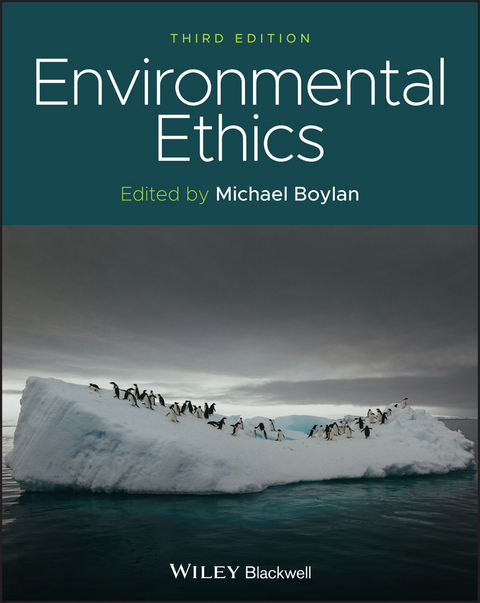
Environmental Ethics (eBook)
John Wiley & Sons (Verlag)
978-1-119-63510-9 (ISBN)

In the newly revised Third Edition of Environmental Ethics, internationally renowned philosopher Michael Boylan delivers another accessible introduction for students new to ethics, and an invaluable reference for scholars of all levels. The anthology includes important essays, both established and contemporary, as well as eight brand-new contributions commissioned specifically for this edition. This new material is the foundation for students' understanding of the most recent ethical debates on the environment and humanity's place within it.
The balanced combination of new material on recent developments in the field and well-known, foundational articles appears alongside helpful pedagogical materials, including case studies and sample questions. The book brings students up to speed on all the main themes in the area, including worldview arguments for environmentalism, the anthropocentric vs. biocentric debate, and a variety of applied environmental problems. Environmental Ethics also offers:
- A thorough introduction to the theoretical background of environmental ethics, including discussions of ethical reasoning, nature, and the tragedy of the commons
- Comprehensive explorations of eco-feminism and social justice, aesthetics, and deep ecology
- Practical discussions of anthropocentric and biocentric justifications in environmental ethics
- In-depth examinations of applied environmental problems, including climate change, animal rights, sustainability, and public policy
Perfect for undergraduate and graduate students studying topics in ethics, the environment, law, and policy, Environmental Ethics will also earn a place in the libraries of philosophers with an interest in applied or environmental ethics, and industry consultants to ecologists, environmental scientists, or environmental policymakers.
Michael Boylan is Professor of Philosophy at Marymount University. He has authored 39 books and over 150 journal articles and book chapters, has served on numerous professional and governmental policy committees, and was a Fellow at the Center for American Progress. He has been invited to speak at universities in fifteen countries on five continents around the world, including Oxford, Cambridge, Cologne, and more.
The latest edition of an essential resource in the theory and applications of environmental ethics In the newly revised Third Edition of Environmental Ethics, internationally renowned philosopher Michael Boylan delivers another accessible introduction for students new to ethics, and an invaluable reference for scholars of all levels. The anthology includes important essays, both established and contemporary, as well as eight brand-new contributions commissioned specifically for this edition. This new material is the foundation for students' understanding of the most recent ethical debates on the environment and humanity's place within it. The balanced combination of new material on recent developments in the field and well-known, foundational articles appears alongside helpful pedagogical materials, including case studies and sample questions. The book brings students up to speed on all the main themes in the area, including worldview arguments for environmentalism, the anthropocentric vs. biocentric debate, and a variety of applied environmental problems. Environmental Ethics also offers: A thorough introduction to the theoretical background of environmental ethics, including discussions of ethical reasoning, nature, and the tragedy of the commons Comprehensive explorations of eco-feminism and social justice, aesthetics, and deep ecology Practical discussions of anthropocentric and biocentric justifications in environmental ethics In-depth examinations of applied environmental problems, including climate change, animal rights, sustainability, and public policy Perfect for undergraduate and graduate students studying topics in ethics, the environment, law, and policy, Environmental Ethics will also earn a place in the libraries of philosophers with an interest in applied or environmental ethics, and industry consultants to ecologists, environmental scientists, or environmental policymakers.
Michael Boylan is Professor of Philosophy at Marymount University. He has authored 39 books and over 150 journal articles and book chapters, has served on numerous professional and governmental policy committees, and was a Fellow at the Center for American Progress. He has been invited to speak at universities in fifteen countries on five continents around the world, including Oxford, Cambridge, Cologne, and more.
1
Ethical Reasoning
MICHAEL BOYLAN
What is the point of studying ethics? This is the critical question that will drive this chapter. Many people do not think about ethics as they make decisions in their day-to-day lives. They see problems and make decisions based upon practical criteria. Many see ethics as rather an affectation of personal taste. It is useful only when it can get you somewhere. Is this correct? Do we act ethically only when there is a win–win situation in which we can get what we want, and also appear to be an honorable, feeling, and caring person?
A Prudential Model of Decision-Making
In order to begin answering this question we must start by examining the way most of us make decisions. Everyone initiates the decision-making process with an established worldview. A worldview is a current personal consciousness that consists in one’s understanding of the facts and about the values in the world. It is the most primitive term to describe our factual and normative conceptions. This worldview may be one that we have chosen or it may be one that we passively accepted as we grew up in a particular culture. Sometimes, this worldview is wildly inconsistent. Sometimes, this worldview has gaping holes so that no answer can be generated. Sometimes, it is geared only to perceived self-interest. And sometimes, it is fanciful and can never be put into practice. Failures in one’s personal worldview model will lead to failures in decision-making.
One common worldview model in the Western world is that of celebrity fantasy. Under this worldview, being a celebrity is everything. Andy Warhol famously claimed that what Americans sought after most was “fifteen minutes of fame.”1 Under this worldview model we should strive to become a celebrity if only for a fleeting moment. What does it mean to be a celebrity? It is someone who is seen and recognized by a large number of people. Notice that this definition does not stipulate that once recognized the object is given positive assent. That would be to take an additional step. To be seen and recognized is enough. One can be a sinner or a saint—all the same. To be recognized is to be recognized. If this is the end, then it is probably easier to take the sinner route. In this way, the passion for celebrity is at heart contrary to ethics.
Another popular worldview model is one of practical competence. Under this model the practitioner strives to consider what is in his or her best interest and applies a practical cost–benefit analysis to various situations in order to ascertain whether action x or action y will maximize the greatest amount of pleasure for the agent (often described in terms of money). Thus, if you are Bernie Madoff (a well-known financial swindler) you might think about the risks and rewards of creating an illegal Ponzi scheme as opposed to creating a legitimate investment house that operates as other investment houses do. The risks of setting off on your own direction are that you might get caught and go to prison. The rewards are that you might make much more money than you would have done under the conventional investment house model. Since you think you are smarter than everyone else and will not get caught, the prudential model would say: “Go for it!” Madoff did get caught, but who knows how many others do not? We cannot know because they have not been caught. But even if you are not caught, is that the best worldview approach? The prudential model says yes.
Possible Ethical Additions to the Prudential Model
Some people, including this author, think that the prudential model is lacking. Something else is necessary in order have a well-functioning worldview by which we can commit purposive action (here understood to be the primary requirement of fulfilled human nature). We first have to accept that the construction of our worldview is within our control. What I suggest is a set of practical guidelines for the construction of our worldview: “All people must develop a single comprehensive and internally coherent worldview that is good and that we strive to act out in our daily lives.” I call this the personal worldview imperative. Now one’s personal worldview is a very basic concept. One’s personal worldview contains all that we hold good, true, and beautiful about existence in the world. There are four parts to the personal worldview imperative: completeness, coherence, connection to a theory of ethics, and practicality. Let us briefly say something about each.
First, completeness. Completeness is a formal term that refers to a theory being able to handle all cases put before it, and being able to determine an answer based upon the system’s recommendations. In this case, I think that the notion of the good will provides completeness to everyone who develops one. There are two senses of the good will. The first is the rational good will. The rational good will means that each agent will develop an understanding about what reason requires of one as we go about our business in the world. In the various domains in which we engage this may require the development of different sorts of skills. In the case of ethics, it would require engaging in a rationally-based philosophical ethics and abiding by what reason demands.
Another sort of goodwill is the affective good will. We are more than just rational machines. We have an affective nature too. Our feelings are important, but just as was the case with reason, some guidelines are in order. For ethics we begin with sympathy. Sympathy will be taken to be the emotional connection that one forms with other humans. This emotional connection must be one in which the parties are considered to be on a level basis. The sort of emotional connection I am talking about is open and between equals. It is not that of a superior “feeling sorry” for an inferior. It is my conjecture that those who engage in interactive human sympathy that is open and level will respond to another with care. Care is an action-guiding response that gives moral motivation to acting properly. Together sympathy, openness, and care constitute love.
When confronted with any novel situation one should utilize the two dimensions of the good will to generate a response. Because these two orientations act differently, it is possible that they may contradict each other. When this is the case, I would allot the tiebreaker to reason. Others, however, demur.2 Each reader should take a moment to think about his or her own response to such an occurrence.
Second, coherence. People should have coherent worldviews. This also has two varieties: deductive and inductive. Deductive coherence speaks to our not having overt contradictions in our worldview. An example of an overt contradiction in one’s worldview would be for Sasha to tell her friend Sharad that she has no prejudice against Muslims and yet in another context she tells anti-Muslim jokes. The coherence provision of the personal worldview imperative states that you should not change who you are and what you stand for depending upon the context in which you happen to be.
Inductive coherence is different. It is about adopting different life strategies that work against each other. In inductive logic this is called a sure loss contract. For example, if a person wanted to be a devoted husband and family man and yet also engaged in extramarital affairs, he would involve himself in inductive incoherence. The very traits that make him a good family man—loyalty, keeping your word, sincere interest in the well-being of others—would hurt one in being a philanderer, which requires selfish manipulation of others for one’s own pleasure. The good family man will be a bad philanderer and vice versa. To try to do both well involves a sure loss contract. Such an individual will fail at both. This is what inductive incoherence means.
Third, connection to a theory of being good, that is, ethics. The personal worldview imperative enjoins that we consider and adopt an ethical theory. It does not give us direction, as such, as to which theory to choose except that the chosen theory must not violate any of the other three conditions (completeness, coherence, and practicability). What is demanded is that one connects to a theory of ethics and uses its action guiding force to control action.
Fourth, practicability. In this case there are two senses to the command. The first sense refers to the fact that we actually carry out what we say we will do. If we did otherwise, we would be hypocrites and also deductively incoherent. But, second, it is important that the demands of ethics and social/political philosophy be doable. One cannot command another to do the impossible! The way that I have chosen to describe this is the distinction between the utopian and the aspirational. The utopian is a command that may have logically valid arguments behind it, but are existentially unsound (meaning that some of the premises in the action-guiding argument are untrue by virtue of their being impractical). In a theory of global ethics, if we required that everyone in a rich country gave up three-quarters of their income so that they might support the legitimate plight of the poor, this would be a utopian vision. Philosophers are very attracted to utopian visions. However, unless philosophers want to be marginalized, we must situate our prescriptions in terms that can actually be used by policymakers. Beautiful visions that can never be should be transferred to artists and poets.
How to Construct Your Own Model
The first step in creating your own...
| Erscheint lt. Verlag | 17.2.2022 |
|---|---|
| Sprache | englisch |
| Themenwelt | Geisteswissenschaften ► Philosophie ► Allgemeines / Lexika |
| Geisteswissenschaften ► Philosophie ► Ethik | |
| Schlagworte | animal rights • anthropocentric • biocentric • Climate Activism • climate change • Eco-feminism • Environmental activism • Environmental Ethics • environmental ethics anthology • Environmental Policy • Environmental Studies • Philosophie • Philosophy • pollution • sustainability • Tragedy of the commons • Umweltethik • Umweltforschung • worldview arguments |
| ISBN-10 | 1-119-63510-1 / 1119635101 |
| ISBN-13 | 978-1-119-63510-9 / 9781119635109 |
| Informationen gemäß Produktsicherheitsverordnung (GPSR) | |
| Haben Sie eine Frage zum Produkt? |
 EPUB (Adobe DRM)
Kopierschutz: Adobe-DRM
Adobe-DRM ist ein Kopierschutz, der das eBook vor Mißbrauch schützen soll. Dabei wird das eBook bereits beim Download auf Ihre persönliche Adobe-ID autorisiert. Lesen können Sie das eBook dann nur auf den Geräten, welche ebenfalls auf Ihre Adobe-ID registriert sind.
Details zum Adobe-DRM
Dateiformat: EPUB (Electronic Publication)
EPUB ist ein offener Standard für eBooks und eignet sich besonders zur Darstellung von Belletristik und Sachbüchern. Der Fließtext wird dynamisch an die Display- und Schriftgröße angepasst. Auch für mobile Lesegeräte ist EPUB daher gut geeignet.
Systemvoraussetzungen:
PC/Mac: Mit einem PC oder Mac können Sie dieses eBook lesen. Sie benötigen eine
eReader: Dieses eBook kann mit (fast) allen eBook-Readern gelesen werden. Mit dem amazon-Kindle ist es aber nicht kompatibel.
Smartphone/Tablet: Egal ob Apple oder Android, dieses eBook können Sie lesen. Sie benötigen eine
Geräteliste und zusätzliche Hinweise
Buying eBooks from abroad
For tax law reasons we can sell eBooks just within Germany and Switzerland. Regrettably we cannot fulfill eBook-orders from other countries.
aus dem Bereich