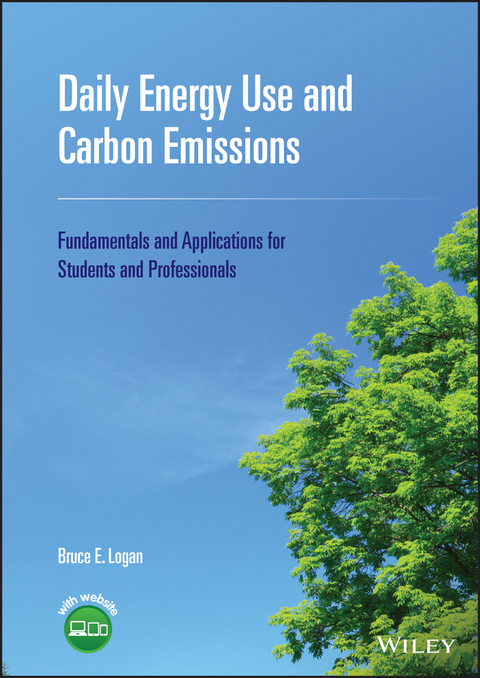
Daily Energy Use and Carbon Emissions (eBook)

Provides an accessible and relatable approach for understanding how much energy we use in our day-to-day lives
Daily Energy Use and Carbon Emissions enables readers to directly evaluate their energy use, estimate the resulting carbon emissions, and use the information to better appreciate and address the impact their activities have on climate change. Using quantities and terms rooted in everyday life, this easy-to-understand textbook helps readers determine the energy they consume driving a car, preparing a meal, charging electronic devices, heating and cooling a house or apartment, and more.
Throughout the text, clear explanations, accurate information, and numerous real-world examples help readers to answer key energy questions such as: How much energy does your house use in a month? What impact will turning off lightbulbs in your home have on energy conservation? Which car emits more CO2 into the atmosphere per mile, a 50 MPG gasoline car or a 100 MPG equivalent electric car? Demonstrating the relation between daily energy use, carbon emissions, and everyday activities in a new way, this innovative textbook:
- Examines daily activities within the context of the basic needs: energy, food, air, and water
- Covers topics such as daily water use, renewable energy, water and energy sources, transportation, concrete and steel, and carbon capture and storage
- Includes discussion of energy and CO2 emissions relative to infrastructure and population growth
- Provides supplemental teaching material including PowerPoint slides, illustrative examples, homework assignments, discussion questions, and classroom quizzes with answers
Daily Energy Use and Carbon Emissions: Fundamentals and Applications for Students and Professionals is a perfect textbook for students and instructors in Environmental Engineering programs, and an essential read for those pursuing careers in areas related to energy, environment, and climate change.
Bruce E. Logan, PhD, is the Evan Pugh University Professor in Engineering, the Stan & Flora Kappe Professor of Environmental Engineering, and Director of the Engineering Energy & Environmental Institute at Penn State University, USA. He is the author of Environmental Transport Processes and Microbial Fuel Cells, and has published more than 540 refereed publications.
Bruce E. Logan, PhD, is the Evan Pugh University Professor in Engineering, the Stan & Flora Kappe Professor of Environmental Engineering, and Director of the Engineering Energy & Environmental Institute at Penn State University, USA. He is the author of Environmental Transport Processes and Microbial Fuel Cells, and has published more than 540 refereed publications.
CHAPTER 1
INTRODUCTION
1.1 A VERY BRIEF HISTORY OF ENERGY USE
For most of the history of mankind, there was no need for a unit of energy: It was all about having enough food to eat and perhaps a fire to stay warm. Animal domestication created the additional burden of needing to ensure a food supply for the animals, but the food‐energy loop was small and centered on food and warmth. Around 5500 y ago, people started riding horses and mankind entered the bronze age with people learning to mine and heat metals to make better tools (and weapons). Human energy needs then became more than about getting enough food for our own energy needs, it also meant providing food for horses and other animals and having sufficient energy to craft tools.
From these early days when people first learned to make and use fire, our global population has remained bound to the concept of burning things. The history of energy use shows that most efforts to obtain energy were centered on finding different things to burn. Wood and other biomass were burned to provide heat from a fire, and then, coal was used as a more efficient energy source due to its greater energy density. Later on, we transitioned to oil and then natural gas, with oil being transformed into many other materials we could burn such as gasoline, kerosene, and jet fuel.
So here we are today with an energy infrastructure based primarily on distributing various kinds of fuels around the world to be burned and provide the energy we use to drive our cars, heat our homes, produce electricity, run factories, and maintain communities. We are used to an abundance of fossil fuels and thus have little direct connections to how much energy we use other than the cost at the gas pump to fill up our car or the money we use to pay our gas or electric bills. It is difficult to sum up the energy from these different sources because they mostly all have different units. One of the purposes of this book is to better connect us to the amount of energy we use to develop an appreciation of how it ties into our daily lives. Another purpose is to show that you can use this knowledge to reduce energy consumption and greatly decrease carbon emissions from fossil fuels into our environment.
In the first few chapters of this book, we will examine the vast array of energy units in our lives and gain an appreciation of where we are today in energy use and carbon emissions. In subsequent chapters, we will explore how much energy we use in our own lives and activities through the daily energy unit D, carbon emissions via the unit C, and water use using the unit w. Once we have examined our own activities using these three units, we can then examine energy use for our built infrastructure and see how much change we need for energy and water consumption to significantly reduce the amounts of carbon emissions in our lifetimes.
1.2 EARLY ENERGY AND POWER FOR TRANSPORTATION AND ELECTRICITY PRODUCTION
It is easy to imagine the path that led to defining the power of an engine in terms of horsepower, since engines were developed to provide an alternative power source to horses for work or transportation. The Scottish engineer James Watt is credited with term as he showed back in the late 18th century that steam engines he invented and developed were superior in the work they could do compared to one or even many horses. There was no “standard horse” in those days, and it is now considered that one horse with above average strength was used to provide the first definition of 1 horsepower (hp). The power provided by a horse was likely closer to its “maximum power” than the sustainable amount of power by a horse over a long period of time.
It does seem rather amazing that after all these years that in the United States we are still using a term such as horsepower for a car, motorcycle, or truck. One way to convey how much power is in a car engine is to relate units of horsepower to those of Watts (W) used for electricity. Thus, we can state that 1 hp equals 746 W or 0.746 kilowatts (kW). An old fashioned incandescent light bulb uses about 100 W, and a modern light emitting diode (LED) unit produces about the same light using only 14–20 W. It seems fitting to have these electrical power units named in honor of the engineer James Watt. Describing the power of a car engine in horsepower does not necessarily tell us how much of that power is being used. For example, car rated at 100 hp will not run continuously at this maximum power rating. Instead, you will use only a fraction of that total horsepower when you drive to the store or take a trip on a highway. Thus, our daily lives we are more connected to the energy used by a car in terms of gallons of gasoline consumed rather than hp or kW. For energy, many different units can be used such as Calories for food, megajoules (MJ) for gasoline, or kilowatt hours (kWh) for the energy used over a certain period of time. The amount of energy used per time is defined as power.
The first engines to replace the horse were steam engines, which use an external combustion system fueled by coal or wood, to produce the steam. Internal combustion engines (ICEs) produce power by burning the fuel within the engine and have the advantage of not needing to use water to transfer the energy from the external combustion chamber to the engine.
Electricity production has not, until very recently, changed from the basic approach of steam engine in the sense that there is an external system that uses a fuel to produce steam, with the steam used drive a turbine that is then used to make electricity. Fuels for electricity production have evolved separately from the turbine systems. Therefore, steam engines that burned wood were replaced by power plants that produced steam from coal, oil, and natural gas. Electricity production has therefore greatly impacted how we use fossil fuels.
Looking back in time to where we first made a transition from a wood economy into a modern society, the transformation is best identified as the start of the Industrial Revolution, which is considered to be a period from 1760 to the early 1820s (1820–1840). This rapid rise in industrial production required increased use of steam and waterpower for manufacturing of chemicals, materials such as iron and textiles, and tools. Wood and coal sustained growth for a period of time but additional sources of energy were eventually needed to sustain our increasingly industrialized societies.
The impact of the industrial revolution on timber and wood resources was enormous in some locations. For example, in Pennsylvania and elsewhere in the northeastern United States, blast furnaces were used to produce iron materials needed for new industrial age, but these furnaces required coke, and coke production required large amounts of wood. Vast tracks of land were nearly completely leveled to run the furnaces in the 1800s leaving much of the land bare and releasing huge amounts of carbon stored in these forests into the air. Many decades were subsequently needed for the recovery and regrowth of these forests after they were cleared for this use. The use of wood used in these furnaces was eventually replaced with anthracite coal, shifting efforts from clearing the land of trees to mining coal.
The Discovery of Oil and the Next Age of Burning Things
The first oil use may have occurred as early as 600 BCE in China, but for the modern world, there were two notable events in the United States: oil first discovered in 1859 in Titusville, PA, and the subsequent operation of that oil well; and the Spindletop Hill oil discovery in Texas in 1901. Most large oil companies have their origins associated this Texas oilfield due to its enormous productivity. The high energy density of oil and its relative ease of extraction led to its prominence in the energy portfolio of the United States and the world in modern times.
Even the development of electricity production from nuclear fuels did not change this basic relationship between using a fuel to heat water, and then the steam being used to make electricity. Energy captured from nuclear fission is used no differently than that from combustion of fuels in steam power plants. Using a source of nuclear energy does have the advantage of not releasing the carbon in fossil fuels as CO2 into the atmosphere, but the overall process remains tied heating water to produce steam. Nuclear production of electricity is also currently the most expensive way to produce electricity in the United States, and the radioactive waste has no permanent solution leaving future generations to deal with this waste product. A sufficient amount of fuel for nuclear reactors is also a big concern. The availability of uranium could enable the production of 100 TWh of electricity and thus a continuous use of 10 TW of power. However, based on using known existing supplies of uranium for nuclear fuel that rate of power generation would deplete uranium stores in less than a decade. There is also no way to quickly ramp up the use of nuclear fuel in the United States. A typical nuclear plant produces 1 gigawatt (GW), or a billion watts, and it takes 10 or more years to construct this type of plant in the United States. The last two nuclear power plants that went into operation in the United States were in 1996 and 2016 (US Energy Information Administration, 2020a). A total of 17 nuclear power plants...
| Erscheint lt. Verlag | 10.1.2022 |
|---|---|
| Sprache | englisch |
| Themenwelt | Geisteswissenschaften ► Geschichte |
| Naturwissenschaften ► Biologie ► Ökologie / Naturschutz | |
| Naturwissenschaften ► Chemie | |
| Naturwissenschaften ► Physik / Astronomie | |
| Technik ► Elektrotechnik / Energietechnik | |
| Schlagworte | Chemie • Chemistry • CO2 • daily activity energy use • daily carbon emissions • daily energy consumption textbook • daily energy use climate change • daily energy use textbook • daily life energy use • Energie • Energie u. Umweltaspekte • Energy • Energy & Environmental Impact • energy use basics • energy use fundamentals • Environmental change • Environmental Studies • Nachhaltige u. Grüne Chemie • Renewable Energy textbook • Sustainable Chemistry & Green Chemistry • Umweltforschung • Umweltveränderungen |
| ISBN-13 | 9781119831037 / 9781119831037 |
| Informationen gemäß Produktsicherheitsverordnung (GPSR) | |
| Haben Sie eine Frage zum Produkt? |
 EPUB (Adobe DRM)
Kopierschutz: Adobe-DRM
Adobe-DRM ist ein Kopierschutz, der das eBook vor Mißbrauch schützen soll. Dabei wird das eBook bereits beim Download auf Ihre persönliche Adobe-ID autorisiert. Lesen können Sie das eBook dann nur auf den Geräten, welche ebenfalls auf Ihre Adobe-ID registriert sind.
Details zum Adobe-DRM
Dateiformat: EPUB (Electronic Publication)
EPUB ist ein offener Standard für eBooks und eignet sich besonders zur Darstellung von Belletristik und Sachbüchern. Der Fließtext wird dynamisch an die Display- und Schriftgröße angepasst. Auch für mobile Lesegeräte ist EPUB daher gut geeignet.
Systemvoraussetzungen:
PC/Mac: Mit einem PC oder Mac können Sie dieses eBook lesen. Sie benötigen eine
eReader: Dieses eBook kann mit (fast) allen eBook-Readern gelesen werden. Mit dem amazon-Kindle ist es aber nicht kompatibel.
Smartphone/Tablet: Egal ob Apple oder Android, dieses eBook können Sie lesen. Sie benötigen eine
Geräteliste und zusätzliche Hinweise
Buying eBooks from abroad
For tax law reasons we can sell eBooks just within Germany and Switzerland. Regrettably we cannot fulfill eBook-orders from other countries.
aus dem Bereich