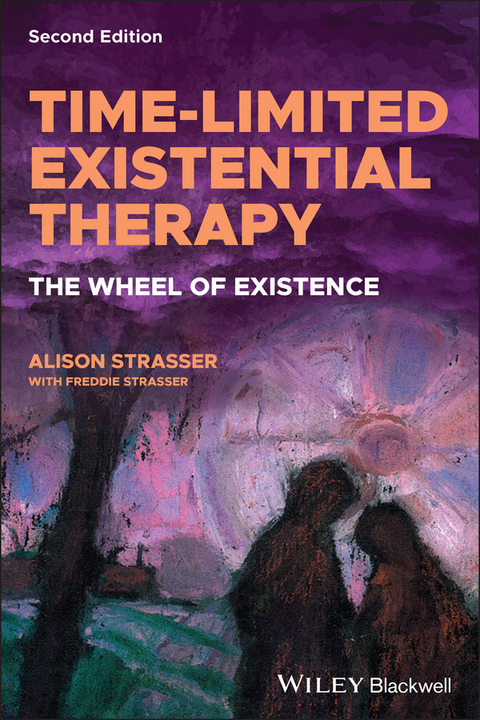
Time-Limited Existential Therapy (eBook)
John Wiley & Sons (Verlag)
978-1-118-71370-9 (ISBN)
Following the innovative first edition which she co-authored with her late father, Freddie Strasser, in the newly revised Second Edition of Time-Limited Existential Therapy: The Wheel of Existence, distinguished therapist Alison Strasser delivers an insightful aid to integrating and working with existential givens as they arise within a therapeutic encounter. She locates the concept of Time as central to all therapies, regardless of their theoretical modality, and demonstrates how it can be used in brief, short-term, and open-ended therapies.
The book relies on the concept of The Wheel to provide a framework for understanding existential and phenomenological philosophies and to help readers put them into practice with clients. It includes meaningful case vignettes that bring existential themes to life and is accessible to both therapists and interested lay members of the public.
Finally, the author highlights how our experience with COVID-19 has impacted, and been impacted by, the existential themes we all deal with on a regular basis.
- A thorough overview of a commonsense existential approach and a discussion of the mystery of time
- Practical discussions of the limitations and possibilities of time-limited existential therapies, as well as concepts and methods in the area.
- Comprehensive explorations of the tyranny of high morality, and examinations of the body, the 'givents' and 'connectedness'.
Alison Strasser is Director of the Centre for Existential Practice in Sydney, Australia. She is also a Therapist and Therapist Supervisor in private practice, as well as an educator with a passion for imparting existential themes and integrating them into other therapeutic approaches.
Explore the concept of time as it applies to the therapeutic setting Following the innovative first edition which she co-authored with her late father, Freddie Strasser, in the newly revised Second Edition of Time-Limited Existential Therapy: The Wheel of Existence, distinguished therapist Alison Strasser delivers an insightful aid to integrating and working with existential givens as they arise within a therapeutic encounter. She locates the concept of Time as central to all therapies, regardless of their theoretical modality, and demonstrates how it can be used in brief, short-term, and open-ended therapies. The book relies on the concept of The Wheel to provide a framework for understanding existential and phenomenological philosophies and to help readers put them into practice with clients. It includes meaningful case vignettes that bring existential themes to life and is accessible to both therapists and interested lay members of the public. Finally, the author highlights how our experience with COVID-19 has impacted, and been impacted by, the existential themes we all deal with on a regular basis. A thorough overview of a commonsense existential approach and a discussion of the mystery of time Practical discussions of the limitations and possibilities of time-limited existential therapies, as well as concepts and methods in the area. Comprehensive explorations of the tyranny of high morality, and examinations of the body, the "e;givents"e; and "e;connectedness"e;. Time-Limited Existential Therapy: The Wheel of Existence is an indispensable resource for experienced psychotherapists, counsellors, social workers, coaches, and psychologists, as well as trainees in these fields seeking a common-sense approach to existential ideas in the context of therapy.
Alison Strasser is Director of the Centre for Existential Practice in Sydney, Australia. She is also a Therapist and Therapist Supervisor in private practice, as well as an educator with a passion for imparting existential themes and integrating them into other therapeutic approaches.
Foreword ix
Preface xi
Acknowledgements xvii
About the Author xviii
Part I 1
1 Existential and Phenomonological Philosophies and the Wheel of Existence 3
2 Core of the Wheel: Time and Self 14
3 Time in Therapy: The Principal Concepts of Existential Time-Limited Therapy 20
4 Approaches to Time-Limited Therapy 30
Part II 39
Layers and Leaves: Ontologicals and Ontics 41
The Ontological Layer: Universalising 43
5 The Ontological 'Givens' 44
Stepping Through the Ontic Leaves: Individualising 54
6 Working with The Phenomenological Process 56
7 Establishing Safety 73
8 Discovering Anxiety 81
9 Revealing the Relationship 93
10 Exploring the Four Worlds 104
11 Clarifying the Worldview 112
12 Working with Paradox and Polarities 123
13 Identifying Choices and Meaning 132
14 Integrating Mind and Body 141
15 Understanding Authenticity 147
Afterword: COVID-19 156
References 162
Index 168
Preface
The only man who behaved sensibly was my tailor: he took my measure anew every time he saw me, while all the rest went on with their old measurements and expected them to fit me.
George Bernard Shaw, Man and Superman (1905)
The first edition of this book, Existential Time Limited Therapy: The Wheel of Existence (Strasser & Strasser, 1997), co‐authored by my father, Freddie Strasser, and me, paved a pathway to describing how existential therapy offers an effective approach to brief therapy where ‘it was the certainty of the ending that was identified as the most influential distinguishing factor’ (Lamont, 2012, p. 172). We proposed that time itself is the ‘tool’ that facilitates awareness and the potential for change.
One of the original aims of the first edition was to convey existential philosophy as a vehicle for common sense. Neither my father nor I saw ourselves as experts in existential philosophy; however, we were both stimulated by how the integration of existential and phenomenological philosophies added alternative perspectives and ways of understanding people that related to their concrete living in the world rather than being limited to a psychological perspective. As is probably true for most existential practitioners, we saw ourselves as existential‐oriented therapists, signifying that we are informed by numerous ideas and approaches that build on our own personal experiences.
In the first edition, we presented the modular approach where the client was offered 12 sessions with the first 10 sessions as consecutive and the final 2 sessions spread a month apart. A subsequent module of 12 sessions could be discussed and implemented depending on the client’s particular circumstances. Indeed, the discussion itself about continuing or not is one of the hidden gems of this approach in that some clients are adamant about wishing to continue or not. Such responses tend to relate to, and reveal, clients’ attitudes towards themselves and to relationships in general.
In conjunction with the development of the time‐limited modular approach, the first edition introduced two Wheels of Existence: Structure and Process wheels. This was a novel way of understanding existential philosophy and brought to existential psychotherapy a structure, albeit fluid, to delineate the aspects of existential theory and its application to psychotherapy practice. Since existential philosophy is not used overtly with clients but creates the backdrop or framework to inform how the therapist listens, how questions are framed, and how inferences and connections are drawn, the wheels provided an interrelational map. The various components provide a schema for understanding how the different elements of existential philosophy are integrated into the whole experience.
In the years following the publication of the first edition, my father and I lived in different countries, followed different pathways, and diverged in our interests but still continued with our weekly conversations. I began exploring supervision and devised a wheel to encompass the existential ideas that emerged from my doctoral research. My father became fascinated with mediation and also created a series of wheels to further enhance his ideas and to show the existential connections retained in this mediation framework. He developed the ideas along with Paul Randolph (a barrister) into the Alternative Dispute Resolution. Interestingly, although two wheels were introduced in the first edition, very soon only one wheel emerged in each of our individual work.
In 2007, when writing a presentation for the Australasian Existential Society, my father and I developed yet another version of the wheel that united our ideas combining our developing thoughts. And we realised that veiled within the original text was the germ of an idea that, as life is time limited, similarly every psychotherapy session, every group of sessions however contracted, has its limitations of time (Strasser & Strasser, 1997, p. 4). This we understood as reflective of the need to be time aware, irrespective of modality or length of sessions. We had every intention of developing these ideas further into a second edition of time‐limited therapy.
However, the time‐limited nature of life assaulted my own sense of certainty and predictability with the unexpected and untimely death of my father, forcing me to confront the finitude of his life, taking the wind out of my sails, and leaving me to honour the legacy and continue our work.
When, some years later, Emmy van Deurzen proposed the idea of my writing the second edition on my own, I felt excited to continue my father’s work. I had accessed his ideas about paradox on his computer and discovered some of his case studies. I knew how we would have written this book together, as we had done previously. I would now write to honour his work; I would write as a tribute to him.
Several months on, however, I was still struggling to gather my thoughts and put together any words related to time‐limited therapy. I was derailed by my wish to write my own thoughts, worried that I’d be unable to do so on my own and fearing offending the existential community. Without my father there was no buffer, and yet I wanted to have my voice heard; I was stuck in my own paradox.
This struggle continued until one of my friends insightfully asked me why I was writing. I realised that my intentions were more duty bound than personally motivated. It seemed that my attempts at writing had been in ‘bad faith’.i Of course I’d be finding it hard!
This has not been an easy journey. In time, I began to appreciate that, as the Bible claims, ‘What has been will be again, what has been done will be done again; there is nothing new under the sun’ (Ecclesiastes 1:9), that no ideas are new, only that our understanding of concepts evolves with our experiences and our ability to challenge and experiment with them. Even if I present what I believe are new ideas in this book, they have evolved from what has been co‐created with others, from my many and varied teachers, mentors, colleagues, friends, adversaries, and, of course, my father.
Since the publication of first edition, many other authors and existential practitioners have written about their work and their understanding and integration of existential philosophy. There is a second and possibly even third generation of writers that are widening and also integrating other frameworks and modalities into the space of existential practice. There is the focusing world of Eugene Gendlin (1978) as integrated by such authors as Greg Madison (2010); the Buddhist mindfulness approach as integrated by such authors as Khong (2013) and Nanda (2009); the continuation of Frankl’s (1963) logotherapy with the work of Alfred Längle ( 2015); as well as the humanists such as Kirk Schneider (Schneider & Krug, 2010) and Mick Cooper (Cooper & Mearns, 2005) who have shown how the humanistic tradition is also existential in nature. Research shows that existential therapy is as valid an approach as any other therapy (Correia, Cooper, & Berdondini, 2014). There is a group of therapists, the New Existentialists (Hoffman, 2015), who no longer adhere to the ‘doom and gloom’ perspective that is often associated with French existentialist writing, focusing instead on a positive interpretation of the philosophy and its application. Indeed, we now read about joy and hope, meaning and purpose as an existential tension to their opposites of sadness and despair, meaninglessness and aloneness and about how we can live our life more fully through self‐examination and taking more responsibility for our life journey. And my own perspective continues to shift and modify as I undertake further reading, add my own daily experience of working with clients, supervisees, students, colleagues, and am challenged and inspired by the vagaries of life in all its complexities.
I returned to writing this second edition, deciding to put my father firmly up ‘in the attic’ and to give myself the option of choosing consciously when and how to invite him in.
Simultaneously, I realised that my compulsion to complete this task on my own was driven my childhood determination to prove my worth; this contributed to my stuckness. By staying with the anxiety of my stuckness, I began to understand that to ask for help was not a negation of my independence but potentially a shift towards something new and exciting. And so I chose to ask for help. Jo Silbert has been a friend and fellow therapist for many years. Through her love of language, she shifted into writing and editing articles and books on psychotherapy. With her help, this second edition began to take shape.
My first decision was to consolidate the two Wheels of Existence into one wheel. This new wheel combines the ideas from the original wheels and simultaneously allows for the integration of the philosophical ideas and the essential processes involved in existential practice. Broadly, the Wheel in this edition brings together the concept that our practice is phenomenological while maintaining the existential philosophy as the backdrop that informs our listening, questions, and reflections.
In this second edition, I will expand on the concept of time‐aware therapy to reveal that all therapy can be viewed as time limited and discuss the various possibilities of using a time‐aware approach in practice to...
| Erscheint lt. Verlag | 30.11.2021 |
|---|---|
| Co-Autor | Freddie Strasser |
| Sprache | englisch |
| Themenwelt | Geisteswissenschaften ► Psychologie |
| Medizin / Pharmazie ► Medizinische Fachgebiete ► Psychiatrie / Psychotherapie | |
| Schlagworte | Concept of Time • existential approaches to psychology • existential psychology • existential themes in psychology • existential themes in psychotherapy • existential themes in therapy • Existential therapy • Practice Management • Psychologie • Psychology • Psychotherapie • Psychotherapie / Praxismanagement • Psychotherapie u. Beratung • Psychotherapy & Counseling • time-limited existential therapies |
| ISBN-10 | 1-118-71370-2 / 1118713702 |
| ISBN-13 | 978-1-118-71370-9 / 9781118713709 |
| Informationen gemäß Produktsicherheitsverordnung (GPSR) | |
| Haben Sie eine Frage zum Produkt? |
 EPUB (Adobe DRM)
Kopierschutz: Adobe-DRM
Adobe-DRM ist ein Kopierschutz, der das eBook vor Mißbrauch schützen soll. Dabei wird das eBook bereits beim Download auf Ihre persönliche Adobe-ID autorisiert. Lesen können Sie das eBook dann nur auf den Geräten, welche ebenfalls auf Ihre Adobe-ID registriert sind.
Details zum Adobe-DRM
Dateiformat: EPUB (Electronic Publication)
EPUB ist ein offener Standard für eBooks und eignet sich besonders zur Darstellung von Belletristik und Sachbüchern. Der Fließtext wird dynamisch an die Display- und Schriftgröße angepasst. Auch für mobile Lesegeräte ist EPUB daher gut geeignet.
Systemvoraussetzungen:
PC/Mac: Mit einem PC oder Mac können Sie dieses eBook lesen. Sie benötigen eine
eReader: Dieses eBook kann mit (fast) allen eBook-Readern gelesen werden. Mit dem amazon-Kindle ist es aber nicht kompatibel.
Smartphone/Tablet: Egal ob Apple oder Android, dieses eBook können Sie lesen. Sie benötigen eine
Geräteliste und zusätzliche Hinweise
Buying eBooks from abroad
For tax law reasons we can sell eBooks just within Germany and Switzerland. Regrettably we cannot fulfill eBook-orders from other countries.
aus dem Bereich