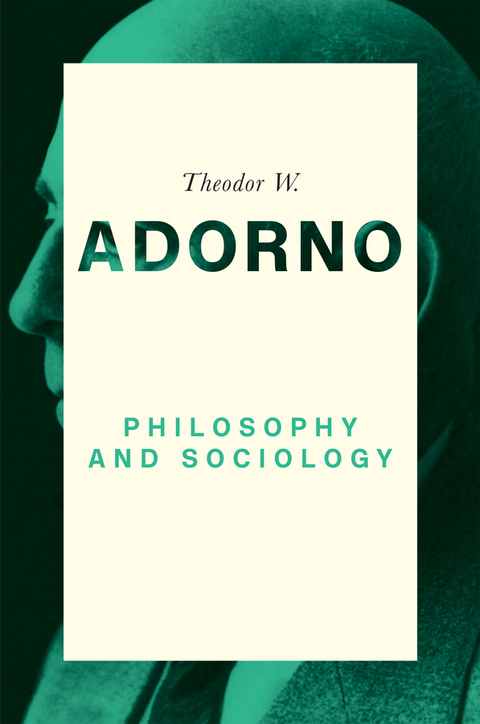
Philosophy and Sociology: 1960 (eBook)
John Wiley & Sons (Verlag)
978-0-7456-9488-7 (ISBN)
In summer 1960, Adorno gave the first of a series of lectures devoted to the relation between sociology and philosophy. One of his central concerns was to dispel the notion, erroneous in his view, that these were two incompatible disciplines, radically opposed in their methods and aims, a notion that was shared by many. While some sociologists were inclined to dismiss philosophy as obsolete and incapable of dealing with the pressing social problems of our time, many philosophers, influenced by Kant, believed that philosophical reflection must remain 'pure', investigating the constitution of knowledge and experience without reference to any real or material factors. By focusing on the problem of truth, Adorno seeks to show that philosophy and sociology share much more in common than many of their practitioners are inclined to assume. Drawing on intellectual history, Adorno demonstrates the connection between truth and social context, arguing that there is no truth that cannot be manipulated by ideology and no theorem that can be wholly detached from social and historical considerations.
This systematic account on the interconnectedness of philosophy and sociology makes these lectures a timeless reflection on the nature of these disciplines and an excellent introduction to critical theory, the sociological content of which is here outlined in detail by Adorno for the first time.
Theodor W. Adorno (1903-1969), a prominent member of the Frankfurt School, was one of the most influential thinkers of the 20th century in the areas of social theory, philosophy and aesthetics.
In summer 1960, Adorno gave the first of a series of lectures devoted to the relation between sociology and philosophy. One of his central concerns was to dispel the notion, erroneous in his view, that these were two incompatible disciplines, radically opposed in their methods and aims, a notion that was shared by many. While some sociologists were inclined to dismiss philosophy as obsolete and incapable of dealing with the pressing social problems of our time, many philosophers, influenced by Kant, believed that philosophical reflection must remain 'pure', investigating the constitution of knowledge and experience without reference to any real or material factors. By focusing on the problem of truth, Adorno seeks to show that philosophy and sociology share much more in common than many of their practitioners are inclined to assume. Drawing on intellectual history, Adorno demonstrates the connection between truth and social context, arguing that there is no truth that cannot be manipulated by ideology and no theorem that can be wholly detached from social and historical considerations. This systematic account on the interconnectedness of philosophy and sociology makes these lectures a timeless reflection on the nature of these disciplines and an excellent introduction to critical theory, the sociological content of which is here outlined in detail by Adorno for the first time.
Theodor W. Adorno (1903-1969), a prominent member of the Frankfurt School, was one of the most influential thinkers of the 20th century in the areas of social theory, philosophy and aesthetics.
Overview
Lectures
Adorno's Notes for the Lectures
Editor's Notes
Editor's Afterword
Index
"The continued relevance of Adorno's radical thought is confirmed by these published lectures."
--Marx & Philosophy Review of Books
LECTURE 2
12 May 1960
Ladies and gentlemen,
In the last lecture I took Kant as a starting point and model for exploring the traditional resistance and antagonism which some disciplines have displayed towards sociology and all forms of truth or knowledge that appeal to the factual domain. In terms of the central problem I have already indicated, I should now like to do the opposite and introduce you to the kind of resistance to philosophy that one typically encounters in the field of sociology. And here you may be surprised by two things in particular. The first is that such resistance has by no means always characterized our two disciplines – for we shall soon be exploring certain theoretical positions for which the distinction between philosophy and sociology did not yet exist at all. But secondly you will also see that the rejection of philosophy on the part of sociology goes back a very long way, and that ever since ‘sociology’ has expressly existed as such – since it became aware of itself as a specific discipline and adopted this elegant name cobbled together out of Latin and Greek – the anti-philosophical impulse has remained alive in the field of sociology. I shall shortly illustrate this with reference to Auguste Comte. But I shall also show you that the reasons for this resistance of sociology to philosophy are very different from those you may generally imagine when you try and understand the problematic relationship between these two fields – and this all recalls Benjamin’s observation that the quotations in his writings are like robbers that assault the reader on the open road and make off with his convictions.1 What I mean is that sociology has not simply proved to be the more progressive or more enlightened discipline in comparison with the less enlightened or reactionary discipline of traditional philosophy; on the contrary, we shall see that sociology, at least in its specific Comtean sense, arose in a polemical reaction to philosophy which was seen as a destructive expression of Enlightenment. In other words, the sociologists of the Comtean period actually reproached philosophy for the same kind of things that our rustic and forest philosophers tend to reproach sociology with today. This may already give you some insight into something which I regard as of the utmost importance, and which I would like you to think about right here: there is no theoretical position, of whatever kind, whose function within society is entirely independent of the social and historical situation at the time. There is no truth that cannot be abused and turned into ideology, no theoretical position that cannot be brought to serve the opposite of what it undertakes to claim. And this alone should already suffice to make you sceptical in the face of the all too hasty identification of theory and praxis that is popular today.
But, to return to Comte and his struggle against philosophy, I should just like to remind you in brief that the concept of ‘progress’, which along with that of ‘order’ is one of the highest concepts in Comte’s sociology, found exemplary expression in his famous theory of stages.2 He assumes three stages in human historical development: firstly, the theological-dogmatic stage; secondly, the metaphysical stage; and, thirdly, the stage which he calls the positive or scientific stage, the stage which in Comte’s eyes culminates in sociology. The really noticeable thing here, and this already reveals one of the remarkable analogies between the arch-positivist Comte and the arch-idealist Hegel, is that the real polemical thrust of this conception – and one never knows with Comte whether we should speak of a philosophy or a sociology here – is directed more against metaphysics, in other words against philosophy, than it is against theology, and this is precisely because in his own time Comte was concerned principally with speculative philosophy as a specifically critical force. You have to realize – and this is the only really essential difference between Comte’s theory and that of Saint-Simon, which Comte basically just devoured and simply expressed in different terms – that, while Saint-Simon still expressed the entire pathos of revolutionary eighteenth-century bourgeois culture, Comte already betrays anxiety in the face of the disintegrating tendencies of the bourgeois revolution. Throughout Comte we detect the fear that philosophical concepts, especially those of freedom, equality and fraternity – in other words, the Enlightenment ideas that in a certain sense lay behind the French Revolution – threaten to undermine every kind of social order and thus lead to anarchy. It is this position which motivates Comte’s general attack on philosophy, and this is very similar to a passage in Hegel – although one can also of course find many other passages in his work that would rather contradict this – where he says that speculative philosophy actually finds itself allied with religious faith in opposition to a merely rationalistic or merely reflective form of thinking.3 I might add here, since it is also part of my task to alert you to certain possible research projects in this field, that it would be extremely instructive, especially for those of you who are specifically interested in the relationship between philosophy and sociology, to consider undertaking a comparative analysis of Comte and Hegel, for, despite the flagrant differences that are undeniably evident here, you will also find some extraordinary similarities in both thinkers.4 In my own lectures, where the history of philosophy is concerned, I constantly have to point out that the divergences between officially quite opposed schools of thought, such as those of empiricism and rationalism, are actually much less striking, when we look at the specific content of the theories in question, than we might otherwise suppose. And this is one of the reasons why we always warn beginners in philosophy against over-emphasizing or immediately exaggerating the conflict between Locke and Leibniz, or Kant and Hume, for example, or between early empiricism and the early seventeenth-century rationalists, between Descartes and Hobbes. Or at least we must warn against taking these oppositions as if they were absolute, and indeed I think we shall have good opportunity in due course to see why these mutually antagonistic schools do not actually constitute such absolute oppositions as we might easily believe. What Comte calls the metaphysical stage, the second stage of human development, is characterized by the way in which it supposedly objectifies or ascribes independent existence to various intellectual essences or entities, as Comte puts it,5 over against the facts which are subsumed by means of them. This argument is simply that of a rigorous nominalism that rejects the objectification of any concept as mere dogma, and Comte regards such objectification of concepts over against the facts as nothing but a kind of semi-secularized theology. He tells us again and again that metaphysical concepts are actually nothing but theological notions that have been half-heartedly filtered through reason.
Let us just look at a couple of revealing passages to see how Comte uses sociology to argue against philosophy. I shall be quoting mainly from the little selection from the Cours de philosophie positive, which was published by Kröner in 1933 and edited by Friedrich Blaschke.6 It is of course no longer that easy to lay your hands on this edition today, but it is probably still easier to find than the huge Dorn-Waentigsche translation that was published by Gustav Fischer in Jena in 1923, which is incredibly unwieldy.7 If you want to familiarize yourselves seriously with Comte, as I certainly recommend that you do, I would just advise you, for humanitarian reasons as it were, to try and get hold of the little selection of texts that I have mentioned and take a good look at it. For the three-volume edition is truly monstrous and indescribably dogged, garrulous and repetitious; no human being could reasonably be expected to read it from beginning to end. In any case I am completely opposed to the mendacious academic practice that insists that one must have closely studied great tomes of this kind, even though we all know we will never read them from start to finish the moment we pick them up. And in Comte’s case this is simply impossible. On the other hand, you will certainly come across some extremely interesting and thought-provoking things in his work, and Blaschke’s edition, to the extent that I have perused it, is very useful in this regard. To read the material in French rather than in German translation would naturally be rather time-consuming here. Nonetheless, I would like to take this opportunity, since we are about to look more closely at a few things from Comte and then some things from Durkheim, just to say that I believe a good knowledge of French is quite indispensable for the study of sociology – and I say this specifically for the sociologists among you, and especially for those who are only just beginning your studies in this area. Sociology emerged in France, and it is only when you are capable of reading in the original certain French sociological texts which are either untranslated or have sometimes been translated very poorly indeed, and here I am thinking especially of things like the Années Sociologiques, the journal founded by Durkheim,8 that you will really be able to understand the origins of sociology, and thereby acquire a richer concept of sociology than...
| Erscheint lt. Verlag | 1.12.2021 |
|---|---|
| Übersetzer | Nicholas Walker |
| Sprache | englisch |
| Themenwelt | Geisteswissenschaften ► Philosophie ► Allgemeines / Lexika |
| Schlagworte | Continental Philosophy • Critical theory • Gesellschaftstheorie • Kontinentalphilosophie • Kritische Theorie • Philosophie • Philosophy • Philosophy, sociology, Kant, purity, Saint-Simon, Comte, Darwinism, ordinary language, social phenomena, Durkheim, Weber, ideology, truth, positivism, subjectivity, science, propaganda, history, mass media, meaning • Social Theory • Sociology • Soziologie |
| ISBN-10 | 0-7456-9488-8 / 0745694888 |
| ISBN-13 | 978-0-7456-9488-7 / 9780745694887 |
| Informationen gemäß Produktsicherheitsverordnung (GPSR) | |
| Haben Sie eine Frage zum Produkt? |
 EPUB (Adobe DRM)
Kopierschutz: Adobe-DRM
Adobe-DRM ist ein Kopierschutz, der das eBook vor Mißbrauch schützen soll. Dabei wird das eBook bereits beim Download auf Ihre persönliche Adobe-ID autorisiert. Lesen können Sie das eBook dann nur auf den Geräten, welche ebenfalls auf Ihre Adobe-ID registriert sind.
Details zum Adobe-DRM
Dateiformat: EPUB (Electronic Publication)
EPUB ist ein offener Standard für eBooks und eignet sich besonders zur Darstellung von Belletristik und Sachbüchern. Der Fließtext wird dynamisch an die Display- und Schriftgröße angepasst. Auch für mobile Lesegeräte ist EPUB daher gut geeignet.
Systemvoraussetzungen:
PC/Mac: Mit einem PC oder Mac können Sie dieses eBook lesen. Sie benötigen eine
eReader: Dieses eBook kann mit (fast) allen eBook-Readern gelesen werden. Mit dem amazon-Kindle ist es aber nicht kompatibel.
Smartphone/Tablet: Egal ob Apple oder Android, dieses eBook können Sie lesen. Sie benötigen eine
Geräteliste und zusätzliche Hinweise
Buying eBooks from abroad
For tax law reasons we can sell eBooks just within Germany and Switzerland. Regrettably we cannot fulfill eBook-orders from other countries.
aus dem Bereich