
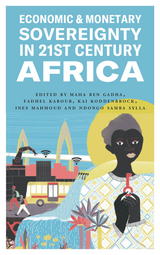
The story of how African societies are resisting financial dependency and colonial legacies
Over forty years after the formal end of colonialism, suffocating ties to Western financial systems continue to prevent African countries from achieving any meaningful monetary sovereignty.
Economic and Monetary Sovereignty in 21st Century Africa traces the recent history of African monetary and financial dependencies, looking at the ways African nations are resisting colonial legacies. Using a comparative, multi-disciplinary approach, this book uncovers what went wrong after the Pan-African approaches that defined the early stages of independence, and how most African economies fell into the firm grip of the IMF, World Bank, and the EU’s strict neoliberal policies.
This collection is the first to offer a wide-ranging, comparative and historical look at how African societies have attempted to increase their policy influence and move beyond neoliberal orthodoxy and US-dollar dependency. Economic and Monetary Sovereignty in 21st Century Africa is essential reading for anyone interested in the African quest for self-determination in a turbulent world of recurring economic and financial crisis.
Foreword - Prabhat Patnaik
Introduction - By the editors
Part I: The contemporary global economic and monetary order
1. China’s Finance and Africa’s Economic and Monetary Sovereignty - Radhika Desai
Part II: Challenges to monetary sovereignty in the postcolonial periphery
2. Banking, Business, and Sovereignty in Sudan (1956–2019) - Harry Cross
3. Money, Finance, and Capital Accumulation in Zimbabwe - Francis Garikayi
4. Monetary Policy in Algeria (1999–2019): An economic and monetary history approach - Fatiha Talahite
Part III: Increasing sovereignty through monetary unions?
5. The West African CFA Franc Zone as a Double Monetary Union: Loss of economic competitiveness and anti-developmental path-dependencies - Carla Coburger
6. The CFA Franc Under Neoliberal Monetary Policy: A labour-focused approach - Hannah Cross
7. From Central Bank Independence to Government Dependence: Monetary colonialism in the Eurozone - Thomas Fazi
8. Geopolitics of Finance in Africa: Birth of financial centres, not monetary unions - Elizabeth Cobbett
Part IV: Alternatives
9. The Great Paradox: Liberalism Destroys the Market Economy: The pitfalls of the neoliberal recipe forAfrican economic and monetary sovereignty - Heiner Flassbeck
10. Food Sovereignty, the National Question, and Post-colonial Development in Africa - Max Ajl
11. Being Poor in the Current Monetary System: Implications of foreign exchange shortage for African economies and possible solutions - Anne Löscher
12. The German Push for Local Currency Bond Markets in African Countries: A pathway to economic sovereignty or increased economic dependency? - Frauke Banse
Notes on Editors
Notes on Contributors
Index
| Erscheint lt. Verlag | 20.12.2021 |
|---|---|
| Vorwort | Prabhat Patnaik |
| Verlagsort | London |
| Sprache | englisch |
| Themenwelt | Geschichte ► Allgemeine Geschichte ► Zeitgeschichte |
| Geisteswissenschaften ► Geschichte ► Regional- / Ländergeschichte | |
| Geschichte ► Teilgebiete der Geschichte ► Wirtschaftsgeschichte | |
| Wirtschaft ► Volkswirtschaftslehre ► Finanzwissenschaft | |
| Wirtschaft ► Volkswirtschaftslehre ► Wirtschaftspolitik | |
| Schlagworte | Africa • African Economies • currency systems • Development Studies • financial colonialism • International Relations • Macroeconomics • Monetary Sovereignty • Monetary systems • Monetary Theory |
| ISBN-10 | 0-7453-4409-7 / 0745344097 |
| ISBN-13 | 978-0-7453-4409-6 / 9780745344096 |
| Informationen gemäß Produktsicherheitsverordnung (GPSR) | |
| Haben Sie eine Frage zum Produkt? |
 EPUB (Adobe DRM)
Kopierschutz: Adobe-DRM
Adobe-DRM ist ein Kopierschutz, der das eBook vor Mißbrauch schützen soll. Dabei wird das eBook bereits beim Download auf Ihre persönliche Adobe-ID autorisiert. Lesen können Sie das eBook dann nur auf den Geräten, welche ebenfalls auf Ihre Adobe-ID registriert sind.
Details zum Adobe-DRM
Dateiformat: EPUB (Electronic Publication)
EPUB ist ein offener Standard für eBooks und eignet sich besonders zur Darstellung von Belletristik und Sachbüchern. Der Fließtext wird dynamisch an die Display- und Schriftgröße angepasst. Auch für mobile Lesegeräte ist EPUB daher gut geeignet.
Systemvoraussetzungen:
PC/Mac: Mit einem PC oder Mac können Sie dieses eBook lesen. Sie benötigen eine
eReader: Dieses eBook kann mit (fast) allen eBook-Readern gelesen werden. Mit dem amazon-Kindle ist es aber nicht kompatibel.
Smartphone/Tablet: Egal ob Apple oder Android, dieses eBook können Sie lesen. Sie benötigen eine
Geräteliste und zusätzliche Hinweise
Buying eBooks from abroad
For tax law reasons we can sell eBooks just within Germany and Switzerland. Regrettably we cannot fulfill eBook-orders from other countries.
aus dem Bereich