


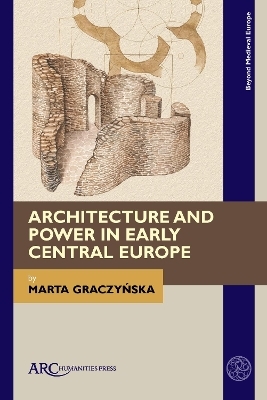
Architecture and Power in Early Central Europe
Seiten
2022
|
New edition
ARC Humanities Press (Verlag)
978-1-64189-204-9 (ISBN)
ARC Humanities Press (Verlag)
978-1-64189-204-9 (ISBN)
Architecture is shown to be a reliable “textual” source for understanding dynastic state development in Central Europe in the tenth and eleventh centuries.
The book presents the panorama of social, cultural, and religious changes in the states of the Piast, Přemyslid, and Arpad dynasties. Major change occurred in the tenth century and again at the turn of the eleventh century. Given the scarcity of written sources, the author employs an analysis of architectural forms which she applies to buildings founded by dukes, kings, and nobles at this period.
Architecture serves as a reliable source of knowledge and can be successfully read as a text using comparative analysis, iconology, and semiotics. No piece of art appeared without an historical context: forms, functions, and styles are all documents created by its founders and creators. The conclusions of this research help us to understand the era that shaped the foundations of the Polish, Czech, and the Hungarian states.
The book presents the panorama of social, cultural, and religious changes in the states of the Piast, Přemyslid, and Arpad dynasties. Major change occurred in the tenth century and again at the turn of the eleventh century. Given the scarcity of written sources, the author employs an analysis of architectural forms which she applies to buildings founded by dukes, kings, and nobles at this period.
Architecture serves as a reliable source of knowledge and can be successfully read as a text using comparative analysis, iconology, and semiotics. No piece of art appeared without an historical context: forms, functions, and styles are all documents created by its founders and creators. The conclusions of this research help us to understand the era that shaped the foundations of the Polish, Czech, and the Hungarian states.
Marta Graczynska is an Art Historian at Wawel Royal Castle in Krakow, Poland, researching the forms and meanings of early medieval architecture in Central Europe.
Introduction
Chapter 1: Displays of Power—Architecture as Sign and Symbol
Chapter 2: Choice of Architectural Forms
Chapter 3: The Code of Form and Shape
Chapter 4: Composition of Spatial Arrangements
Chapter 5: Appropriation and/or Influence
Chapter 6: Architecture as a Vehicle of Meanings
Chapter 7: Form vs. Function
Chapter 8: Interpreting Function
Chapter 9: Reading Architecture
Conclusions
| Erscheinungsdatum | 02.12.2021 |
|---|---|
| Reihe/Serie | Beyond Medieval Europe |
| Zusatzinfo | 6 Maps; 31 Illustrations, black and white |
| Sprache | englisch |
| Maße | 152 x 229 mm |
| Themenwelt | Kunst / Musik / Theater ► Kunstgeschichte / Kunststile |
| Geschichte ► Allgemeine Geschichte ► Mittelalter | |
| Technik ► Architektur | |
| ISBN-10 | 1-64189-204-8 / 1641892048 |
| ISBN-13 | 978-1-64189-204-9 / 9781641892049 |
| Zustand | Neuware |
| Informationen gemäß Produktsicherheitsverordnung (GPSR) | |
| Haben Sie eine Frage zum Produkt? |
Mehr entdecken
aus dem Bereich

aus dem Bereich
Geschichte einer Augsburger Familie (1367-1650)
Buch | Softcover (2024)
Kohlhammer (Verlag)
CHF 47,60


