


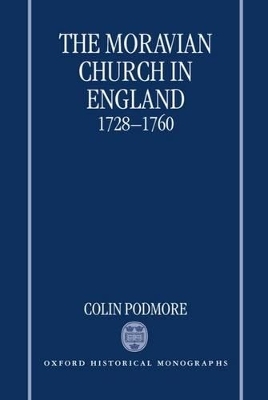
The Moravian Church in England, 1728-1760
Seiten
1998
Oxford University Press (Verlag)
978-0-19-820725-2 (ISBN)
Oxford University Press (Verlag)
978-0-19-820725-2 (ISBN)
The effects of the great Evangelical Revival in 18th-century England were felt throughout the world, not least in America. This volume examines the role and importance of the Moravian church in this process, arguing that it gave the movement much of its initial impetus.
The effects of the great Evangelical Revival in eighteenth-century England were felt throughout the world, not least in America. It has long been accepted that the Revival owed much of its initial impetus to the Moravian Church, but previous accounts of the Moravians' role have been inadequate and overly dependent on Wesleyan sources. Colin Podmore uses original material, from German as well as British archives to dispel common misunderstandings about the Moravians, and to reveal that their influence was much greater than has previously been acknowledged. Dr Podmore discusses what motivated people to join the Church, analyses the Moravians' changing relationships with John Wesley and George Whitefield, and shows how Anglican bishops responded to the Moravians' successive ecumenical stategies. His analysis of the successful campaign to secure state recognition (granted in 1749) sheds light on the inner workings of the Hanoverian parliament. In conclusion, he examines how acclaim quickly turned to ridicule in a crisis of unpopularity which was to affect the Moravian Church for a generation.
The effects of the great Evangelical Revival in eighteenth-century England were felt throughout the world, not least in America. It has long been accepted that the Revival owed much of its initial impetus to the Moravian Church, but previous accounts of the Moravians' role have been inadequate and overly dependent on Wesleyan sources. Colin Podmore uses original material, from German as well as British archives to dispel common misunderstandings about the Moravians, and to reveal that their influence was much greater than has previously been acknowledged. Dr Podmore discusses what motivated people to join the Church, analyses the Moravians' changing relationships with John Wesley and George Whitefield, and shows how Anglican bishops responded to the Moravians' successive ecumenical stategies. His analysis of the successful campaign to secure state recognition (granted in 1749) sheds light on the inner workings of the Hanoverian parliament. In conclusion, he examines how acclaim quickly turned to ridicule in a crisis of unpopularity which was to affect the Moravian Church for a generation.
Preface ; Introduction ; 1. The First Decade: 17281737 ; 2. The Fetter Lane Society: 17381740 ; 3. The Moravians' Relations with the Methodists ; 4. The Moravians' Role in the Evangelical Revival ; 5. The Appeal of the Moravian Church in England ; 6. Episcopal Attitudes to the Moravians before 1749 ; 7. 'An Antient Protestant Episcopal Church': The Moravian Act of 1749 ; 8. The Crisis of 1753 ; Bibliography
| Erscheint lt. Verlag | 14.5.1998 |
|---|---|
| Reihe/Serie | Oxford Historical Monographs |
| Zusatzinfo | 11 text illustrations, 2 maps |
| Verlagsort | Oxford |
| Sprache | englisch |
| Maße | 146 x 224 mm |
| Gewicht | 566 g |
| Themenwelt | Geschichte ► Allgemeine Geschichte ► Neuzeit (bis 1918) |
| Geisteswissenschaften ► Geschichte ► Regional- / Ländergeschichte | |
| Geisteswissenschaften ► Religion / Theologie ► Christentum | |
| ISBN-10 | 0-19-820725-5 / 0198207255 |
| ISBN-13 | 978-0-19-820725-2 / 9780198207252 |
| Zustand | Neuware |
| Informationen gemäß Produktsicherheitsverordnung (GPSR) | |
| Haben Sie eine Frage zum Produkt? |
Mehr entdecken
aus dem Bereich


aus dem Bereich
Geschichte einer wilden Handlung
Buch | Hardcover (2024)
C.H.Beck (Verlag)
CHF 47,60


