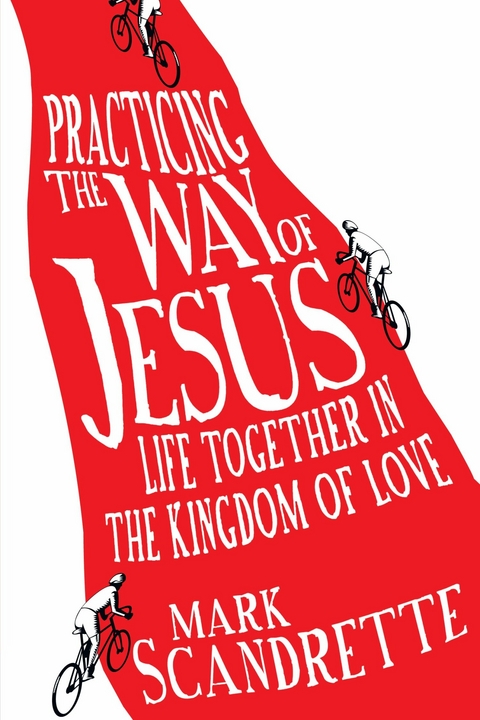
Practicing the Way of Jesus (eBook)
220 Seiten
IVP Formatio (Verlag)
978-0-8308-6872-8 (ISBN)
Mark Scandrette is executive director and cofounder of ReIMAGINE, a center for spiritual formation in San Francisco, and the Jesus Dojo, a yearlong intensive formation process inspired by the life and teachings of Jesus. He is the author of Soul Graffiti.
Mark Scandrette is an author, teacher, activist, and networker among innovative Christian leaders. As the founding director of ReIMAGINE, a center for integral Christian practice based in San Francisco, he leads an annual series of retreats, learning labs, conversations, and projects designed to help participants integrate the teachings of Christ into every aspect of life through shared practices and community experiments. Mark is the author of FREE: Spending Your Time and Money on What Matters Most, Practicing the Way of Jesus, and Soul Graffiti.A sought after voice for creative, radical, and embodied Christian practice, Mark speaks nationally and internationally at universities, conferences, and churches, and offers training and coaching to leaders and organizations. He assisted in the development of CONSP!RE Magazine and has contributed to publications like Leadership Journal and Conversations Journal and books such as An Emergent Manifesto of Hope, Community of Kindness, and The Relevant Church. He currently serves as an adjunct faculty member at Fuller Seminary, and his work has been profiled in books that include The Shaping of Things to Come by Alan Hirsch and Michael Frost, Emerging Churches by Eddie Gibbs and Ryan Bolger, I.AM.RELEVANT by the Relevant Media group, and The New Conspirators by Tom Sine. Mark and his wife Lisa and their three children live in the Mission District of San Francisco. He enjoys running, biking, cooking, dumpster diving, home coffee roasting, long city walks, going on dates with Lisa, and watching T.V. and films with their kids.
2
Following the Way of the Rabbi
When I first discovered the way of Jesus, I remember how eager I was to take steps to live into my new understanding of life in the kingdom of love. As I studied what Jesus did and taught, it wasn’t long before I wanted to live his kind of life. I did what spoke most immediately to me or seemed most obvious. I went through my closets and gave away any extra clothes I had. I went out of my way to make friends with people on the margins. Noticing that Jesus often prayed in lonely places, I began taking long walks alone. As an attempt to renew the “eye” of my mind, for a period of time I swore off music, movies and television. After reading “[if] your brother or sister has something against you . . . go and be reconciled” (Matthew 5:23-24), I quickly made a list of anyone I could think of that I had wronged, and started making phone calls. Trying to be a good Samaritan, I made a vow to stop and help anyone I saw stranded along the side of the road (which led to many interesting trips to auto-parts stores with strangers). Hearing that “the Son of Man has no place to lay his head” (Matthew 8:20), I started sleeping in my car whenever I could. And once, after reading, “If your right hand causes you to sin, cut it off” (Matthew 5:30 NIV), I actually took out a knife and contemplated using it.
Looking back, some of my early experiments now seem childish, sentimental or naive. But at the time they helped me get momentum in discovering how to practice the Way. And perhaps being childlike and imaginative isn’t such a bad thing. Jesus once said, “Unless you change and become like little children, you will never enter the kingdom” (Matthew 18:3). The pressure we feel to be respectable or sophisticated can rob us of the sense of playfulness required to experience life in the kingdom of love. It is those little steps of obedience that propel us toward greater understanding.
I credit my parents with inspiring my early attempts to practice the Way. I remember coming down the stairs early in the morning to find my dad kneeling on the living room floor at prayer, preparing for the day. He also carried a stack of note cards with Scripture verses written on them that he used to meditate during his daily commute. My mom always seemed to be on the phone listening to peoples’ problems and offering help or advice. Growing up, Tuesday night at our house was soup night for us kids (with no dessert) and fasting for our parents—so that we could share our resources with children living in places where they didn’t have enough to eat. After dinner my dad would often take out the Bible, read a portion of the Gospels to us, and begin asking questions, like “What do you imagine it would look like for us to live as Jesus did?” Or he would push us to wrestle with a particular instruction: “Let’s think of who our neighbors are. What can we do to love them?” Together we would generate a list of ideas to enact over the coming weeks: Invite neighbor Joe over for dinner. Shovel snow for the elderly couple down the block. Welcome a friend from school whose family is in crisis to spend the weekend at our house. One memorable holiday season my parents created a project to help us learn how to bless our neighbors. Over several nights we made Christmas decorations and cookies and then went door to door distributing them with an invitation to come to a holiday party. A few weeks later our home was full of neighbors, many of whom were meeting for the first time. The party really brought the neighborhood together, and I still remember the excitement of being a part of something bigger than myself.
My wife, Lisa, and I have three teenage children whom we have tried to raise with a similar sense of adventure and shared practices. They’ve grown up participating in our Jesus dojo experiments—both at home and with our tribe of friends.[*] We have eaten together with drug addicts, gone on weekend-long silent prayer retreats, written our own poems and prayers, helped prepare hospitality meals, and cared for orphans. We realize this might be different than the typical path of Christian education, but we think children are most impacted by the modeling and example of the people closest to them. We don’t want to just tell them about the significance of a homeless messiah-prophet, we want them to walk in his steps. I’m convinced that one experience of embodied intentional practice can teach more than a year’s worth of Sunday school lessons or well-prepared talks. Sometimes kids can recognize the truth of this more easily than adults. My son Noah once came with me when I spoke at a large retreat for college students. After observing several sessions where I taught, which included extended worship sets performed by an indie rock band, Noah turned to me and said, “Papa, I don’t understand. You get up there and speak about things like listening to God or caring for victims of human trafficking—and then everyone leaves the building to do things that have nothing to do with what you talked about.” Wherever possible, we need to create environments that include both good instruction and opportunities for shared action.
My son Isaiah and I recently spent a weekend together doing an experiment that combined reflections on the life Christ, sessions of silent prayer and meal fellowship with people living on the streets. Isaiah was initially hesitant to go with me because praying in hour-long chunks didn’t sound immediately appealing to an active thirteen-year-old. He also wasn’t sure how comfortable he would feel spending time with people who are homeless and struggling with mental illness or addictions. Isaiah surprised himself (and me) by his ability to sit in stillness before God. When we went to the shelter for breakfast, we sat down by Eugene, a friendly older man who had been homeless for several years. After a lively conversation, Eugene invited us to go see where he lived. Isaiah’s eyes brightened at the thought of an adventure. We followed Eugene as he briskly walked the mile to his encampment hidden under brush and trees within yards of the freeway. He showed us how to jump the fence leading to his house, an area of tarps and junked furniture. Eugene welcomed us as honored guests, inviting us to sit on his couch—an old van seat—and serving us sparkling lemonade. We held up our Styrofoam cups like champagne flutes and each gave a toast or said a prayer of thanks. Eugene shed a few tears, telling us how grateful he was to have us in his home. Before we left he gave Isaiah a baseball cap, and on the way back told us about the loss of his wife and his struggles with depression and alcohol. We had many more amazing father-son experiences of prayer and friendship that weekend, and were reminded that there are two places where we are sure to find God’s presence in our world—in the quiet of prayer and in the faces of those who suffer.
I was in college when I first began to appreciate the power of taking steps of obedience in solidarity with others. One day after psychology class, my friend Forrest and I sat discussing the various mental disorders we were studying. It suddenly occurred to us that people living with severe mental illnesses must be very lonely. As followers of the Way, it seemed obvious that we would want to seek to be friends with people struggling with mental illness. Forrest made a few phone calls and a week later we found ourselves standing in front of a forlorn brick building that housed the adolescent unit of a state mental hospital less than a mile from our campus. While playing checkers and tossing the football we got to know students who had killed their parents, been severely abused or abandoned. One young man, convinced that he was possessed by demons, pleaded with me to pray for him. I was way out of my comfort zone and had to quickly adapt. As I listened to their stories I felt a depth of love welling up inside of me that I didn’t know I had. After that first visit I drove away from the hospital with tears in my eyes, feeling more alive than ever before.
Some may bristle at my use of the term experiments to describe practical acts of obedience like this. It’s helpful to remember that obedience to Jesus is creative—it is not just about what we won’t do, but also what we will do to be alive to the kingdom of love. Naming these steps of obedience experiments acknowledges the fact that we are in the process of finding out “what pleases the Lord” (Ephesians 5:10). It is one thing to consider what a person should do or might do in theory, but quite another to discern what I will do in the immediacy of this moment. Action is the way that we make our vision and desire for the good and beautiful tangible (1 John 3:18). Listening to the voice of the Spirit, we take risks to improvise new steps of obedience, not knowing exactly which actions or practices will be most helpful. A practice that is effective for one person might not be for another. For example, extended silence and solitude might be deeply enlightening for an extrovert, but taking a risk to engage with people might impact an introvert more. Also, a practice that helped us at one stage of life may not in another. Practices are a means toward an end, not the end in themselves. So we are invited to be playful, experimenting by trial and error to discover what actions help us become most awake to God and empowered to love.
Levels and Kinds of Experiments
Like me, you probably have many stories about small risks of obedience that have shaped your journey with God. As I’ve already mentioned, taking risks to practice the...
| Erscheint lt. Verlag | 4.5.2011 |
|---|---|
| Verlagsort | Lisle |
| Sprache | englisch |
| Themenwelt | Religion / Theologie ► Christentum ► Kirchengeschichte |
| Religion / Theologie ► Christentum ► Moraltheologie / Sozialethik | |
| Schlagworte | Christian • christian growth • Christian Life • christian living • God • Jesus • spiritual growth • Spiritual life |
| ISBN-10 | 0-8308-6872-0 / 0830868720 |
| ISBN-13 | 978-0-8308-6872-8 / 9780830868728 |
| Informationen gemäß Produktsicherheitsverordnung (GPSR) | |
| Haben Sie eine Frage zum Produkt? |
 EPUB (Wasserzeichen)
DRM: Digitales Wasserzeichen
Dieses eBook enthält ein digitales Wasserzeichen und ist damit für Sie personalisiert. Bei einer missbräuchlichen Weitergabe des eBooks an Dritte ist eine Rückverfolgung an die Quelle möglich.
Dateiformat: EPUB (Electronic Publication)
EPUB ist ein offener Standard für eBooks und eignet sich besonders zur Darstellung von Belletristik und Sachbüchern. Der Fließtext wird dynamisch an die Display- und Schriftgröße angepasst. Auch für mobile Lesegeräte ist EPUB daher gut geeignet.
Systemvoraussetzungen:
PC/Mac: Mit einem PC oder Mac können Sie dieses eBook lesen. Sie benötigen dafür die kostenlose Software Adobe Digital Editions.
eReader: Dieses eBook kann mit (fast) allen eBook-Readern gelesen werden. Mit dem amazon-Kindle ist es aber nicht kompatibel.
Smartphone/Tablet: Egal ob Apple oder Android, dieses eBook können Sie lesen. Sie benötigen dafür eine kostenlose App.
Geräteliste und zusätzliche Hinweise
Buying eBooks from abroad
For tax law reasons we can sell eBooks just within Germany and Switzerland. Regrettably we cannot fulfill eBook-orders from other countries.
aus dem Bereich