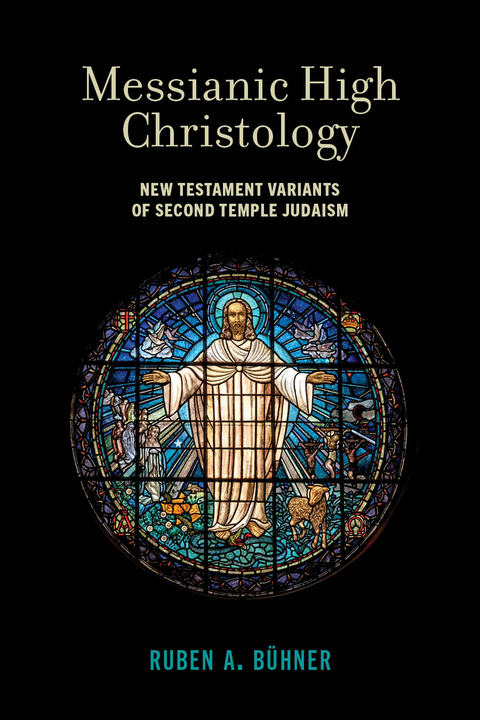
Messianic High Christology (eBook)
244 Seiten
Baylor University Press (Verlag)
978-1-4813-1613-2 (ISBN)
The depiction of Christ as divine is often assumed to be the categorical difference between early Jewish messianism and New Testament Christology. Despite the prolific accomplishments of recent scholarship on Second Temple messianism and on the origin and development of "high" Christology, research has largely treated these as two separate lines of inquiry. As an unintended result, earliest Christianity appears not as an organic outgrowth of ancient Judaism, but as something of an anomaly. Ruben A. Bühner calls this line of thinking into question in Messianic High Christology.
Through a curated set of exegetical comparisons, each between a christological text and one or two messianic texts, Bühner reveals to what extent Second Temple messianism is indeed the primary context for the high Christologies of the New Testament: most New Testament concepts of Christ’s divinity are to be understood precisely as part of contemporary discourse within early Jewish messianism. While early understandings of Christ are not simply identical with some other Jewish messianic expectations, they should be understood as deliberate developments in acceptance of and in dialogue with the wider Jewish discourse produced by some Jewish subgroups. As Bühner argues, it was not until the second and subsequent centuries that Jews as well as non-Jewish followers of Christ began to consider the divinity of the messiah as the decisive criterion by which to distinguish between what later would develop into two separate religions.
With Messianic High Christology, Bühner brings the New Testament Christologies closer to their first-century Jewish context. In doing so, he augments our understanding of the correlation between early devotion to Christ and early Jewish thought and practice more broadly, and challenges current historical reconstructions.
Ruben A. Bühner is a postdoctoral researcher for New Testament Studies at the University of Zurich and at the University of Tübingen. He received the 2021 Manfred Lautenschlaeger Award for Theological Promise for his dissertation entitled "High Messianology." The prize is awarded by the Heidelberg Research Center for International and Interdisciplinary Theology (FIIT). He was also awarded the 2020 Young Scientist Prize from the Zurich Center for the Study of Antiquity.
Introduction
1 The Exaltation of Christ: Philippians 2:6-11 and Messianic Exaltation Texts
2 The Heavenly Christ: Mark 14:61-65 and Celestial Messianic Figures
3 The Virginal Conception of Christ: Luke 1:26-38, Divine Sonship, and Miraculous Births
4 Christ the Enthroned Lamb: Revelation 4-5 and the Son of Man Seated on the Throne of Glory
5 Christ the Divine Word: John's Prologue and the Destructive Power of Messiah's Utterance
6 Paths Not Taken: Angelic Messianism and Angelomorphic Christology
7 High Christology: A Contested Variant of Second Temple Messianism
Conclusion
| Erscheint lt. Verlag | 15.9.2021 |
|---|---|
| Verlagsort | Waco |
| Sprache | englisch |
| Themenwelt | Religion / Theologie ► Christentum ► Kirchengeschichte |
| Geisteswissenschaften ► Religion / Theologie ► Judentum | |
| Schlagworte | Messianism, divinity of Christ, Richard Bauckham, Larry Hurtado, Dead Sea Scrolls, Pseudepigrapha, Philo, logos, wisdom tradition, early Judaism and early Christianity, intermediary figures, angelomorphic Christology, Enoch, Melchizedek |
| ISBN-10 | 1-4813-1613-3 / 1481316133 |
| ISBN-13 | 978-1-4813-1613-2 / 9781481316132 |
| Informationen gemäß Produktsicherheitsverordnung (GPSR) | |
| Haben Sie eine Frage zum Produkt? |
 PDF (Adobe DRM)
Kopierschutz: Adobe-DRM
Adobe-DRM ist ein Kopierschutz, der das eBook vor Mißbrauch schützen soll. Dabei wird das eBook bereits beim Download auf Ihre persönliche Adobe-ID autorisiert. Lesen können Sie das eBook dann nur auf den Geräten, welche ebenfalls auf Ihre Adobe-ID registriert sind.
Details zum Adobe-DRM
Dateiformat: PDF (Portable Document Format)
Mit einem festen Seitenlayout eignet sich die PDF besonders für Fachbücher mit Spalten, Tabellen und Abbildungen. Eine PDF kann auf fast allen Geräten angezeigt werden, ist aber für kleine Displays (Smartphone, eReader) nur eingeschränkt geeignet.
Systemvoraussetzungen:
PC/Mac: Mit einem PC oder Mac können Sie dieses eBook lesen. Sie benötigen eine
eReader: Dieses eBook kann mit (fast) allen eBook-Readern gelesen werden. Mit dem amazon-Kindle ist es aber nicht kompatibel.
Smartphone/Tablet: Egal ob Apple oder Android, dieses eBook können Sie lesen. Sie benötigen eine
Geräteliste und zusätzliche Hinweise
Buying eBooks from abroad
For tax law reasons we can sell eBooks just within Germany and Switzerland. Regrettably we cannot fulfill eBook-orders from other countries.
aus dem Bereich