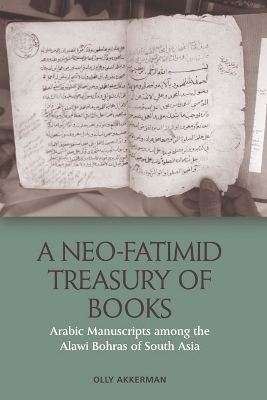
A Neo-Fatimid Treasury of Books
Edinburgh University Press (Verlag)
978-1-4744-7956-1 (ISBN)
This book tells the story of a manuscript repository found all over the pre-modern Muslim world: the khizanat al-kutub, or treasury of books. The focus is on the undisclosed Arabic manuscript culture of a small but vibrant South Asian Shi’i Muslim community, the Bohras. It looks at how books that were once part of one of the biggest imperial book repositories of the medieval Muslim world, the khizanat of the Fatimids of North Africa and Egypt (909CE-1171CE) ended up having a rich social life among the Bohras across the Western Indian Ocean, starting in Yemen and ending in Gujarat. It shows how, under strict conditions of secrecy, and over several centuries, one khizana was turned into another, its manuscripts gaining new meanings in the new social realities in which they were preserved, read, transmitted, venerated and copied into. What emerged was a new distinctive Bohra Ismaili manuscript culture shaped by its local contexts.
Olly Akkerman is assistant professor at the Institute of Islamic Studies, Freie Universität Berlin. Her research focuses on the social lives of Arabic manuscripts and their spaces of enshrinement within Muslim communities in the past and present, particularly in the context of the Bohras and the Western Indian Ocean (Yemen and Gujarat). She is the author of The Bohra Manuscript Treasury as a Sacred Site of Philology: a Study in Social Codicology (Philological Encounters), "Documentary Remains of a Fatimid Past in Gujarat" in Journal of Material Cultures in the Muslim World, and is editor of Social Codicology: The Multiple Lives of Manuscripts in Muslim Societies (Brill, 2022).
Prologue: Fatimid Encounters across the Indian Ocean
Introduction: Reading Sijistani in Gujarat: the Bohra Treasury of Books
Inside the Treasury of Books: Reflections on the Ethnography of Manuscripts
Chapter 1. Community
1.1 Shrine Custodians
1.2 Secret Manuscripts and their Social Lives
1.3 Everyday Documents and the Organization of the Da’wa
1.4 An Indian Muslim Caste
Chapter 2. The Treasury of Books
2.1. Neither Library nor Archive: the Khizana as a Treasury of Books
2.2. A Lost Fatimid Khizana in Gujarat?
2.3. A Treasury of Books across the Indian Ocean
2.4. A Neo-Fatimid Treasury of Books in Baroda
Chapter 3. Secret Universe
3.1. Bohra Spaces and their Modes of Access
3.2. Access I: a Profane Topography of the Bohra Universe
3.3. Access II: a Sacred Geography of the Bohra universe
3.4. Gender, Etiquette, and Access
Chapter 4. Manuscript Stories
4.1. Secret Khizana, Social Manuscripts
4.2. Manuscripts of Alawi Provence
4.3. Manuscripts of Non-Alawi Provenance
4.4. Practices of Borrowing, Lending, and Appropriation
Chapter 5. The Materiality of Secrecy
5.1. Codicology of the Treasury of Books
5.2. Anatomy of Bohra Manuscripts: Paratexts from Head to Tail
5.4. Occult Paratexts: Batini Manuscript Culture
5.5. Magical Marginalia: Zahiri Manuscript Culture
Chapter 6. Script and Scribal Politics
6.1. A Modern Isma’ili Manuscriptorium
6.2. Script and the Language of Secrecy
6.3. Khizana Scripts
6.4. Scribal Politics
Conclusion: A Jihad for Books
Epilogue: A Case for Social Codicology
| Erscheinungsdatum | 22.07.2022 |
|---|---|
| Zusatzinfo | 50 black and white illustrations |
| Verlagsort | Edinburgh |
| Sprache | englisch |
| Maße | 156 x 234 mm |
| Themenwelt | Geisteswissenschaften ► Sprach- / Literaturwissenschaft ► Anglistik / Amerikanistik |
| Geisteswissenschaften ► Sprach- / Literaturwissenschaft ► Literaturwissenschaft | |
| ISBN-10 | 1-4744-7956-1 / 1474479561 |
| ISBN-13 | 978-1-4744-7956-1 / 9781474479561 |
| Zustand | Neuware |
| Informationen gemäß Produktsicherheitsverordnung (GPSR) | |
| Haben Sie eine Frage zum Produkt? |
aus dem Bereich