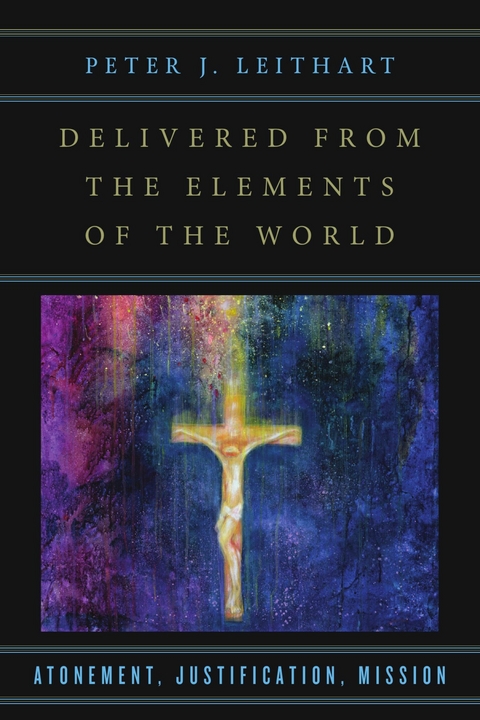
Delivered from the Elements of the World (eBook)
586 Seiten
InterVarsity Press (Verlag)
978-0-8308-9971-5 (ISBN)
Peter J. Leithart (PhD, University of Cambridge) is president of Theopolis Institute and an adjunct senior fellow of theology at New Saint Andrews College in Moscow, Idaho. He is the author of many books including Defending Constantine,
In Delivered from the Elements of the World Peter Leithart reframes Anselm's question, "e;Why the God Man?"e; Instead he asks, "e;How can the death and resurrection of a Jewish rabbi of the first century . . . be the decisive event in the history of humanity, the hinge and crux and crossroads for everything?"e; With the question reframed for the wide screen, Leithart pursues the cultural and public settings and consequences of the cross and resurrection. He writes, "e;I hope to show that atonement theology must be social theory if it is going to have any coherence, relevance or comprehensibility at all."e;There are no small thoughts or cramped plot lines in this vision of the deep-down things of cross and culture. While much is recognizable as biblical theology projected along Pauline vectors, Leithart marshals a stunning array of discourse to crack open one of the big questions of Christian theology. This is a book on the atonement that eludes conventional categories, prods our theological imaginations and is sure to spark conversation and debate.
Peter J. Leithart (PhD, University of Cambridge) is president of Theopolis Institute and an adjunct senior fellow of theology at New Saint Andrews College in Moscow, Idaho. He is the author of many books including Defending Constantine, Traces of the Trinity and Gratitude: An Intellectual History. He is a blog writer and columnist for firstthings.com, and he has published articles in many periodicals, both popular and academic. Ordained in the Communion of Reformed Evangelical Churches (CREC), Leithart pastored Reformed Heritage Presbyterian Church (now Trinity Presbyterian Church) in Birmingham, Alabama, and Trinity Reformed Church in Moscow, Idaho. He and his wife Noel have ten children and seven grandchildren.
- one -
ATONEMENT AS SOCIAL THEORY
No purely secular society exists or has ever existed. Define religion how you will: As a matter of ultimate concern, as belief in something transcendent, as the organizing master narrative for history and human lives, as a set of practices. However religion is defined, all institutions, structures and patterns of behavior have religious features. All cultures are infused with values and actions that have religious dimensions and overtones. Whether they name the name of a known God or not, societies and cultures are always patterned by some ultimate inspiration and aspiration.
By the same token, all religions have social aspects; they all are embedded in and rely on patterns of interaction among persons. Even the retreat of a solitary ascetic into the desert is a social act, since it is a retreat from social relation. And all religions deal with artifacts, symbols and rituals that might as well be called “cultural.”
Religion is not the “soul” of culture, nor culture the “body” of religion. Religions have bodies, and cultures have souls. It is rather the case that in dealing with any group of human beings, we are always dealing with socioreligious or religio-cultural entities. The common contemporary rhetoric of conflicts between religion and politics obscures the reality. Conflicts are never between politics and religion. Conflicts are always between rivals that are both religious and both political.
Islamic terrorists kill themselves and innocent bystanders for overtly religious reasons. In response, the United States sends troops to the Middle East to make the world safe from terrorism, but also to sacrifice themselves to preserve and advance America’s values, freedom and democracy. To say that the terrorist and the Marine are both motivated by religious values is not to make a moral equivalence. But we misread the times unless we recognize that the war on terror is a religious war on both sides.
We think ourselves all secular, all grown-up, but we have our taboos, our pollution avoidances, our instincts of recoil and disgust. Not so long ago, many found homosexual sodomy disgusting. In a matter of decades, the disgust has turned inside out, and now those who consider homosexual conduct sinful and unnatural are outcasts, treated with contempt. The freedom to engage in any form of consensual sex is now considered a right, and a sacred one, as inviolable as the sacred precincts of an ancient temple.
When the religious character of society is stressed, the emphasis is often placed more or less exclusively on beliefs. It is thought that societies and cultures are religious because they express religious ideas. Contemporary American culture is religious because it is founded on a belief system that Christian Smith has labeled “Moralistic Therapeutic Deism.” That emphasis on ideas is misplaced, not because beliefs are insignificant, but because beliefs and practices are inseparable. Exclusive focus on beliefs misses the habitual, often instinctive actions that form the stuff of social relationships. Rules of etiquette are, deep down, based on a set of beliefs, but few mothers teach their children those beliefs. What they teach is, “Say thank you” and “Shake hands with the nice man” and “Don’t pick your nose!”
My references to purity and holiness are not accidental. I will argue in this book that the fundamental physics of every socioreligious, cultural-religious formation consists of practices concerning holiness, purity and sacrifice. Locate the sacred center of a group; its boundaries of tolerable and intolerable persons, objects and behavior; its rituals of sacrifice—discover all this and you have got down to the elementary particles that determine the group’s chemical composition. Relocate the sacred, rearrange the boundaries of purity and pollution, revise its sacrificial procedures, and you have changed the fundamental physics of the society. A revolution here is the most profound of social revolutions, and it is the revolution achieved by Jesus in his cross and resurrection.
Cur Deus Homo
Delivered from the Elements of the World addresses questions internal to Christian theology. That is not a limitation. Christians believe the gospel encompasses everything, and so all Christian theology that is worthy of the name strains beyond the confines of “theology” to the ends of the earth.
The main questions I attempt to answer can be posed in several complementary ways.
They can be posed as a variation on the interrogative form of Anselm’s classic treatise on the atonement, Cur Deus Homo? At one level, my aim is the same as Anselm’s. It is an attempt to unravel the rationality of the central claims of the Christian gospel: Jesus died and rose again to save us from our sins. Like Anselm, I assume that the gospel is true and probe to discover how it happened. How can the death and resurrection of a Jewish rabbi of the first century, an event in the putative backwaters of the Roman Empire, be the decisive event in the history of humanity, the hinge and crux and crossroads for everything? Even here we can assume a partial that: because of the history of the church founded by Jesus, it is clear that his death and resurrection changed a great deal, perhaps everything. Again, my question is about the mechanics: How did that happen?
Unlike Anselm, however, I have self-consciously asked Cur Deus Homo as a question of social and political theology, as an exploration of the cultural and public settings and consequences of the event of the cross and resurrection. We are social and political creatures. If humanity is going to achieve a state of health (what Christians call salvation), we are going to have to be saved in our social and political situations; our social structures and political institutions are going to have to become conducive to harmony and justice, peace and human flourishing. For Christians, the health of the human race turns on the work done by Jesus, and that means that the good of social life must somehow have its source there, on Calvary and at the empty tomb. Ultimately Jesus died and rose again to bring the human race to its final end in glory, to gather a people who will one day be a spotless bride, without blemish or wrinkle or any such thing, a perfected humanity to be presented to the Father. While I keep that eschatological qualification in mind throughout, my focus is on the already of the eschatological dualism. Cur Deus Homo for the salvation of human society in history? What need do we have of a God-man, or of the death and resurrection of a God-man, to restore human culture and society? Why can we not simply establish institutions that promote peace and justice? Why can we not found our common life on our common humanity?1
That is one way to ask the question. Another is in terms of sacramental theology: the church cannot exist without rites, any more than any society. For there is no religious society, Augustine insists, whether true or false, whose separate members are not “coagulated” into common life by sacraments and signs. According to Augustine, old figural and prophetic sacraments are fulfilled in new sacraments, more powerful, easier and fewer than the sacraments of old (virtute maiora, utilitate meliora, actu faciliora, numero pauciora; Contra Faustum 19.13). Fine. I agree. But again my question is, Why do we need a dead and risen Christ to accomplish this? When Moses instituted the sacraments of the old law, there was opposition, occasional threats on his life, but in the end he survived to see Torah established. Why could Jesus not be another Moses? Why could he not be a teacher and founder of a new cultus and a new sect? Why does he need to die in order to institute new signs and sacraments for the new society he forms? Why the cross if the task is simply to relocate the sacred and change the rules of purity and sacrifice?
The question can be posed in another way. Old Testament acts of judgment and redemption were inescapably acts of social and political salvation, and if Christian faith takes the Old Testament as canon, and if Jesus and his body fulfill Israel’s history, then judgment and redemption in Christian theology must take social and political form. It must at least coagulate that new society around those new sacraments, but, beyond that, if the gospel is about the salvation of humanity it must carry a message of hope for the salvation of human society.
The problem is this: Old Testament acts of judgment and redemption were comprehensibly acts of judgment and redemption. Many today will think the story of Adam’s sin in Eden’s garden to be a bit of implausible mythology. But it is comprehensible mythology: Adam is put in a garden and told not to eat the fruit of the tree on pain of death. Yahweh forms Eve to be a helper suited to him. We know what will happen: Satan tempts Eve, she and Adam eat, and they are expelled from the garden, exiled from the tree of life. Many regard it as a children’s story; even the skeptic can agree that it has at least one virtue: it possesses the bright clarity of a fairy tale.
So too do the other stories of judgment and deliverance throughout the Old Testament. Seeing his world ruined by violent heroism, Yahweh regrets having created in the first place, so he wipes out the world in the flood. Yet he rescues Noah by disclosing the threat ahead of time and giving him instructions for an ark. Again, many sniff out mythology here, but it is not a difficult myth to understand. Catastrophe falls on wrongdoers (yay!),...
| Erscheint lt. Verlag | 28.4.2016 |
|---|---|
| Verlagsort | Lisle |
| Sprache | englisch |
| Themenwelt | Religion / Theologie ► Christentum ► Kirchengeschichte |
| Schlagworte | Atonement • Christ • Christianity • death and resurrection of Christ • faith of Jesus Christ • Jesus • Jesus Christ • Justification • Political Theology • Religions • Resurrection of Jesus |
| ISBN-10 | 0-8308-9971-5 / 0830899715 |
| ISBN-13 | 978-0-8308-9971-5 / 9780830899715 |
| Informationen gemäß Produktsicherheitsverordnung (GPSR) | |
| Haben Sie eine Frage zum Produkt? |
 EPUB (Adobe DRM)
Kopierschutz: Adobe-DRM
Adobe-DRM ist ein Kopierschutz, der das eBook vor Mißbrauch schützen soll. Dabei wird das eBook bereits beim Download auf Ihre persönliche Adobe-ID autorisiert. Lesen können Sie das eBook dann nur auf den Geräten, welche ebenfalls auf Ihre Adobe-ID registriert sind.
Details zum Adobe-DRM
Dateiformat: EPUB (Electronic Publication)
EPUB ist ein offener Standard für eBooks und eignet sich besonders zur Darstellung von Belletristik und Sachbüchern. Der Fließtext wird dynamisch an die Display- und Schriftgröße angepasst. Auch für mobile Lesegeräte ist EPUB daher gut geeignet.
Systemvoraussetzungen:
PC/Mac: Mit einem PC oder Mac können Sie dieses eBook lesen. Sie benötigen eine
eReader: Dieses eBook kann mit (fast) allen eBook-Readern gelesen werden. Mit dem amazon-Kindle ist es aber nicht kompatibel.
Smartphone/Tablet: Egal ob Apple oder Android, dieses eBook können Sie lesen. Sie benötigen eine
Geräteliste und zusätzliche Hinweise
Buying eBooks from abroad
For tax law reasons we can sell eBooks just within Germany and Switzerland. Regrettably we cannot fulfill eBook-orders from other countries.
aus dem Bereich