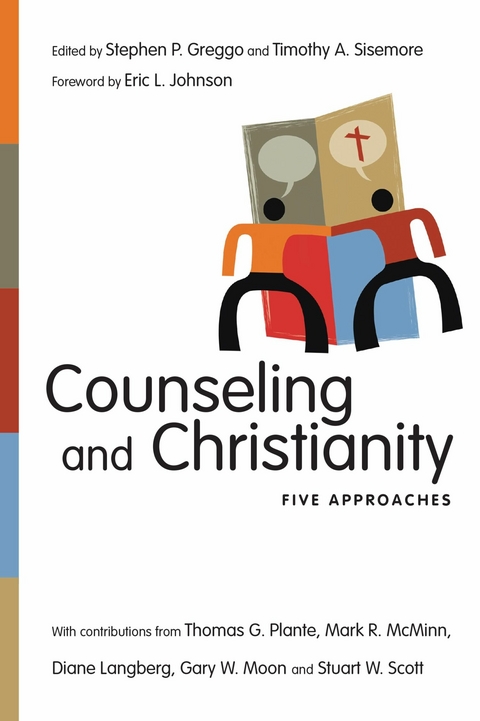
Counseling and Christianity (eBook)
352 Seiten
IVP Academic (Verlag)
978-0-8308-6328-0 (ISBN)
Stephen P. Greggo (Psy.D., State University of New York, Albany) is professor of counseling at Trinity Evangelical Divinity School in Deerfield, Illinois. He is the author of Trekking Toward Wholeness, a licensed psychologist and a partner and consultant with Christian Counseling Associates in Delmar, New York.
What does authentic Christian counseling look like in practice?This volume explores how five major perspectives on the interface of Christianity and psychology would each actually be applied in a clinical setting. Respected experts associated with each of the perspectives depict how to assess, conceptualize, counsel and offer aftercare to Jake, a hypothetical client with a variety of complex issues. In each case the contributors seek to explain how theory can translate into real-life counseling scenarios.This book builds on the framework of Eric L. Johnson's Psychology Christianity: Five Views. These include the Levels-of-Explanation Approach, the Integration Approach, the Christian Psychology Approach, the Transformational Approach and the Biblical Counseling Approach. While Counseling and Christianity can be used independently of Johnson's volume, the two can also function as useful companions.Christians who counsel, both those in practice and those still in training, will be served by this volume as it strengthens the connections between theory and practice in relating our faith to the mental health disciplines. They will finally get an answer to their persistent but unanswered question: "e;What would that counseling view look like behind closed doors?"e;Christian Association for Psychological Studies (CAPS) Books explore how Christianity relates to mental health and behavioral sciences including psychology, counseling, social work, and marriage and family therapy in order to equip Christian clinicians to support the well-being of their clients.
Eric L. Johnson (PhD, Michigan State University) trained as an academic psychologist and is Lawrence and Charlotte Hoover Professor of Pastoral Care at The Southern Baptist Theological Seminary in Louisville, Kentucky. He is the author of Foundations for Soul Care and the coeditor of God Under Fire and Christianity and Psychology: Four Views. An associate editor of the Journal of Psychology and Theology, he is the director of the Society for Christian Psychology and the Institute for Christian Psychology. Stephen P. Greggo (Psy.D., State University of New York, Albany) is professor of counseling, training clergy and mental health counselors at Trinity Evangelical Divinity School in Deerfield, Illinois. He is author of Trekking Toward Wholeness, is a licensed psychologist and maintains a long-standing association as partner and consultant with Christian Counseling Associates in Delmar, New York. Timothy A. Sisemore (Ph.D., Fuller Theological Seminary) is Director of Research and Professor of Psychology and Counseling at Richmont Graduate University in Chattanooga, TN, and maintains a clinical practice at Richmont's CBI Counseling Center. He is author of several books, the most recent being The Clinician's Guide to Exposure Therapies for Anxiety Spectrum Disorders (New Harbinger).
1
Setting the Stage for the Five Approaches
Learning Objectives
- Differentiate pastoral and Christian counseling trends from secular, medically oriented clinical services
- Distinguish key features of the five major views for relating the Christian faith to modern psychology
- Associate each of the approaches in this volume with the corresponding viewpoint in Psychology & Christianity: Five Views (Johnson, 2010a)
Walking down the hall in the Student Center, Jake looked like a typical 22-year-old with his holey jeans, mussed hair covering his ears, and a couple of days’ growth of beard on his face. Upon closer scrutiny, there was a pained resolve on his face and urgency to his gaze. With a moist palm, he hesitantly opened the door to the Student Support Services office. Somewhat to his surprise, Jake did not back out of his counseling appointment.
Jake was struggling to adjust to life at a Christian college and sought some guidance with his study habits. Yet deep down he knew there was much more to it than that. His short life had overflowed with challenges, joys, sorrows and failures. The Christian faith of his childhood had been battered as he faced the throes of life, and Jake clung to the tattered remnants of that faith as he opened that door. Academic psychology and abstract theology meant little to him at the moment. He needed help—desperately enough to keep this appointment.
Jake, whom we will get to know quite well in the pages that follow, is not unusual. Modern life is challenging, confusing and often daunting. While Christians know their faith is a resource in coping with the trials of life, we struggle to know exactly how this works out in the “real world.” For thousands of believers, talking with a counselor is an act of hope that their lives can be better, and their faith stronger. But what should counsel to Christians look like? How do we take the truths of Scripture and apply them to twenty-first-century life? And what do we do with the insights of psychology and its sister mental health disciplines? Do we ignore them and stick to the Bible, embrace them wholeheartedly as gifts from God, or find some via media that incorporates both? Christian counselors must confront these issues if we are to be ready to help the thousands of Jakes who seek our services. It is not enough merely to offer encouragement haphazardly, going with our gut or calling counseling “Christian” simply because we hold to the faith. We must think through how to relate our faith—both beliefs and behaviors—to modern approaches to counseling, but the bottom line is this must translate to practice: what we say and do in session. We intend in the ensuing pages to serve Christian counselors, both those in practice and those still in training, by furthering the connection between theory and practice in relating our faith to the mental health disciplines.
To do so, we will unashamedly build on another’s foundation. Eric L. Johnson’s (2010a) Psychology & Christianity: Five Views offers five major views that represent families of approaches in connecting the discipline of psychology with the Christian faith. These vital theoretical approaches are essential to form a model from which to relate these two fields. Good basic science must always undergird applied science, and likewise biblical wisdom is foundational to biblical advice. Yet for many, a further step is necessary: how do science and biblical wisdom translate into real-life counseling scenarios?
In this introductory chapter, we will document the crucial need for practical application of the theories in Johnson’s book before turning to a summary of those views to prepare for the chapters ahead, introducing the clinicians who will guide us as we go.
The Burgeoning of Counseling Services and Providers
How badly do we need to address this issue of how “Christian counseling” should look in the consulting office? We argue that it is vital given the demand for such counsel. Anyone working in mental health who is a Christian can sense the growth of the field over the past few years.
In the world of the twenty-first century, counseling is not just for the seriously mentally ill or wealthy. While it goes by differing names such as psychotherapy, psychoanalysis, therapy, pastoral care, coaching or counseling (depending largely on who is doing it), it is far from uncommon. Why? Seeing a counselor lacks the stigma it once had, which frees many up to seek help who might not have a generation ago. This is especially true for Christians as they accept that being a believer does not immunize one against the struggles of life, nor does seeking help mean one is “mentally ill.” The availability of more expert helpers who explicitly state they are Christians or who promote themselves as doing faith-based counseling further enhances the openness to counseling for followers of Christ.
Another reason for the amplified interest in counseling is the increase in mental health problems. While arguments abound as to whether this reflects the stress of (post)modern life or changes in diagnostic criteria, the facts remain. In 2009, the National Institute of Mental Health (NIMH) reported that 26.2% of Americans 18 years of age or older (i.e., roughly one quarter of adult Americans) suffer a diagnosable mental condition each year. That translates to nearly 60 million persons, with 6% of these persons experiencing serious forms of mental illness. Nearly half (45%) of those with one diagnosable condition meet criteria for a second.
One way to look at the significance of this trend is to consider the impact of emotional distress on the economy. Mental illness accounts for 15% of the total impact of disease on the American economy—more than all cancers combined. It is also the leading cause of disability in the United States and Canada. Some 9.5% of the U.S. population meets criteria for depression and 18% for anxiety (NIMH, 2010). Consequently, some 15% of U.S. adults use mental health services each year (U.S. Department of Health and Human Services, 1999). That translates to more than 30 million adults seeking services each year, and while many of those will see a physician for medications, a significant number of them will seek out a talking cure.
Studies focusing on children reveal a similar situation. The NIMH (2010) found 13% of teenagers have a mental disorder. The U.S. Department of Health and Human Services (1999) states that 20% of children and adolescents experience a mental illness each year, translating to approximately 10 million young people. Yet some two-thirds of those do not get the professional services they need. Adding that to the adult totals, some 70 million Americans suffer from a diagnosable mental illness each year, and that does not include those who are not diagnosable but who bear hardships through divorces, job loss and other stressors. Even though many of these persons do not seek specialized support, a great need for counseling services obviously exists in the United States and elsewhere.
This demand for services is paralleled by an increase in supply. I (TAS) can measure it subjectively by tracing the counseling center where I work. An anomaly in a mid-sized Southern U.S. city when launched in the late 1970s, it has grown to include 15 clinicians plus interns who provide 1100 hours of therapy per month. Even so, several other centers have appeared in our city in recent years and are also expanding rapidly. Or, track the growth with book publishing: Christian counseling titles and self-help books have gained in popularity even as other genres have languished. Or, consider the burgeoning number of Christian counseling training programs. When I applied to graduate school in 1979, there were only three programs on the map: Fuller Theological Seminary, Rosemead Graduate School and Psychological Studies Institute (now Richmont Graduate University). My town alone now has three of its own, exemplifying the explosive expansion in the number of programs available to believers who want to counsel in a manner that incorporates faith.
From another vantage point, I (SPG) have been associated with Christian Counseling Associates (CCA) in the Capital region of upstate New York. The practice mission is to honor Christ according to his revealed Word, partner with Christian ministries, and assist those hurting in heart, mind, relationship and health (www.ccahope.com). Birthed by visionary evangelical leaders over 30 years ago, the intention was to support pastors and parishioners via advanced therapeutic assistance that complemented, not crushed, personal faith in Jesus Christ as Lord and Savior. Increased reliance on third-party funding for medically sanctioned mental health services prompted changes through the years in both organizational structure and counselor credentials. The heritage of CCA is typical of Christian practices across the country. For perspective, in 2010, CCA provided a weekly average of 147.5 billable hours of service. Nearly 80%, or 6,136, of these clinical sessions flowed through a variant of managed mental health care. Despite compliance with oversight requirements and “best practice” expectations, CCA counselors humbly designate our efforts as Christian counseling. In our limited corner of the evangelical world, CCA provides over 7,670 hours a year of professional-level therapy to clients who desire to utilize faith as a critical resource in promoting both overall health and spiritual growth (Greggo, 2007). The demand for service continues to expand.
But maybe national data says it best.
The number of counselors of various ilk is growing to meet the need. As of 2008, there were 152,000 employed clinical, counseling and school psychologists in America...
| Erscheint lt. Verlag | 2.9.2012 |
|---|---|
| Reihe/Serie | Christian Association for Psychological Studies Books |
| Vorwort | Eric L. Johnson |
| Verlagsort | Lisle |
| Sprache | englisch |
| Themenwelt | Geisteswissenschaften ► Psychologie |
| Religion / Theologie ► Christentum ► Kirchengeschichte | |
| Religion / Theologie ► Christentum ► Pastoraltheologie | |
| Medizin / Pharmazie ► Gesundheitsfachberufe | |
| Medizin / Pharmazie ► Medizinische Fachgebiete ► Psychiatrie / Psychotherapie | |
| Sozialwissenschaften ► Soziologie | |
| Schlagworte | Biblical • Case study • Christian • Client • Clinician • contextualization • Counselor • Dialogue • Faith • God • Integration • Jesus • Mental Health • Model • Perspectives • Practice • Professor • psychotherapy • Religion • session • Student • Therapist • therapy • transformational • Viewpoint |
| ISBN-10 | 0-8308-6328-1 / 0830863281 |
| ISBN-13 | 978-0-8308-6328-0 / 9780830863280 |
| Informationen gemäß Produktsicherheitsverordnung (GPSR) | |
| Haben Sie eine Frage zum Produkt? |
 EPUB (Adobe DRM)
Kopierschutz: Adobe-DRM
Adobe-DRM ist ein Kopierschutz, der das eBook vor Mißbrauch schützen soll. Dabei wird das eBook bereits beim Download auf Ihre persönliche Adobe-ID autorisiert. Lesen können Sie das eBook dann nur auf den Geräten, welche ebenfalls auf Ihre Adobe-ID registriert sind.
Details zum Adobe-DRM
Dateiformat: EPUB (Electronic Publication)
EPUB ist ein offener Standard für eBooks und eignet sich besonders zur Darstellung von Belletristik und Sachbüchern. Der Fließtext wird dynamisch an die Display- und Schriftgröße angepasst. Auch für mobile Lesegeräte ist EPUB daher gut geeignet.
Systemvoraussetzungen:
PC/Mac: Mit einem PC oder Mac können Sie dieses eBook lesen. Sie benötigen eine
eReader: Dieses eBook kann mit (fast) allen eBook-Readern gelesen werden. Mit dem amazon-Kindle ist es aber nicht kompatibel.
Smartphone/Tablet: Egal ob Apple oder Android, dieses eBook können Sie lesen. Sie benötigen eine
Geräteliste und zusätzliche Hinweise
Buying eBooks from abroad
For tax law reasons we can sell eBooks just within Germany and Switzerland. Regrettably we cannot fulfill eBook-orders from other countries.
aus dem Bereich