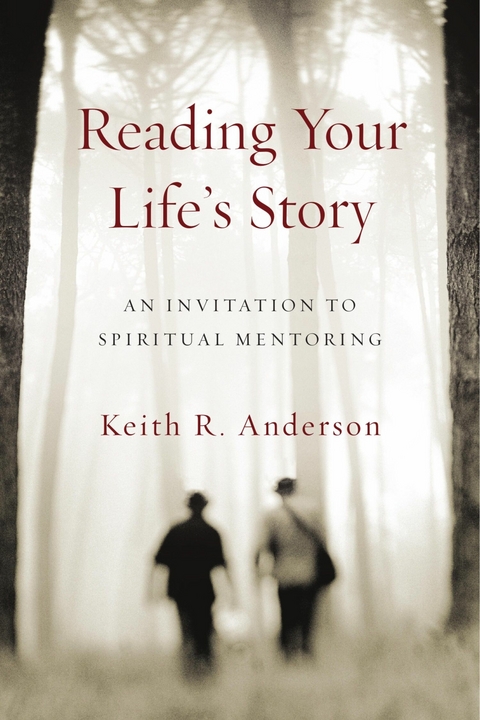
Reading Your Life's Story (eBook)
224 Seiten
IVP Formatio (Verlag)
978-0-8308-7319-7 (ISBN)
Keith R. Anderson is president of The Seattle School of Theology Psychology. He has authored a number of books, including A Spirituality of Listening, and coauthored Spiritual Mentoring.
Keith R. Anderson (DMin, George Fox Evangelical Seminary) is president of The Seattle School of Theology and Psychology. He is the author of A Spirituality of Listening, Spiritual Mentoring: A Guide for Those Giving and Receiving Direction, Friendships That Run Deep, Is This The One? and What They Don't Always Teach You at a Christian College.Anderson previously served as dean of spiritual formation and vocation at Northwestern College in Orange City, Iowa, and as dean of spiritual formation/campus pastor at Bethel University in St. Paul, Minnesota. He was director of Vocare, a program for theological exploration of vocation funded by a $2 million grant from the Lilly Endowment, and has been the Senior Fellow for Spiritual Formation for the Council for Christian Colleges and Universities since 2000. His parish ministry experience includes serving urban parishes in Washington State, Michigan and Minnesota.
1
Reading with a
Consecrated Purpose
Learning to read was both natural and easy for me as a young child. Words became like pictures that offered a portal into a world of color, beauty, imagery and a strange kind of power. Yes, the ability to interpret the meaning of the lines on a page was power, even for a small boy. By second grade I loved words even more because they had moved from simple vocabulary to story. They had become a direct doorway into imagination. The Hardy Boys mysteries, the Sugar Creek Gang and other stories acceptable in my Christian home became frequent companions at night under the covers with a smuggled flashlight but also outside on a summer’s day or in the private world of boyhood imagination. Books from school were allowed, so I read To Kill a Mockingbird, Black Like Me and The Red Badge of Courage. At home we also listened to stories on the radio—missionary drama and rescue from addiction on the mean streets of the cities. Of course, the constant companion in my family was the Bible, with its stories of women and men of faith, courage, conviction and obedience. Only later did I discover these people also had stories of disobedience, fear, deception and failure. Later also came my “intellectual period” with Russian writers Solzhenitsyn, Dostoyevsky and Tolstoy. The Beat Poets and Ferlinghetti were companions for a time and, by contrast, so were Dag Hammarskjöld, Robert Frost, and Emily Dickinson. Now I am eager for Wendell Berry, Billy Collins, David McCullough biographies, and even pulp fiction.
At one point I traded fiction and poetry for what I deemed to be more scholarly work as I studied history, political science, theology and spirituality. But somehow my calling as pastor, teacher and preacher kept stories close. You cannot preach gospel well without story, just as you cannot live the meaning of gospel well without engaging your own story. We often say at the Seattle School of Theology and Psychology that you cannot take others farther than you have been willing to go yourself. One of our signature programs is the Story Workshop, which takes people into the crucible of learning to tell their story of tragedy to a small group. A trained facilitator is present to assist in “reading” the story well together because we believe our spirituality is shaped by narrative and how we tell the stories of our lives. Story is not only fiction or history, chronology and timeline; story is meaning making in its most formative sense. We are formed by our story and we are formed as we tell our story to others and as we learn to read our life as story with others. We who are mentors might be considered selfish people. We mentor others because we love story, and we read the lives of our mentees because we receive so much as we do. On our best days, we know it is about the other, but on all days we are deeply touched because we’ve been invited into their life.
Spiritual mentoring is learning to read all of their story—desire and tragedy, beauty and shame, glory and failure. It is not simply to mark change in the way we chart the upward growth of a child in pencil on a doorway in the bedroom; not simply a timeline to chart years passed, moments experienced and events undergone. In spiritual mentoring we recognize all of life as story. Mark Twain said his first rule in story writing was that “a tale should accomplish something and arrive somewhere.”1 Others point out that a story has, at least, a beginning, a middle and an end. Reading a story, then, starts with an understanding of how a story actually “works.”
THE ELEMENTS OF HOLY NARRATIVE
What are the elements of a story? At its simplest, there are at least five elements of a story.
-
There is an author.
-
There is an unfolding plot, a theme, question or issue that gives coherence to the story. In classical stories this may be the conflict that initiates the story.
-
There are characters.
-
There are events, ordinary and surprising, that form the backbone of the story in context as the plot develops.
-
There may be a resolution, climax or denouement—or not. In contemporary American fiction, a new popular form is an abrupt conclusion that only hints at how the story will actually end, but there is a movement or flow as an author narrates to a moment of conclusion.
Each of these will aid us as we learn the role of mentoring another. Reminded of authorship (authorization and authority), we will keep the focus on God’s primary role in cocreating the story. Reminded of plot, we will learn to read for intentionality, themes and meaning in the seemingly random events of life. Reminded of characters, we will see development, formation, malformation, regression and surprising growth in ourselves through interaction with others. Reminded of the place of events, we will look to both the ordinary and extraordinary as formational and generative and lived in a particular context of time and place. And reminded of resolution, we will learn that there is no final telling of our story in this life but rather in eternity. Reading story as holy narrative is a nuanced metaphor for the richness, individuality and complexity of a person. It is a sacred task to be done carefully, respectfully and in holy curiosity. It is reading with a consecrated purpose.
My Life as a House is the story of a man who is dying of cancer, but only he knows his diagnosis. I’ve seen the movie at least a half dozen times. It draws me in by its plot but more, I suppose, by the emotions it evokes in me. He is divorced from his wife and estranged from his self-loathing and rebellious teenage son, who considers his father a relic of something long since forgotten. He owns a piece of property that overlooks the California coast that once contained a ramshackle house built by his own father. Fired by his architectural company, in a rage he destroys all of the architectural models he has created over his career but keeps the design of a house he once crafted. In an act of undetermined motivation he decides to build a new house based on the one remaining model to replace the house his father had built years before.
After his death there is a voice-over in which the architect, George, speaks to his son about his life and house. “I always thought of myself as a house. I was always what I lived in. It didn’t need to be big; it didn’t even need to be beautiful; it just needed to be mine. I became what I was meant to be. I built myself a life. . . . I built myself a house.” Building a house was the plot for the father, George (Kevin Kline), to read the final chapter of his own unfolding story.
We live in what we have built. The stories of our life become a house we inhabit with its limitations, eccentricities, mistakes, hidden meanings and crafted beauty. In this book I hope to offer ways to help us all read the story of our life through the centuries-deep practice of spiritual mentoring. Stories are a way to find coherence and meaning in what seems random, episodic or even chaotic. Alan Jones’s words are irrepressibly stunning: “My drifting is consecrated in pilgrimage”2
“Passion for pilgrimage,” the title of Jones’s book, is one way to describe our human longing for meaning. What the spiritual teachers of my life share in common, along with generations of others named and anonymous, is that they practiced spiritual friendship on a common quest for identity, community and purpose. Spiritual mentoring is not a form of evangelism, catechism or pastoral care, per se; it is an embodiment of spiritual companionship. The mentor chooses to walk alongside another in what Celtic spirituality calls anamchara—soul friendship—seeking to find meaning on the journey. It may be as simple as two friends who share a common hunger for faith who know they need companions for the journey. It is enriched by centuries of wisdom distilled from spiritual directors, monastics, clergy, priests, and very ordinary women and men who reached out to another to sit at the table of spiritual nurture in this ministry of reading the story of each other’s lives. It is the recognition that I can be helped through the wisdom of one who has climbed this mountain trail before and is willing to sit by the fire and tell the stories of their own trek across terrain I now will walk. The book that will be read is the life story of the mentee.
Mentors are, most often, people we know who live alongside us as companions of the sacred in the most ordinary ways. Pilgrimage is a metaphor that speaks of an earlier era or a dramatic spiritual quest. Lacy Ellman is a spiritual director who once was a student of mine. She says:
Though ancient in its roots, the practice of pilgrimage is alive and well today, beckoning a new generation of seekers to journey beyond the edge of daily life into terrains of mystery, wonder, revelation, delight, acceptance and transformation. But you don’t have to leave home to begin living like a pilgrim. To live as a pilgrim at home, all you need to do is to see your life as a journey and your role as a seeker of the Sacred.3
Yesterday two men spoke to me at a conference with eyes glistening with joy. “You know our best friend, PJ.” They were correct. I knew PJ as a student who I was privileged to spend time with frequently over his college career. “You gave him tenderness as a new follower of Jesus.” That same day a woman at the conference said, “You know my pastor. She was your student.” I knew immediately who she was. In both cases I lit up with anticipation to hear about their work and ministry. I was humbled...
| Erscheint lt. Verlag | 3.10.2016 |
|---|---|
| Verlagsort | Lisle |
| Sprache | englisch |
| Themenwelt | Religion / Theologie ► Christentum ► Kirchengeschichte |
| Religion / Theologie ► Christentum ► Moraltheologie / Sozialethik | |
| Religion / Theologie ► Christentum ► Pastoraltheologie | |
| Schlagworte | Mentor • mentoree • Mentoring • mentoring relationship • mentoring tips • questions • Spiritual direction • spiritual director • spiritual friendship • spiritual mentoring • transference |
| ISBN-10 | 0-8308-7319-8 / 0830873198 |
| ISBN-13 | 978-0-8308-7319-7 / 9780830873197 |
| Informationen gemäß Produktsicherheitsverordnung (GPSR) | |
| Haben Sie eine Frage zum Produkt? |
 EPUB (Wasserzeichen)
DRM: Digitales Wasserzeichen
Dieses eBook enthält ein digitales Wasserzeichen und ist damit für Sie personalisiert. Bei einer missbräuchlichen Weitergabe des eBooks an Dritte ist eine Rückverfolgung an die Quelle möglich.
Dateiformat: EPUB (Electronic Publication)
EPUB ist ein offener Standard für eBooks und eignet sich besonders zur Darstellung von Belletristik und Sachbüchern. Der Fließtext wird dynamisch an die Display- und Schriftgröße angepasst. Auch für mobile Lesegeräte ist EPUB daher gut geeignet.
Systemvoraussetzungen:
PC/Mac: Mit einem PC oder Mac können Sie dieses eBook lesen. Sie benötigen dafür die kostenlose Software Adobe Digital Editions.
eReader: Dieses eBook kann mit (fast) allen eBook-Readern gelesen werden. Mit dem amazon-Kindle ist es aber nicht kompatibel.
Smartphone/Tablet: Egal ob Apple oder Android, dieses eBook können Sie lesen. Sie benötigen dafür eine kostenlose App.
Geräteliste und zusätzliche Hinweise
Buying eBooks from abroad
For tax law reasons we can sell eBooks just within Germany and Switzerland. Regrettably we cannot fulfill eBook-orders from other countries.
aus dem Bereich