


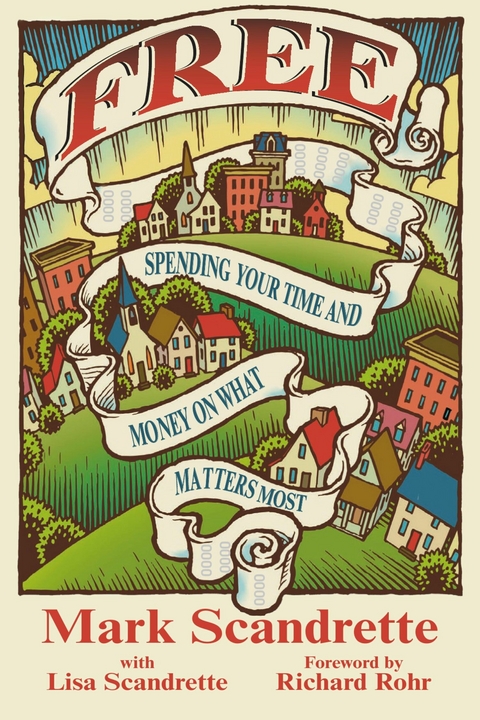
Free (eBook)
313 Seiten
InterVarsity Press (Verlag)
978-0-8308-9551-9 (ISBN)
Mark Scandrette is executive director and cofounder of ReIMAGINE, a center for spiritual formation in San Francisco, and the Jesus Dojo, a yearlong intensive formation process inspired by the life and teachings of Jesus. He is the author of Soul Graffiti.
If you already own a copy of Free, use the password found in the Group Learning Guide to access eight supplementary videos.Why does chasing the good life make us feel so bad? We dream big and spend our money and time chasing our dreams-only to find ourselves exhausted, deeply in debt and spiritually empty. Mark and Lisa Scandrette realized at the beginning of their lives together that what they want, what they need and what they were being told to want didn't sync up. In Free Mark (with a little help from Lisa) shares the secrets of how they bought a home and raised a family debt-free in the most expensive city in the United States-and how they've enjoyed good relationships, good adventures and good food along the way. Packed with helpful exercises for getting a handle on your money story, and designed for healing and generative money conversations with friends, Free gives you a path to financial freedom and spiritual flourishing that awakens your heart and energizes your soul.
Mark Scandrette is an author, teacher, activist, and networker among innovative Christian leaders. As the founding director of ReIMAGINE, a center for integral Christian practice based in San Francisco, he leads an annual series of retreats, learning labs, conversations, and projects designed to help participants integrate the teachings of Christ into every aspect of life through shared practices and community experiments. Mark is the author of FREE: Spending Your Time and Money on What Matters Most, Practicing the Way of Jesus, and Soul Graffiti.A sought after voice for creative, radical, and embodied Christian practice, Mark speaks nationally and internationally at universities, conferences, and churches, and offers training and coaching to leaders and organizations. He assisted in the development of CONSP!RE Magazine and has contributed to publications like Leadership Journal and Conversations Journal and books such as An Emergent Manifesto of Hope, Community of Kindness, and The Relevant Church. He currently serves as an adjunct faculty member at Fuller Seminary, and his work has been profiled in books that include The Shaping of Things to Come by Alan Hirsch and Michael Frost, Emerging Churches by Eddie Gibbs and Ryan Bolger, I.AM.RELEVANT by the Relevant Media group, and The New Conspirators by Tom Sine. Mark and his wife Lisa and their three children live in the Mission District of San Francisco. He enjoys running, biking, cooking, dumpster diving, home coffee roasting, long city walks, going on dates with Lisa, and watching T.V. and films with their kids. Lisa Scandrette has devoted herself to a life of care, hospitality, and teaching. She regularly facilitates workshops and provides administrative support for ReIMAGINE, a center for integral Christian practice with a mission to help people become more fully human through engagement with the life and teachings of Jesus. She makes a life in the Mission District of San Francisco with her husband Mark and their three children, and she is coauthor of FREE: Spending Your Time and Money on What Matters Most.
Introduction
Making Space for Life to Grow
The seed that fell among thorns stands for those who hear, but as they go on their way they are choked by life’s worries, riches and pleasures, and they do not mature. But the seed on good soil stands for those with a noble and good heart, who hear the word, retain it, and by persevering produce a crop.
Luke 8:14-15
Growing up, my family was a bit odd. In the 1970s, when most people who could moved to the suburbs, we bought a little house in an older part of the city.[8] In an era of dual incomes, conspicuous consumption and shopping malls, my family chose to live on one salary, my dad’s Army Reserve job, and my mom made the unfashionable choice to stay home to raise us four kids. I was the kid with the brown bag lunches and high-water, hand-me-down jeans. We owned one car, a rusty old station wagon with fake wood paneling that sat in our garage most of the week. Rain or shine my dad biked five miles to work each way in his military fatigues. For much of my childhood, our television was under lock and key. Six of us shared one bathroom, which made getting ready for school and church a challenge—creatively solved by having one person on the toilet and another in the shower, with a third person at the sink brushing their teeth.
Being odd in the ways we were had some advantages. We knew our neighbors well and went to local schools and shops. Mom had time to make nutritious meals and to be a hospitable neighbor and caring friend. Dad’s job allowed him to be home by 4:30 each day. After dinner we had many leisurely hours to enjoy reading and discussing books at the table, playing volleyball in the backyard or going on walks together along the Mississippi river. Our life was simple, connected and largely local.
When I was twelve Dad accepted a promotion that would provide new opportunities and pay $10,000 more a year—a lot of money back then. But the job required him to transfer to a new city every three or four years. The summer before my senior year we moved from Minneapolis to rural Alabama. With the money made from selling our small city home, my parents bought a large brick house in the country with a built-in swimming pool on two acres of land. It had four bedrooms, two living rooms, a formal dining room and not one, not two, but four bathrooms! With my dad’s larger salary we could afford many things we’d previously gone without: better clothes, a house full of new furniture, stereo equipment and our first home computer. Living in the country, we quickly became a three-car family. Suddenly we went from being oddly simple to “those rich Yankees out on King’s Hollow Road.”
Our larger house and pool were great for entertaining, and living in another culture broadened and enriched our horizons, but there were also unanticipated consequences to our new life. Uprooting from where we’d lived for thirteen years was traumatic and often lonely. It took thirty minutes to drive to school, to work or to church activities. With more stuff came more responsibility—cleaning the pool, mowing an acre of lawn, maintaining three vehicles and scrubbing those four bathrooms! Dad traveled regularly, worked late and often came home stressed or exhausted. On good days we celebrated our new opportunities and friendships. On bad days, Dad voiced his doubts about whether the increase in status and pay were worth what we’d lost by moving. His honest reflections about this transition left a lasting impression on me about the trade-offs we make with any decision.
What Matters Most?
When I was in college, beginning to clarify my life vision and values, I compared the two versions of “the good life” that I’d experienced. Of course there were benefits and costs to both circumstances, but I decided that if at some point I had to choose one over the other, meaningful work and relationships were more precious to me than money or things. I felt a hunger awakening inside of me for a life of greater freedom to pursue what matters most.
One of the things that mattered most to me was a girl I’d left behind in Minnesota. Lisa and I met at camp when we were fifteen and sixteen. After moving to Alabama I spent much of my spare time writing letters to Lisa and a lot of my money calling her long distance. During our second year in college, we began to consider marriage. We had an instant connection and over time discovered that we wanted many of the same things out of life: to be God-oriented, to create a loving family, to serve needs and to live simply and creatively. Looking around us, it didn’t seem like most people were free to pursue their deeper values and purpose. We began to ask ourselves, “What choices can we make now to be free to pursue what matters most to us in the future?”
Over the next few months Lisa and I talked extensively about our shared dreams. We imagined living in an old house in a large city, raising kids, offering hospitality and caring for needs in our neighborhood. We hoped that one of us would be able to stay at home to nurture our kids, that our home would be a place of hospitality, and that we would be free to spend our time doing work we were passionate about, having the flexibility to work and serve together. We began to realize that our dream was not about a particular job or a career, but more a way of life—and a pretty idealistic one at that. But we also believed that this was the kind of life we were called to, and we would make any sacrifices that were necessary.
What quickly became clear to us was that we wouldn’t be able to pursue this dream and an American lifestyle of consumption at the same time. We decided to choose time and freedom over money and stuff. During this process, we began to pay more careful attention to the wise and crazy things that Jesus said about wealth, meaning and material possessions.
Sell your possessions and give to the poor. (Luke 12:33)
Life does not consist in an abundance of possessions. (Luke 12:15)
Do not worry about your life, what you will eat or drink. . . . Seek first [God’s] kingdom. (Matthew 6:25, 33)
We began to ask ourselves, “What if we tried to live by these teachings instead of the culturally dominant messages about success, security and prosperity?”
Common Messages We Hear About Money and Prosperity in Our Culture
“You deserve better.”
“Satisfy your cravings.”
“You can never have enough. More is always better.”
“The kind of work you do determines your worth.”
“First take care of yourself, then be generous with the leftovers.”
“Happiness comes from wealth.”
“Wealth equals success.”
“Resources are scarce. Take as much as you can.”
“Having resources provides security and control.”
“Pursue wealth and security at any cost.”
“If you have money, God has blessed you or you’ve done something right.”
“If you don’t have money, you’ve done something wrong or you don’t have enough faith.”
“We don’t talk about money!”
We realized that unless we became more conscious and intentional about our financial and vocational choices, the force of a fearful and consumptive culture would make most of our decisions for us. We were already feeling the pressure to follow this script: “Go to college. Study hard. Land a good job. Buy the American Dream.” There seemed to be an unspoken expectation that each generation should be more economically and professionally successful than the previous one.
Raised in the Christian faith, both of us grew up hearing stories about saints and heroes, like Saint Francis and Sister Clare, Hudson Taylor and Amy Carmichael, who took more radical and unconventional paths. They quit school, aborted their careers or gave away their possessions to pursue a deeper purpose. What if we started making our decisions based more on a sense of calling than on the material expectations of our culture? Could we find a way to be more content and less consumer oriented, spend less time earning and more time serving, and discover ways to live more consciously and generously?
An Experiment in Radical Simplicity
We decided to begin taking risks to experiment with voluntary simplicity. We got engaged, quit our university studies, gave away many of our possessions and moved to the inner city to serve at-risk children and families. The guiding principles for our “experiment” were largely inspired by the ancient Scriptures and the teachings of Jesus:
- Be grateful and content with what we have.
- Make work and financial decisions, whenever possible, based on a deeper sense of purpose and calling.
- Be resourceful and ecologically conscious.
- Trust God and ask for what we need.
- Budget and make clear financial plans.
- Avoid debt.
- Be generous and use resources (time, money, talents and possessions) to do good.
Before we began, I remember sitting in the library at my university racking my brain to figure out how we could avoid the trap of increased consumption. As a thought experiment I posed the question, What is the minimum amount that a person needs to live? I recalled a comment the apostle Paul made, “If we have food and clothing, we will be content with that” (1 Timothy 6:8). Anticipating a move back to snowy Minneapolis, I decided that in addition to food and clothes, shelter might also be a necessity. I estimated that I would need $300 a...
| Erscheint lt. Verlag | 14.5.2013 |
|---|---|
| Co-Autor | Lisa Scandrette |
| Vorwort | Richard Rohr |
| Verlagsort | Lisle |
| Sprache | englisch |
| Themenwelt | Religion / Theologie ► Christentum ► Moraltheologie / Sozialethik |
| Schlagworte | Abundance • Alignment • Budget • Christian • debt • enough • expensive • Faith • Financial • Flourish • freedom • Generosity • Giving • God • Gratitude • growth • lifestyle • Practical • priorities • resources • small group • Spiritual Formation • Stewardship • Trust • Values • wisdom |
| ISBN-10 | 0-8308-9551-5 / 0830895515 |
| ISBN-13 | 978-0-8308-9551-9 / 9780830895519 |
| Informationen gemäß Produktsicherheitsverordnung (GPSR) | |
| Haben Sie eine Frage zum Produkt? |
 EPUB (Adobe DRM)
Kopierschutz: Adobe-DRM
Adobe-DRM ist ein Kopierschutz, der das eBook vor Mißbrauch schützen soll. Dabei wird das eBook bereits beim Download auf Ihre persönliche Adobe-ID autorisiert. Lesen können Sie das eBook dann nur auf den Geräten, welche ebenfalls auf Ihre Adobe-ID registriert sind.
Details zum Adobe-DRM
Dateiformat: EPUB (Electronic Publication)
EPUB ist ein offener Standard für eBooks und eignet sich besonders zur Darstellung von Belletristik und Sachbüchern. Der Fließtext wird dynamisch an die Display- und Schriftgröße angepasst. Auch für mobile Lesegeräte ist EPUB daher gut geeignet.
Systemvoraussetzungen:
PC/Mac: Mit einem PC oder Mac können Sie dieses eBook lesen. Sie benötigen eine
eReader: Dieses eBook kann mit (fast) allen eBook-Readern gelesen werden. Mit dem amazon-Kindle ist es aber nicht kompatibel.
Smartphone/Tablet: Egal ob Apple oder Android, dieses eBook können Sie lesen. Sie benötigen eine
Geräteliste und zusätzliche Hinweise
Buying eBooks from abroad
For tax law reasons we can sell eBooks just within Germany and Switzerland. Regrettably we cannot fulfill eBook-orders from other countries.
aus dem Bereich


