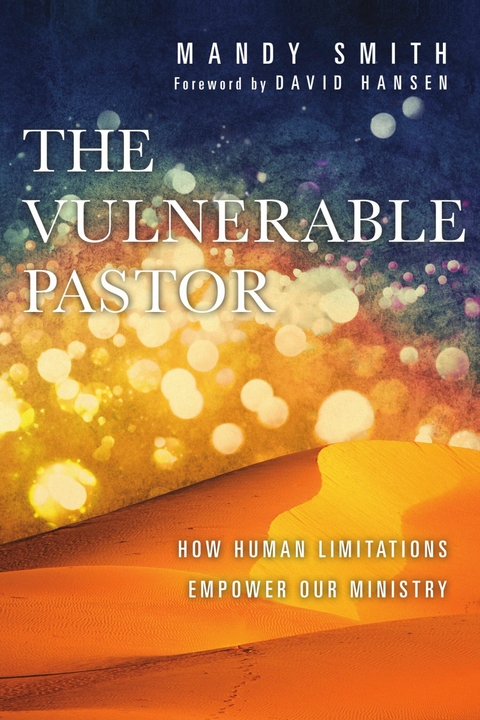
The Vulnerable Pastor (eBook)
208 Seiten
IVP (Verlag)
978-0-8308-9887-9 (ISBN)
Originally from Australia, Mandy Smith is lead pastor of University Christian Church, a campus and neighborhood congregation with its own fair-trade café in Cincinnati, Ohio. She is a regular contributor to Leadership Journal and PARSE and the author of Making a Mess and Meeting God. She is also the creator of The Collect, a citywide trash-to-art project. She and her husband live with their two children in a little house where the teapot is always warm.
Originally from Australia, Mandy Smith is lead pastor of University Christian Church, a campus and neighborhood congregation with its own fair-trade café in Cincinnati, Ohio. She is a regular contributor to Leadership Journal and PARSE and the author of Making a Mess and Meeting God. She is also the creator of The Collect, a citywide trash-to-art project. Mandy and her husband Jamie, a New Testament professor at Cincinnati Christian University, live with their two kids in a little house where the teapot is always warm. David Hansen is pastor of Heritage Community Church in Cincinnati, Ohio. He has also pastored in Montana, the setting for many of the stories in his book The Art of Pastoring: Ministry Without All the Answers (IVP). Hansen is also author of Loving the Church You Lead: Pastoring with Acceptance and Grace (Baker).In 1999, Hansen was awarded an honorary doctor of divinity degree from Gordon-Conwell Theological Seminary. He has been a contributing editor for Leadership Journal, and is a frequent speaker at pastoral ministry conferences.
Introduction
God Is an Odd Leader
Since being a pastor was impossible, I decided to do that. I prayed: “Lord, being a pastor is impossible, so if you will be with me all the way to help me, I will be a pastor.”
David Hansen, The Art of Pastoring
Our work as pastors is impossible. This is a fact many of us don’t learn until we’re well into it. In the beginning we see some intelligence, charm or talent in ourselves that makes us think we’re up for the challenge of ministry, but inevitably we find it’s not enough. We always will if we’re doing this work right, for we have been given an impossible task as imperfect beings representing a perfect God. Eventually we find that we have been called to something far beyond us. At some point we will be faced with a sadness too great for our hearts to carry, a question too heavy for our minds, a responsibility that crushes us. When we get there, what will we do? Walk away from a cruel God who would hand us an impossibility? Internalize it as our own failing? Blame everyone around us?
Maybe there’s another way. Maybe God gave us an impossible task for a greater purpose.
When we as leaders have an important message or a huge task, we pull out all the stops—lights, music, production. But over and over, when God has some serious business to take care of, he goes small and obscure. Throughout Scripture, when it’s time to cast a vision or start a movement, he begins with a child, a pauper or a stranger. He seems to see some kind of renewable resource in human emptiness, a power source in human weakness. Which leads him to make the very odd choice to call us to ministry.
If God’s effort to engage with humans were only about communicating ideas, he could do just fine without us. His linguistic skill outstrips anything we bring. But he sees potential in us to express his deepest heart. To tell his story, God often begins with human limitation—a blank canvas where he can begin creating.
Whether or not we talk about it, we’re aware of our own limitation. This is especially true when we’re faced with the challenges of ministry. We’re reminded every day how we’re not witty or educated or talented enough. And when we get that sinking feeling of knowing our own limitations, when we’re dragged down by the weight of our own emptiness, we want to do whatever we can to fix it. We desperately work harder, hoping that if we’re perfect this time it will all be okay. We wear ourselves out, trying to match some preconceived ideal. Or we keep ourselves busy or entertained so we don’t have to think about it. And if our own inner voices don’t hound us enough, our advertising culture is happy to tell us how to control the pain of our human condition—buy this product, this program, this book, and all our problems will go away.
In the end none of it helps us feel any better about our ability to fulfill our call to ministry. And the more desperate we feel, the more we try to mask how far in over our heads we are, hoping no one will be able to tell.
But this perpetuates the problem. In our efforts to project strength and success, we continue a cycle of unhealthy ideals, setting up unrealistic expectations for others, reproducing something hollow. When we hear only about the strengths and successes of others, it crushes us. And yet we crush others by presenting only our own strengths and successes.
It’s time for a new approach. God doesn’t need our perfection. He already has his own. He chooses us because we offer something different—humanity. To be what he needs, we can’t shy away from our intense experience of weakness. Our stories of human limitation are a kind of confession, and in them we are strangely empowered. When one person is willing to step into vulnerability, it disrupts forever the cycle that traps us, giving us permission to share our fears, creating a space for others to be human and for God to be God.
One of the most encouraging moments in my ministry was when Hayden, a seminary student who attends my church, said, “When I see how you do ministry, for the first time I see that I could do ministry.” The hope I saw in his eyes is what I want to share with others who may not feel they can do it. Because, ironically, the way I do ministry has grown out of a deep sense of my inability to do it. Hayden was not looking at my great skill, only at the way I have learned to laugh at my inadequacy and keep on working. We admit weakness not only to be free from the shame of our limitations but also to turn to a true source of power.
What discipline is required for the future leader to overcome the temptation of individual heroism? I would like to propose the discipline of confession.
Henri J. M. Nouwen1
Don’t get me wrong. I’m not naturally comfortable talking about vulnerability. I’m painfully aware that my writing is filled with first-person pronouns. I’d much rather talk about impersonal ideas. But confessions begin with “I.”
It began with confession to my congregation, with my need to break out of the silent shame of my limitations, trusting Bonhoeffer’s wisdom that when we confess to a fellow believer, we are no longer alone but we experience the presence of God in that person.2
And what do I confess? Not sin in the way we usually understand it. And yet it is a “falling short of the glory,” an unhealthy appetite of a different kind. I confess that I am vulnerable. Not simply that I feel vulnerable, but that I am inherently susceptible to weakness, inadequacy. And that in response I try to compensate, to be invincible, to be God. If it was their efforts to be like God that had Adam and Eve expelled from the garden, this is serious confession.
In confessing for my own sake, I’ve watched how it’s given grace to others, how it’s breaking a culture of performance, perfectionism and shame. And so although it’s uncomfortable, I’m happy to extend that confession to a broader community in the form of a book, albeit a book with a lot of the word “I.”
Another reason I’m uncomfortable talking about vulnerability is because the discussion naturally turns to issues of gender. In my conversations with women and minorities, I’ve seen the unique challenges we face. I don’t like to talk like a victim, but there are certainly many times when, directly and indirectly, I have been told my voice is less valid than others’—so finding it has taken more grace and courage than you might think. We could say that the history of marginalization reflects the failure of those in power, yet it doesn’t stop the marginalized from feeling like failures. It’s hard for anyone to admit weakness. It’s even harder for the marginalized as they work to be taken seriously in a world not their own.
While the marginalized are figuring that out, those of us in leadership feel the added pressure of an audience. While I don’t have a chip on my shoulder, as the only female lead pastor in my fellowship of some six thousand churches, I feel the pressure to be perfect.3 Even as I ask myself, Can I do this? I know there are many watching me who are also asking, Can she do this? They’re assessing my attitude, the success of my church, the power of my preaching—and even if it’s mostly with good intentions or curiosity, it puts pressure on me to be strong. So it’s even harder to admit how very much I’m weak.
I don’t want this to be “A Female Pastor’s Guide to Ministry,” but I am a female pastor. I realize the cliché—a woman writing a book about weakness and vulnerability. But I’m not naturally good at it. Everything in my education and culture has taught me to put on a good front, to work extra hard behind the scenes so that my performance is faultless. When you’re the first woman anything you have to be better at it to be taken seriously. Taking myself seriously worked for a while. But before long it was ludicrous. My only choice was to throw up my hands and laugh.
I can laugh because confessing inadequacy has taught me this: If feeling our own weakness makes us rely on God, and if the best ministry grows from reliance on him, then our weakness is a ministry resource. And we have an unlimited supply of this resource. With this approach, learning to embrace weakness has made me feel strangely invincible! The things that used to bring shame and fear now force me to tell those I lead, “Well, we’re just going to have to trust God because I’m so inadequate it’s funny!”
I’ll tell the story as it unfolded for me: first in a deeply personal place, then with my church leaders, then with the congregation, then with the broader world. Allowing the questions to begin in my own life meant I had to trust that I was not the only one asking them. Whether we’re talking about an individual’s experience or the experience of the billions who inhabit this earth, we’re talking about vulnerable human experience.
This question of what it means to be human is one of the most important questions we can ask. And important questions should be handled in important ways, which often means in detached, formal ways. I started there when I first asked this question, but my nice, detached ideas kept burrowing themselves back into their birthplace—my own life. Eventually I had to stop fighting and let them stay there, not because it’s comfortable asking important questions in a very personal way but because when the questions are about humanity, the investigation of them must be a human one. If we believe the same truth expresses...
| Erscheint lt. Verlag | 25.9.2015 |
|---|---|
| Vorwort | David Hansen |
| Verlagsort | Lisle |
| Sprache | englisch |
| Themenwelt | Religion / Theologie ► Christentum ► Kirchengeschichte |
| Religion / Theologie ► Christentum ► Moraltheologie / Sozialethik | |
| Religion / Theologie ► Christentum ► Pastoraltheologie | |
| Schlagworte | Christian • Church • church culture • church leader • Church Leadership • Emotions • Gender • Hope • Humanity • human scale • Humble • Leader • Leadership • Limitations • Pastor • Pastoral Care • Pastoral Ministry • pastoring • Peace • Power • Preaching • Strength • strong • sustainable ministry • Teaching • Transparency • vulnerability • Vulnerable • weak • Weakness • women in ministry |
| ISBN-10 | 0-8308-9887-5 / 0830898875 |
| ISBN-13 | 978-0-8308-9887-9 / 9780830898879 |
| Informationen gemäß Produktsicherheitsverordnung (GPSR) | |
| Haben Sie eine Frage zum Produkt? |
 EPUB (Wasserzeichen)
DRM: Digitales Wasserzeichen
Dieses eBook enthält ein digitales Wasserzeichen und ist damit für Sie personalisiert. Bei einer missbräuchlichen Weitergabe des eBooks an Dritte ist eine Rückverfolgung an die Quelle möglich.
Dateiformat: EPUB (Electronic Publication)
EPUB ist ein offener Standard für eBooks und eignet sich besonders zur Darstellung von Belletristik und Sachbüchern. Der Fließtext wird dynamisch an die Display- und Schriftgröße angepasst. Auch für mobile Lesegeräte ist EPUB daher gut geeignet.
Systemvoraussetzungen:
PC/Mac: Mit einem PC oder Mac können Sie dieses eBook lesen. Sie benötigen dafür die kostenlose Software Adobe Digital Editions.
eReader: Dieses eBook kann mit (fast) allen eBook-Readern gelesen werden. Mit dem amazon-Kindle ist es aber nicht kompatibel.
Smartphone/Tablet: Egal ob Apple oder Android, dieses eBook können Sie lesen. Sie benötigen dafür eine kostenlose App.
Geräteliste und zusätzliche Hinweise
Buying eBooks from abroad
For tax law reasons we can sell eBooks just within Germany and Switzerland. Regrettably we cannot fulfill eBook-orders from other countries.
aus dem Bereich