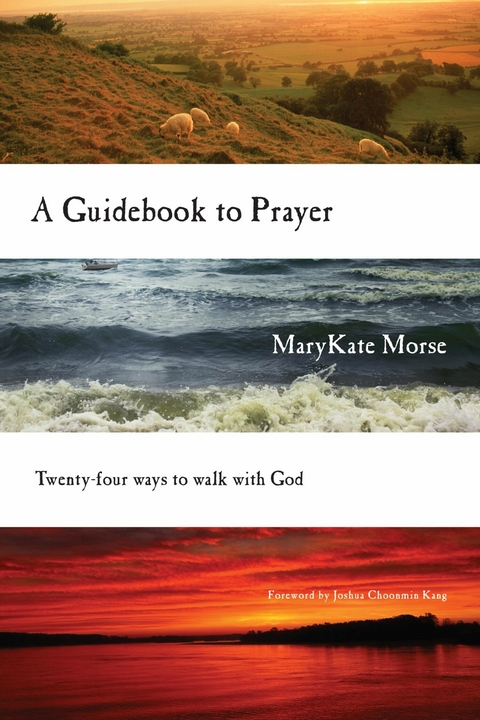
Guidebook to Prayer (eBook)
397 Seiten
InterVarsity Press (Verlag)
978-0-8308-6464-5 (ISBN)
MaryKate Morse is professor of leadership and spiritual formation at George Fox Evangelical Seminary in Portland, Oregon. She is a speaker, a retreat leader and a Friends pastor who has planted two churches with leadership teams. MaryKate also serves as a mentor and spiritual director to church and parachurch leaders.
Why is prayer so hard?Many of us have asked that question. We want to pray. We intend to pray. But, as spiritual director and professor MaryKate Morse notes, "e; we don't pray as consistently or as meaningfully as we might like."e;And yet prayer offers us such spiritual riches. Prayer- draws us to experience love and to be love- increases our faith- expands our vision of God- helps us grow in self-understanding- gives us perspective on life and deathMorse continues: "e;Through prayer, we experience forgiveness, guidance and peace. We are healed physically and emotionally. We experience the mystery of God, see truth and receive spiritual gifts. We receive vision and courage for God's mission. Faith becomes more beautiful, more real."e;This guidebook is designed to move you from lamenting over prayerlessness to the joy of praying. Whether you are a beginner or a lifetime person of faith, you will find a treasure trove of riches here to guide you into a deeper experience of prayer.Each chapter explores a different angle of prayer with sections focusing on each of the persons of the Trinity Father, Son and Holy Spirit. And each chapter offers specific ways to pray both on your own, with a partner or in a group. Sprinkled throughout are reflections from the author's former students describing on their own experience with these practices.A treasure trove of both resources and encouragement, you will find this book to be an indispensable guide to your life of prayer.
MaryKate Morse is professor of leadership and spiritual formation at George Fox Evangelical Seminary in Portland, Oregon. She is the author of Making Room for Leadership. She holds an M.A. in biblical studies and an M.Div. from Western Evangelical Seminary (now George Fox Evangelical Seminary), and her doctorate in leadership from Gonzaga University.In addition to teaching she also serves as a consultant to churches and organizations in transition or with leadership challenges. She has planted two churches with leadership teams in Portland, Oregon. Along with being a Quaker minister and a trained spiritual director, she also does conference and retreat ministries and mentors leaders. Joshua Choonmin Kang (ThM, Talbot School of Theology; MDiv, Azusa Pacific University) is founding pastor of New Life Vision Church in the Koreatown area of Los Angeles, California. He is a speaker and has written books such as Deep-Rooted in Christ and Scripture by Heart. Kang is also the author of thirty books in Korean, including God's Grace That Turns the Life Around, with over 1.5 million copies in print.
1
Community Prayer
The God revealed in the Christian Scripture is,
in essence, plurality in oneness: three persons in one being,
Father, Son, and Holy Spirit, all eternally bonded together in
the original community of oneness, in the embrace of the
interpersonal dynamics that the Bible describes best when it
summarily affirms that “God is love” (1 John 4:8, 16).
Gilbert Bilezikian
Insects crawl Fish swim Birds fly Humans pray.
Leonard Sweet
God as One in Community
When you meet people for the very first time, you immediately begin gathering impressions about them. Are they quiet? Outgoing? Content? Sad? If you were to open the Bible for the very first time and you knew nothing about God, you would meet the God of Genesis 1 and 2. In the beginning of Scripture, God is known as the Creator in Community. God creates out of nothing and makes it good. And God creates in community and for community. The very first way that we know God is that God made us and made us for connection.
Then God said, “Let us make humankind in our image, according to our likeness; and let them have dominion over the fish of the sea, and over the birds of the air, and over the cattle, and over all the wild animals of the earth, and over every creeping thing that creeps upon the earth.”
So God created humankind in his image, in the image of God he created them; male and female he created them. (Gen 1:26-27)
Then the LORD God said, “It is not good that the man should be alone; I will make him a helper as his partner.” (Gen 2:18)
Being made in the image of God, we are designed for relationship with our Maker and with each other. It is not good for us to be alone. God desires connection with us, and we desire connection with God and others. Prayer is the simplest and most intimate way in which we can connect to God. Because we are made in God’s image and God is manifested in the Trinity as God the Father, the Holy Spirit, and Jesus Christ, one in three Persons, we too are most alive and most true to ourselves when we are in community. C. Baxter Kruger, trinitarian theologian (and fishing lure designer) wrote this:
God is not some faceless, all-powerful abstraction. God is Father, Son and Spirit, existing in a passionate and joyous fellowship. . . . The Trinity is a circle of shared life, and the life shared is full, not empty, abounding and rich and beautiful, not lonely and sad and boring. The river begins right there, in the fellowship of the Trinity.1
A few years ago I asked my friend June (one of the women I call on Mother’s Day every year, a devoted Christ-follower, a professor of psychology and a counselor). “June,” I said, “can you put something in clinical terms for me?”
“Anything I can do,” she said—already laughing.
“How do you say, ‘when people hang out, they rub off on each other’ in clinical speak?”
“It looks something like this: In the natural and normal course of human interaction, attitudes and behaviors are mutually modified at both a high and a low level of awareness.”
That God seeks our friendship is astounding. It is indeed motivated by divine Love. It is our only hope of transformation on all levels.
—Wilson Parrish
Psychologists and social scientists have conclusively observed that the emotional attachment of a healthy, loving parent with his or her child results in a healthy, loving child. When we are unable to attach for whatever reason, our mental health is unstable and our outlook on the world and on ourselves is skewed. God is perfectly whole and loving, and when we relate to God our lives begin to resonate with God’s character and nature. When we pray with others, we become in tune to each other. In the Garden of Eden, God would walk and talk with Adam and Eve. They would visit each day. It was a completely natural and even ordinary relationship.
We are created to be in relationship with God and others, so we are always seeking stabilization with others. Our humanity is precisely this—that we are most human when we connect. God as our Creator is most able to provide a foundation of love and worth in the midst of life’s challenges when we connect regularly to God. In the same way that we greet our loved ones each day, we greet God. In the same way we call and check in, we connect to God. With prayer we are bonded to our Maker and Sustainer.
Before the fall, prayer was not called “prayer.” Adam and Eve walked and talked with God. They had conversation and time together. After the fall when our natural connection was broken, prayer became more occasional. The first mention of prayer after the fall is found in Genesis 4:26: “At that time people began to invoke the name of the Lord.” People in the Old Testament began to pray after the fall. Throughout the Old Testament there are many forms of prayer—daily routine prayers, desperation prayers, guidance prayers, celebration prayers and petition prayers. The most basic of prayers are the prayers done together in community, often called “liturgical” or written prayers.
The purposefulness of saying each word aloud, to God, stirred something I don’t know how to describe. I love listening to God, but speaking to him doesn’t come easily, and I don’t know why. Praying a liturgy of psalms aloud makes a difference for me. I feel more connected in my prayer time. The repetition allows the meaning of the words to soak in. I stay focused rather than let my thoughts stray. I want to keep praying like this and see how my relationship with God grows through it.
—Cheryl Flaim
Community Prayer
Worship in the Old Testament tradition involved saying prayers aloud in community, especially using the Psalms. Deuteronomy 11:13 describes the nature of prayer for the Jewish people: “If you will only heed his every commandment that I am commanding you today—loving the LORD your God, and serving him with all your heart and with all your soul.” To love and serve God with all your heart and soul meant to pray. It was called the avodah sheba-lev, service from the heart. The structure for prayer is called the Shemoneh Esrie, which consists of eighteen (later nineteen) blessings. The prayer structure contains the basics of prayer: praise, petition and thanksgiving.2
Prayer was a part of life experienced in worship and by praying three times a day. The prayers were a combination of written words that included Scripture verses and words that brought to remembrance God’s character and promises and the people’s covenantal response. Always there was a place for people to pray their own personal prayers during the recitation of the Shemoneh Esrie. Three times a day, morning, afternoon, and evening, Jewish people would stop to pray, men and women. There were extensive prayer versions and shorter ones to accommodate individuals’ prayer time frames.
It is not clear where the habit of praying three times a day originated. However, it probably corresponded with the temple sacrifices, which were offered three times a day, and it recognized the three patriarchs, Abraham, Isaac and Jacob. We also know that David and Daniel prayed three times a day. For us, it is clear that prayer is a regular way to connect with God and be reminded of God’s grace and goodness. It is a time to adore God and bring our concerns to God, and also for God to love us and respond to us.
Prayers were said standing, kneeling, lying flat on the ground, sitting or raising hands. Prayers were said in the temple or in one’s bedroom or by the roadside. Not many contemporary Christians have a habit of praying three times a day, but we can choose to have regular times to connect with God and others. Time, place and manner help create space for prayer. Another necessary element is attentiveness to God. Attentiveness is an awareness that we are in God’s presence, and God is in ours. The Jewish people call it kavanah, a proper concentration or focus. Simply put, it is a sincere desire to enter God’s presence. We give our attention to someone with whom we are talking. We focus on the person. In the same way, we focus on God.
I have always enjoyed praying Scripture aloud to God. It helps me form pictures in my mind that I may have never been able to conjure given all of the noise in my head or trouble in my heart. This was an especially trying week for me emotionally, so it was wonderful to have a set, structured way to approach God with some very powerful words of praise to him. I worked over each word in my mind and heart as I read them aloud, trying to focus on him. This prayer was very powerful for me.
—Michael Mahon
In the Jewish tradition, psalms are prayed aloud. The faithful stand as individuals together in worship and surrounded by all the faithful throughout time. There is a very present nature to prayer and also a timeless aspect. Those from the beginning and millions since David have prayed the psalms. And into the future, people will pray these prayers. Saying written prayers such as the psalms or prayers written by faithful men and women in the past has several advantages.
First, we become part of the great community of faithful from the Old Testament people to Jesus to today. We are not alone or isolated. We also become part of the community of faithful all around the world in every country and tongue. We might not understand their words, but when we say psalms together we are saying the...
| Erscheint lt. Verlag | 4.10.2013 |
|---|---|
| Vorwort | Joshua Choonmin Kang |
| Verlagsort | Lisle |
| Sprache | englisch |
| Themenwelt | Religion / Theologie ► Christentum ► Gebete / Lieder / Meditationen |
| Religion / Theologie ► Christentum ► Kirchengeschichte | |
| Religion / Theologie ► Christentum ► Moraltheologie / Sozialethik | |
| Schlagworte | Christian Life • God • Holy Spirit • Jesus • Prayer • prayer methods • Spiritual Formation • Trinity |
| ISBN-10 | 0-8308-6464-4 / 0830864644 |
| ISBN-13 | 978-0-8308-6464-5 / 9780830864645 |
| Informationen gemäß Produktsicherheitsverordnung (GPSR) | |
| Haben Sie eine Frage zum Produkt? |
 EPUB (Adobe DRM)
Kopierschutz: Adobe-DRM
Adobe-DRM ist ein Kopierschutz, der das eBook vor Mißbrauch schützen soll. Dabei wird das eBook bereits beim Download auf Ihre persönliche Adobe-ID autorisiert. Lesen können Sie das eBook dann nur auf den Geräten, welche ebenfalls auf Ihre Adobe-ID registriert sind.
Details zum Adobe-DRM
Dateiformat: EPUB (Electronic Publication)
EPUB ist ein offener Standard für eBooks und eignet sich besonders zur Darstellung von Belletristik und Sachbüchern. Der Fließtext wird dynamisch an die Display- und Schriftgröße angepasst. Auch für mobile Lesegeräte ist EPUB daher gut geeignet.
Systemvoraussetzungen:
PC/Mac: Mit einem PC oder Mac können Sie dieses eBook lesen. Sie benötigen eine
eReader: Dieses eBook kann mit (fast) allen eBook-Readern gelesen werden. Mit dem amazon-Kindle ist es aber nicht kompatibel.
Smartphone/Tablet: Egal ob Apple oder Android, dieses eBook können Sie lesen. Sie benötigen eine
Geräteliste und zusätzliche Hinweise
Buying eBooks from abroad
For tax law reasons we can sell eBooks just within Germany and Switzerland. Regrettably we cannot fulfill eBook-orders from other countries.
aus dem Bereich