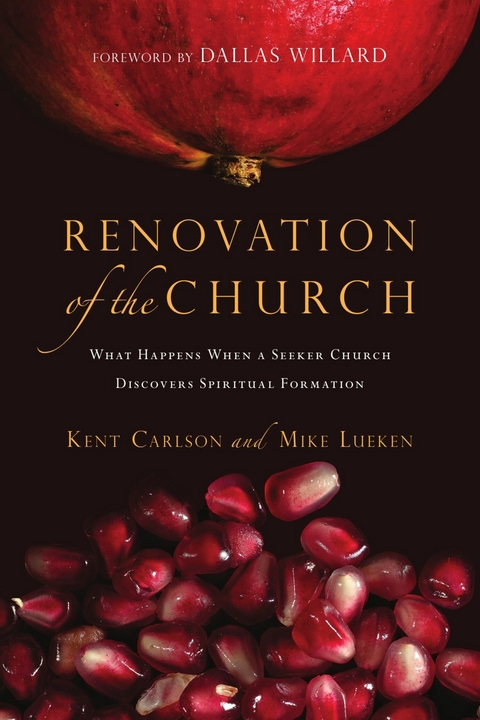
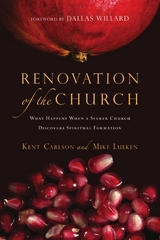
Renovation of the Church (eBook)
Kent Carlson founded Oak Hills Church of Folsom, California, in 1984. For the past thirteen years he has been co-senior pastor of the church with Mike Lueken. Mike and Kent are both graduates of Trinity Evangelical Divinity School. They each live with their families in the Sacramento, California, area.
Christianity Today Book Award winnerLeadership Journal Top Book of the YearCopastors Kent Carlson and Mike Lueken tell the story of how God took their thriving, consumer-oriented church and transformed it into a modest congregation of unformed believers committed to the growth of the spirit--even when it meant a decline in numbers. As Kent and Mike found out, a decade of major change is not easy on a church. Oak Hills Church, from the pastoral staff to the congregation, had to confront addiction to personal ambition, resist consumerism and reorient their lives around the teachings of Jesus. Their renewed focus on spiritual formation over numerical growth triggered major changes in the content of their sermons, the tenor of their worship services, and the reason for their outreach. They lost members. But the health and spiritual depth of their church today is a testimony of God's transforming work and enduring faithfulness to the people he loves. Honest and humble, this is Kent and Mike's story of a church they love, written to inspire and challenge other churches to let God rewrite their stories as well. Read it for the church you love.
Mike Lueken is copastor (with Kent Carlson) of Oak Hills Church of Folsom, California. He is a graduate of Trinity Evangelical Divinity School and lives with his family in the Sacramento, California, area. Dallas Willard (1935-2013) was a professor in the School of Philosophy at the University of Southern California in Los Angeles for over forty years. A highly influential author and teacher, Willard was as celebrated for his enduring writings on spiritual formation as he was for his scholarship. His books include The Divine Conspiracy (Christianity Today?s Book of the Year in 1998), The Spirit of the Disciplines, Hearing God, Renovation of the Heart and others. His books have received numerous Christianity Today Annual Book Awards and other recognitions.Willard served on the boards of the C. S. Lewis Foundation and Biola University, and was a member of numerous evaluation committees for the Western Association of Schools and Colleges. He received bachelor?s degrees from both Tennessee Temple College and Baylor University and a graduate degree at Baylor University, as well as a PhD from the University of Wisconsin in Philosophy and the History of Science. Kent Carlson is vice president of leadership formation for the North American Baptist Conference, shepherding the spiritual formation of pastors, regional ministers, and Christian leaders throughout the conference. He is also pastor emeritus of Oak Hills Church of Folsom, California, which he founded in 1984. Kent is a graduate of Trinity Evangelical Divinity School and lives with his family in the Sacramento, California, area.
Introduction
KENT CARLSON
“Hi there. We’re new to the area, and we’re looking for a new church home. We found your website and were wondering if you could answer a few questions about your church.” On the surface this begins a conversation repeated countless times every week in the religious life of North America. This family has a decision to make, and they are trying to make it in the only way they know how. They have a list of wants and desires that they hope a church can fulfill, and they are doing some comparison shopping. Out of the various churches in the area, they are trying to find the one that most closely aligns with them.
It’s a big deal for a family to find a church. It can be an unsettling time. The reasons for looking for a new church home varies from person to person. This may be a new beginning for them, and they may want to get involved in a church for the first time, perhaps in decades. They may be looking for a church that is similar to the one they came from. On the other hand, they may be coming out of a difficult church situation and are looking for one that is opposite of the church they left. They may be wondering if our church has a denominational affiliation or what style of worship we have. They may be interested in our youth or our children’s ministry. Their priorities may be doctrinal, political or simply practical (“Do you have an early service, because we like to take our boat out on the lake on Sundays?”). And sometimes they want to find out, although it is unlikely they will say it this way, if they can meet God here.
Underneath it all, though, there is something going on that makes all this rather complicated and messy, and, from our perspective, exposes some core difficulties about church life today. This family innocently approaches our church as consumers, and I, in turn, respond as a provider of religious goods. It is my job to present our various “products” in such a way that this family will be inclined to choose us over the religious offerings of the other churches in town. There is a weirdness to this. I’ve never gotten used to it. I know it is the way the game is played, and I have no ideal alternative as to how it might be played differently, but I can’t help but feel that there is something fundamentally flawed about the whole thing.
Eventually, someone looking for a church home will ask some variation of this question: “So, what kind of church are you?” Such an easy question to ask, but I don’t think it is a very easy question to answer. I don’t know how to describe a church in a short telephone conversation. Actually, I don’t think I know how to describe almost anything of substance in a short telephone conversation. It’s like someone asking me, “What kind of a family do you have?” How would I answer that? Would I talk about the house we live in, the cars we drive, the various things we have accomplished, the jobs we have, the investments we have made? I suspect not. I think I would begin by telling some of the stories of our family. I’d talk about some of the big moments, the tragedies, the celebrations, the milestones, the disappointments, the mistakes. I’d also tell some of the hilarious and absurd moments, as well as some of the quiet, poignant moments that can almost capture the heart of my family.
In a sense, that is what Mike and I are trying to do in this book.
The Story of a Church
This book is a story about a church. It is written from the perspective of two pastors who have lived and struggled in the midst of it. We write not as theorists but as practitioners. We are telling this story not as historians but as “evangelists.” We write about good news, wonderful news. We write to inspire. To challenge. Perhaps even to incite a rebellion. We dream of another way of being the church. We dare to hope that this dream captures others as well.
We write for two reasons. First, in spite of wonderful stories of outward success and church growth, we believe that the church in North America is in serious trouble. We know there are voices in the church today who disagree with this assessment. Some even go so far as to point to the rise of the megachurch and other external successes as indicators of a robust Christianity on the move. We respectfully disagree.
If church leaders believe that the church in North America is healthy and is merely experiencing troubles that have typically plagued the church through the centuries, then they will gently tweak existing structures and programs, or perhaps simply add to what is already happening. In other words, if the patient is not sick, nobody will look for a cure. We believe the patient is indeed desperately sick and needs to recover from a religious system that places a premium on outward success. We add our voices to the growing number of those inside and outside the church who are calling for the church to be reformed. We Christian leaders have created the current religious system, or at least have been complicit in its flourishing, and we ought to feel a responsibility for the rather meager and impotent product that has resulted. An important and messy dialogue on these issues is required of us. This book is an attempt to lend our voices to that dialogue.
Yet in no way do we believe that we are getting everything right. Quite to the contrary, we spend many of our days wondering if we are getting anything right. Some days we find ourselves looking at our church as a laboratory, and we’re desperately trying to keep the laboratory open so we can keep the experiments in spiritual formation going. Some days, after another failed experiment leaves us with broken beakers and smudged faces in a smoke-filled room, we try to find the motivation to clean up the place and start over again. This book is not another success story. We’re not convinced we know how to do it. We offer neither a seven-step strategy to reform the church nor five key principles for success. We are simply dissatisfied with the state of the church in North America, repentant over our part in it and determined to find another way. This book is about that journey.
The second reason we are writing this book is less dramatic, but no less important for us: we hope this story will benefit the people of Oak Hills Church. When we unplugged from the high-octane, entrepreneurial, pragmatic, success-driven, attractional model of church growth, our church was plunged into a decade-long roller-coaster ride of excessive (at times) introspection, organizational upheaval, uncertainty, plummeting attendance and fractured relationships. Sadly, a certain percentage of this was due to our own mistakes and internal and philosophical angst. We struggled with how to restructure the DNA of our church without ruining the church in the proc-ess. It has been a costly journey. Well over a thousand people left our church for other churches in the area. Many of those people had poured years of work and resources into the ministry. It hurt to lose them. We know it harmed many of them as well.
The larger story though, and the one we want to emphasize here, is that many stayed and struggled with us. Many others joined us in the midst of this story. Others, wonderfully, have returned. We are thankful for all of them. We continue to dream together of doing church another way. In good times and bad, through seasons of confusion and clarity, hundreds of people have refused to give up and have demonstrated in countless ways their support, trust and belief that God was and is up to something. They have embraced the Benedictine vow of stability. They have pushed back at the cultural norm of viewing the church as consumers, a place to get their spiritual needs met. Their loyalty and long obedience in the same direction is a constant source of encouragement and a powerful motivator to stay faithful to our calling as pastors. We are extremely grateful for them. This story is largely their story, and we wanted to write it so that they would know the story and understand their place in it.
The Shape of the Book
The first three chapters of this book comprise a quick overview of the story of our church. This story is told with an emphasis on explaining the tumultuous transition that began around the year 2000. In truth, there is nothing that fascinating, or at least unique, about our church before this. We were riding the same religious and cultural wave that brought relative outward success to thousands of suburban churches during that time. But our story since then has been somewhat unique, and while it is still fresh in our minds, we want to tell it.
The greater portion of this book, though, is an attempt to take some of the larger, overarching themes and “learnings” we have stumbled upon and flesh them out in greater detail. Some of these themes overwhelmed us like flashes of lightening. Other themes snuck up on us gradually, and only after the fact, upon careful reflection, have we noticed their power and influence on us. Regardless, these have become some of the core values that brought about and shaped our church in the past decade. While this section of the book will be more objective and propositional, we hope you will be able to see the intricate connection these themes have with our story.
There is something else you should know. Relentless authenticity is a huge value at Oak Hills. We are aware that this does not make us at all unique. In fact, you would have to search pretty diligently to find a church that didn’t say it values authenticity these days. Yet we believe it is common for people to be more drawn to the concept of authenticity than the thing itself. There remain many in our world who do not...
| Erscheint lt. Verlag | 21.11.2013 |
|---|---|
| Vorwort | Dallas Willard |
| Verlagsort | Lisle |
| Sprache | englisch |
| Themenwelt | Religion / Theologie ► Christentum ► Kirchengeschichte |
| Religion / Theologie ► Christentum ► Moraltheologie / Sozialethik | |
| Religion / Theologie ► Christentum ► Pastoraltheologie | |
| Schlagworte | Christian Church • Christian ministry • christian resources • Church • church ministry • church resources • ministry • ministry resources • Pastor • Pastoral Resources |
| ISBN-10 | 0-8308-6858-5 / 0830868585 |
| ISBN-13 | 978-0-8308-6858-2 / 9780830868582 |
| Informationen gemäß Produktsicherheitsverordnung (GPSR) | |
| Haben Sie eine Frage zum Produkt? |
 EPUB (Adobe DRM)
Kopierschutz: Adobe-DRM
Adobe-DRM ist ein Kopierschutz, der das eBook vor Mißbrauch schützen soll. Dabei wird das eBook bereits beim Download auf Ihre persönliche Adobe-ID autorisiert. Lesen können Sie das eBook dann nur auf den Geräten, welche ebenfalls auf Ihre Adobe-ID registriert sind.
Details zum Adobe-DRM
Dateiformat: EPUB (Electronic Publication)
EPUB ist ein offener Standard für eBooks und eignet sich besonders zur Darstellung von Belletristik und Sachbüchern. Der Fließtext wird dynamisch an die Display- und Schriftgröße angepasst. Auch für mobile Lesegeräte ist EPUB daher gut geeignet.
Systemvoraussetzungen:
PC/Mac: Mit einem PC oder Mac können Sie dieses eBook lesen. Sie benötigen eine
eReader: Dieses eBook kann mit (fast) allen eBook-Readern gelesen werden. Mit dem amazon-Kindle ist es aber nicht kompatibel.
Smartphone/Tablet: Egal ob Apple oder Android, dieses eBook können Sie lesen. Sie benötigen eine
Geräteliste und zusätzliche Hinweise
Buying eBooks from abroad
For tax law reasons we can sell eBooks just within Germany and Switzerland. Regrettably we cannot fulfill eBook-orders from other countries.
aus dem Bereich