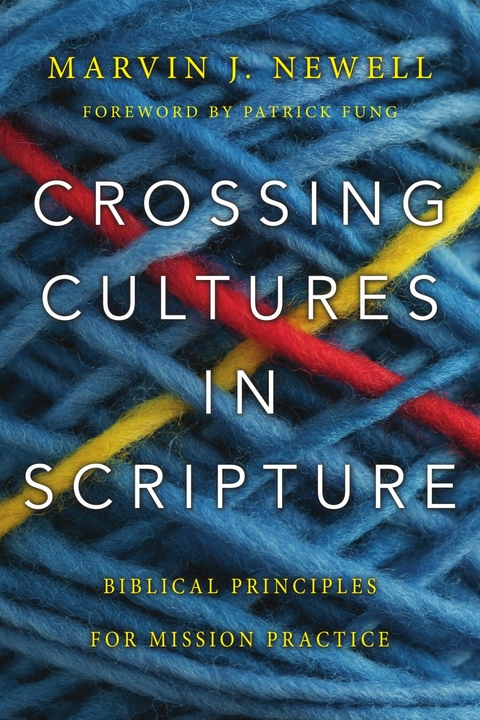
Crossing Cultures in Scripture (eBook)
InterVarsity Press (Verlag)
978-0-8308-7333-3 (ISBN)
Marvin J. Newell (DMiss, Trinity Evangelical Divinity School) is senior vice president of Missio Nexus, a network of evangelical mission agencies, churches and training centers in North America. He served as a missionary in East and Southeast Asia for two decades and was professor and chair of the intercultural studies program at Moody Theological Seminary. His books include Commissioned and A Martyr's Grace.
- 14th Annual Outreach Magazine Resource of the Year, Cross-Cultural CategoryFrom Genesis to Revelation, the Bible is a crosscultural book. Scripture is full of narratives of God's people crossing cultures in pursuit of God's mission. Biblical texts shed light on mission dynamics: Sarah and Hagar functioning in an honor-shame culture, Moses as a multicultural leader, Ruth as a crosscultural conversion, David and Uriah illustrating power distance, the queen of Sheba as an international truth-seeker, Daniel as a transnational student, Paul in Athens as a model of contextualization, and much more.Missionary and missions professor Marvin Newell provides a biblical theology of culture and mission, mining the depths of Scripture to tease out missiological insights and crosscultural perspectives. Unlike other such books that are organized topically, this text is organized canonically, revealing how the whole of Scripture speaks to contemporary mission realities.Comprehensive in scope, filled with biblical insight and missional expertise, this book is an essential resource for students and practitioners of crosscultural ministry and mission.
Marvin J. Newell (DMiss, Trinity Evangelical Divinity School) is senior vice president of Missio Nexus, a network of evangelical mission agencies, churches and training centers in North America. Previously, he was the executive director of CrossGlobal Link (formerly IFMA) and he served with TEAM as a missionary to Indonesia for twenty-one years and then as the Asia-Pacific regional director. Following that he was professor of missions and intercultural studies at the Moody Theological Seminary in Chicago. He is the author of A Martyr?s Grace, Commissioned: What Jesus Wants You to Know as You Go and Expect Great Things: Mission Quotes that Inform and Inspire.
2
Eden
The Beginning of Human Culture
GENESIS 1:26-27
Then God said, “Let us make man in our image, after our likeness. And let them have dominion over the fish of the sea and over the birds of the heavens and over the livestock and over all the earth and over every creeping thing that creeps on the earth.” So God created man in his image, in the image of God he created him; male and female he created them.
In our day, there is much confusion and a plethora of wrong assumptions about the origin of human culture. Secular anthropologists would have us believe that as humankind evolved, more complex and developed cultures emerged. Therefore, cultural origins developed as humans evolved from their primate state into humanness. As humans continued in developmental ascent, they experienced progressive cultural ascent as well. This is the prevailing view of the majority of secularists, who would dismiss any reference to God in cultural consideration.
But that view is a far cry from what Scripture tells us about culture. For those who take the Bible seriously, it isn’t difficult to discover the divine account of the origin of human culture. The book of Genesis is the book of origins. Explanation for the beginning of everything in the universe is found there—including humankind and culture.
Since, as we have already seen, culture is innate to human beings, and since there has never been a person who didn’t possess culture, human culture had to have been an integral part of Adam and Eve’s created makeup. But a question arises: “How is that so? How was culture ingrained in humankind’s first parents? How is it that culture was part of Adam from the very moment he was created?” We don’t need to look far in Scripture to discover how that came about. Genesis 1:26-27 gives us the answer.
THE PLURALITY OF GOD
Considering the plurality in the nature of God is the place to start, and God’s plurality is unmistakable in this passage. It is first evident in the word used for God. In these two verses, Moses, the writer, refers to God with the name Elohim three times. Elohim is a plural form of the word for “God.” Moses wanted the reader to know a basic truth about God’s personhood, and that truth would eventually develop through Scripture into the fuller doctrine of the Trinity. He wanted his readers to know that God is one, yet there is plurality in his oneness.
A second evidence of God’s plurality comes from the phrases “let us make man in our image, after our likeness” (Gen 1:26). Again, these phrases are striking because of their reference to a divine plurality by the repeated use of the personal plural pronouns “us” and “our.” The prestigious position of humans over the previously described created order can’t be missed (Gen 1:1-25). The creation of humankind is of such importance that Moses portrays God as conferring in his plurality about this final and crowning creative act.
Although it defies full explanation, the plural unity of God is revealed throughout the Bible. Biblically based Christianity is unique in this view of monotheism. It sees God as a plural unity consisting of three distinct persons, yet one. Although it’s a complex doctrine to understand, its origins come from Scripture, beginning with the very first verse at Genesis 1:1, where God is mentioned in the plural (Elohim) at the very outset of his creative work.
“So,” you might wonder, “how does the plurality of God relate to the beginning of human culture?” The answer is that the origin of human culture is embedded in the reality of God’s plurality by strong inference. God, who created humankind, is a plural unity comprising three distinct persons; therefore, it follows that there must exist a relationship among the three personalities in order for them to function perfectly in a community of unity. This relationship would comprise what can be considered a divine culture between them.
In the previous chapter, it was stated that human culture comprises the distinctive beliefs, values, and customs of a particular group of people that determine how they think, feel, and behave. Now, it would be presumptuous to think that, within his nature, God as plural unity must also contain distinctive beliefs, customs, and values. He is so utterly other from humans that we dare not limit him to those traits. But since a perfectly functioning relationship exists between the members of the godhead in a divine culture, it can be said that God had the capacity to bequeath culture upon humankind at the moment he created Adam.
FROM CAPACITY TO ACTUALITY
But just because God had the capacity to bequeath culture on humankind, how do we know that he did? As we look again at Genesis 1:26, it becomes clear. The double modifying phrase “in our image, after our likeness” signifies that he did. These two phrases aim to assert with emphasis that humans are closely patterned after their maker. The first word, “image,” has the root meaning “to carve” or “to cut from.” The second word, “likeness,” refers to “similarity.”1 These two conjoining phrases are used, among other things, to show that a God who himself possessed culture created humankind with it as well.2
It can be asserted that the unseen spiritual and inner side of the image of God that was bestowed on humankind’s spirit, or immaterial part, included a degree of culture. God not only had the capacity in and of himself in keeping with his nature to impart culture to humans, but he also actually did it. He did it when he created humankind in his image and likeness. Humankind was endowed with a free, self-conscious personality, a creaturely copy of the divine life. This included a cultural component.
CULTURE AT ITS BEST AND ITS DETERIORATION
As a result of this divine act, it can be inferred that in their perfect, pre-fallen state, Adam and Eve lived in a harmonious, unadulterated culture (its highest form). Since their minds were permeated with truth, they had perfect beliefs. Since their pattern for living was modeled after God’s, they practiced perfect values. And since they knew no evil, they exhibited perfect customs. Theirs was an unimaginably rich, full, and satisfying culture at its very finest. It was absolutely perfect! No humans since then have experienced the high degree of cultural perfection that Adam and Eve lived and practiced. The zenith of cultural perfection was theirs.
The Christian diagnosis of humanity’s fatal flaw is radical. Sin has alienated us from God and we cannot put it right ourselves. But the solution is equally radical. God in Christ has taken the burden of sin upon himself on the cross, so that through repentance and faith in Christ we can receive a new, supernatural life as an unmerited gift.
AGAINST THE FLOW
But subsequently, humankind’s concrete essence of divine likeness was shattered by sin. Genesis 3 relays how this tragic degradation came about. Adam and Eve’s fall from perfection included a cultural degeneration and its subsequent sliding deterioration. Humankind’s perfect, divinely given culture was shattered. This was by far the most far-reaching crossing of cultures in the history of humankind, and one from which Adam never recovered. It affected him physically, mentally, spiritually, and psychologically.
Perhaps up to 800 years3 of Adam’s 930 (Gen 5:5) were spent watching human culture deteriorate from the perfection that he and Eve once enjoyed. He experienced the heartbreak of a murdered son and of another being a castaway (Gen 4:15-16). His heart was grieved as he witnessed his descendants sliding deeper into a culture of “sexual immorality, impurity, sensuality, idolatry, sorcery, enmity, strife, jealousy, fits of anger, rivalries, dissensions, divisions, envy, drunkenness, orgies” (Gal 5:19-21). What a contrast to that perfect pre-sin wholesome culture of “love, joy, peace, patience, kindness, goodness, faithfulness, gentleness, self-control” (Gal 5:22-23)!
Consequently, perhaps the saddest omission in all of Scripture is found in Hebrews 11:4, where the writer begins his historical lineage of people of faith, not with Adam, whom we would have expected to be mentioned first, but with his son Abel. In his honesty, the writer had to pass over the first generation of humankind and move on to the second. Could it be that Adam’s resultant disheartened mood and depressed state of mind after losing his unspoiled culture disqualified him as an example of a person of faith?
Regardless of the impact on Adam and Eve themselves, their sin had universal consequences. By their act of disobedience, all of human culture has become corrupt and has been in decline ever since. There is no place on earth (“under heaven”) or any society anywhere (“given among men”) where this is not the case (Acts 4:12). The myth of the “noble savage” tucked away somewhere in a remote corner of the earth, enjoying some kind of social utopia, is just that—a myth. Humankind’s cultural degradation is universal and comprehensive.
I witnessed this firsthand during my fifteen years of ministry on the island of Papua, Indonesia. During those years, I never encountered people of a newly reached tribal group (several of which our mission pioneered) who were not anxious to free themselves from their degraded cultural practices. The light of the gospel brought them hope. It redeemed not only the individuals but also their community’s beliefs, values,...
| Erscheint lt. Verlag | 2.10.2016 |
|---|---|
| Vorwort | Patrick Fung |
| Verlagsort | Lisle |
| Sprache | englisch |
| Themenwelt | Religion / Theologie ► Christentum ► Kirchengeschichte |
| Schlagworte | becoming bicultural • beginning of cultural diversity • being a cultural minority • Bible • contextualization • contextualization of message • contextualization of messenger • contrasting worldviews • crosscultural • cross-cultural human trafficking • crosscultural ministry • crosscultural missionary • Cultural genocide • Ethnocentrism • Honor • Missiology • Mission • Missionary • missions • Origin of human culture • Scripture • Shame • Theology of Culture |
| ISBN-10 | 0-8308-7333-3 / 0830873333 |
| ISBN-13 | 978-0-8308-7333-3 / 9780830873333 |
| Informationen gemäß Produktsicherheitsverordnung (GPSR) | |
| Haben Sie eine Frage zum Produkt? |
 EPUB (Adobe DRM)
Kopierschutz: Adobe-DRM
Adobe-DRM ist ein Kopierschutz, der das eBook vor Mißbrauch schützen soll. Dabei wird das eBook bereits beim Download auf Ihre persönliche Adobe-ID autorisiert. Lesen können Sie das eBook dann nur auf den Geräten, welche ebenfalls auf Ihre Adobe-ID registriert sind.
Details zum Adobe-DRM
Dateiformat: EPUB (Electronic Publication)
EPUB ist ein offener Standard für eBooks und eignet sich besonders zur Darstellung von Belletristik und Sachbüchern. Der Fließtext wird dynamisch an die Display- und Schriftgröße angepasst. Auch für mobile Lesegeräte ist EPUB daher gut geeignet.
Systemvoraussetzungen:
PC/Mac: Mit einem PC oder Mac können Sie dieses eBook lesen. Sie benötigen eine
eReader: Dieses eBook kann mit (fast) allen eBook-Readern gelesen werden. Mit dem amazon-Kindle ist es aber nicht kompatibel.
Smartphone/Tablet: Egal ob Apple oder Android, dieses eBook können Sie lesen. Sie benötigen eine
Geräteliste und zusätzliche Hinweise
Buying eBooks from abroad
For tax law reasons we can sell eBooks just within Germany and Switzerland. Regrettably we cannot fulfill eBook-orders from other countries.
aus dem Bereich