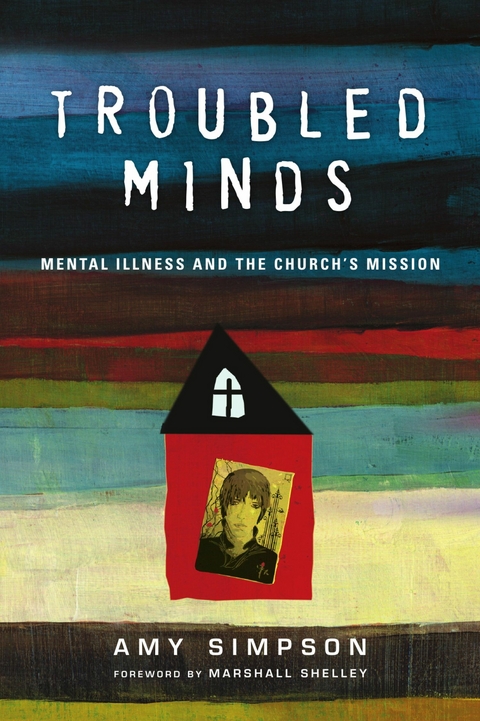
Troubled Minds (eBook)
222 Seiten
IVP (Verlag)
978-0-8308-8432-2 (ISBN)
Formerly vice president of the church ministry media group at Christianity Today, Amy Simpson is currently editor of GiftedForLeadership.com and managing editor of marriage and parenting resources for Today's Christian Woman. She is the author of Into the Word: How to Get the Most from Your Bible (NavPress, 2008).
Amy Simpson (MBA, University of Colorado) is a passionate leader and communicator who loves to encourage Christ?s church and its people to discern and fulfill their calling in this life. Amy is a former publishing executive who currently serves as editor of Christianity Today?s Gifted for Leadership and senior editor of Leadership Journal. She is also a personal and professional Co-Active coach. She has spent nearly two decades as an award-winning writer, authoring numerous resources for Christian ministry, including Diving Deep: Experiencing Jesus Through Spiritual Disciplines, In the Word: Bible Study Basics for Youth Ministry, Into the Word: How to Get the Most from Your Bible and Troubled Minds: Mental Illness and the Church's Mission. She has published articles with Christianity Today, Leadership Journal, Today?s Christian Woman, Christian Singles, Group magazine, Relevant, Her.meneutics, and others. She has worked for Tyndale House Publishers, Group Publishing, Gospel Light, Standard Publishing, LifeWay, Focus on the Family, and Christianity Today.Amy holds an English degree from Trinity International University and an MBA from the University of Colorado. She is deeply in love with her incredible husband, Trevor, and extremely proud of her two fantastic kids. She lives with these wonderful people in Illinois, where she is committed to using the gifts God has given her in work that changes the world.Visit Amy's website at www.amysimpsononline.com or follow her on Twitter at @aresimpson.
Introduction
You’re writing a book about ministry to people with mental illness?”
“Yes, I am.”
“Thank you so much for writing on this topic. The church really needs a book like that. . . . Can I tell you my own story?”
As I wrote this book, I had countless conversations like this. Nearly everyone I spoke with about the project had a story to share about their journey through mental illness or their walk alongside a loved one who suffered short-term or lifelong emotional or cognitive anguish.
There was the gentle woman who told me her husband has suffered with early-onset dementia for decades, turning their marriage into a long test of her faithfulness and self-sacrifice in caring for him. The friend who told me his easygoing demeanor masks an internal storm of anxiety and adrenaline surges he must control with medication. The man whose depression, untreated for years because of his church’s condemnation, brought him to a point where he couldn’t get out of bed and had to “risk God’s rejection” by seeking treatment. Another man who had spent twenty-five years aching to relieve the anguish of his wife’s depression. A father who had lost his twenty-something son to suicide after more than a decade of living with bipolar disorder. A woman who struggles to raise her children in the shadow of her parents’ disorders. Parents of children debilitated by illness. People whose childhoods were disrupted by their ill parents’ inability to give them the stable, loving homes they needed. Coworkers, friends, casual acquaintances. Strangers who contacted me after they read a magazine article I wrote. My own family, for whom this book served as a catalyst for healing conversations we had not yet had. People who are getting by with a gritty mix of vulnerability and fortitude, despair and hope, fear and faith. All shared with me stories they had kept mostly secret, some of them for decades.
Why? Because I’ve also suffered in the shadow of mental illness, and I was finally talking about it. Because what hurting people need, perhaps most of all, is to know that they are not alone, that someone else will hear their story and will love them just as much after they tell it. They need to know that their pain does not mean God has turned his back on them.
The suffering of mental illness, whether for the afflicted or for their families, is typically marked by isolation. When people desperately need to experience the love and empathy of their fellow human beings and to know that their Creator has not abandoned them, many reach out and are shocked to touch the church’s painfully cold shoulder. Others fear the church’s rejection enough to hide their struggles and not risk exposure at all.
Throughout the writing process, I’ve been encouraged to hear from many people about their experiences. It’s uplifting for me to feel the support of others who have walked a similar road. It’s invaluable to receive some confirmation that my writing project will connect with the experiences of many others. And it is heartbreaking reinforcement that the church needs this book.
Most people don’t spend much time thinking about mental illness. Some have a vague sense that such illness is mostly confined to some kind of “institute” on the edge of town, where a doctor with a German accent analyzes the dreams of straitjacketed “crazy” people in padded rooms. Some assume that mental illness exists purely in the spiritual realm, believing it is a symptom of demon possession or weak faith. Others are confronted with the feral glances and paranoid mutterings of people on the street and quickly turn away, feeling helpless to make a difference and momentarily wondering whether anything can be done to help such people. They fear the behavior and afflictions of people they don’t understand, so they dismiss mental illness as something that probably won’t touch them.
Most people don’t think about the mental health of their neighbors and friends, and people sitting next to them at church on Sunday morning. But the truth is, mental illness is everywhere. The statistics tell us that virtually everyone has been affected by it to some degree—some through their own illness and more of us through the challenge of relating to someone with a disorder.
Our society is growing dramatically in its acceptance of mental illness and its openness to discuss mental health publicly. Each year, the US Congress sanctions Mental Illness Awareness Week in October and Mental Health Month in May. In the news, we hear from a small but growing stream of celebrities who are willing to alter their public images with confessions of their own struggles with mental illness, in the name of making it easier for other people to get the help they need. Lawmakers and insurance companies are removing the discriminatory practices that have left so many people in the noman’s land of insurance coverage with no diagnosis, no access to the care they need for treatable conditions and no hope of financial stability. Even Hollywood is treating mental illness with more accuracy and sensitivity.
Should the church be the last holdout in this movement toward grace? Should we be the ones clinging to old, fear-based beliefs that keep us convinced that people with mental illness should be isolated, shamed and silent—that their burdens are too great for the church to bear, their diagnoses too dire for the hope of Christ?
The church can and should be at the forefront of this move toward loving acceptance and open support for those with mental illness. In the words of the apostle Paul, “God has put the body together such that extra honor and care are given to those parts that have less dignity. This makes for harmony among the members, so that all the members care for each other. If one part suffers, all the parts suffer with it, and if one part is honored, all the parts are glad” (1 Cor 12:24-26). Does this passage describe your church’s approach to those among you who “have less dignity,” those who are suffering?
The church can make a difference. The darkness is deep enough that even a tiny light can help someone find the way out. I spoke with one man who was hospitalized during an episode of severe depression as a young man. He said,
I was sitting in the hospital and praying that someone would visit me. A few minutes after that, Dad showed up, and he had the pastor of our church with him. I was terrified of what he thought of me. Was he going to just pray with me? Was he going to lay his hands on me and make me happy? I had never really talked to him that much; I always just listened to him in church. The pastor told me that he and the church were praying, and I said, “What? You mean they are praying for me?”
He said yes. And my father was nodding his head. Somehow the stigma came right out. I was going to say, “Please don’t do that,” and was getting ready to cry and beg them not to tell anyone. Then I looked over at another patient, my suite-mate on the ward, who was sitting in the corner ranting and raving to some imaginary person. It hit me: I have more than he does! I have a church praying for me!
If you’re intrigued, hopeful, intimidated or overwhelmed, read on. You’ll read about my family’s experience in navigating the ongoing challenge of serious mental illness. You might be shocked to learn how common mental illness is. You’ll hear from many people who can’t afford not to think about mental illness, and you’ll begin to understand something about the hardships they face. I hope you’ll be grieved to read about the experiences of people both outside and inside the church. You’ll read stories of people just like the ones in your own church, and you’ll learn how you can help them. And you’ll have the opportunity to consider why such ministry matters to God.
This is not a clinical work or an academic tome. It’s not a gripe session or a tirade against the church. It’s a book that the church needs because of both its practicality and its stories. It’s filled with personal stories of those affected by mental illness, as well as helpful information about mental illness and how it is treated in the church.
The church allows people to suffer because we don’t understand what they need and how to help them. We have taken our cue from the world around us and ignored, marginalized and laughed at the mentally ill or simply sent them to the professionals and washed our hands of them. This book will help you understand the prevalence of mental illness and the suffering it causes. But more important, it will help you understand the secondary suffering of the mentally ill within the church because of the church’s response to them.
I recognize that each person’s experiences and perspectives are unique, and my experiences and insights don’t reflect the totality of experience with mental illness in the church. In this book I’ve attempted to capture a general sense of many people’s reality, along with sharing my family’s experience, to offer some insight into the challenge of ministry to people with mental illness. I hope you’ll find that the pages of this book are filled with honesty and yet overflow with grace for both those directly affected by mental illness and those called to help suffering people in the context of the church.
In this book, you’ll also find a heavy dose of hope. This hope is not based in what the church can do or in the efforts of a few committed and hard-working individuals. It is based in the power and grace of Christ, who is always with us and who will not allow anything to separate us from his love....
| Erscheint lt. Verlag | 6.3.2013 |
|---|---|
| Vorwort | Marshall Shelley |
| Verlagsort | Lisle |
| Sprache | englisch |
| Themenwelt | Geisteswissenschaften ► Psychologie |
| Religion / Theologie ► Christentum ► Kirchengeschichte | |
| Religion / Theologie ► Christentum ► Moraltheologie / Sozialethik | |
| Religion / Theologie ► Christentum ► Pastoraltheologie | |
| Schlagworte | Abnormal Psychology • Anxiety • Bible • Bipolar • body of Christ • brain • Care • Christian • Church • Comfort • Community Support • Darkness Is My Only Companion • depressed • Depression • disorder • Grace for the Afflicted • Help • Mental Health • mental health ministry • mental health stigma • Mental Illness • Mental illness in the church • mental illness ministry • Mental Illness Stigma • Mind • Psychological Disorder • Recovery • Schizophrenia • Schizophrenic • social issues • Spiritual comfort • struggle • Support • UNITY |
| ISBN-10 | 0-8308-8432-7 / 0830884327 |
| ISBN-13 | 978-0-8308-8432-2 / 9780830884322 |
| Informationen gemäß Produktsicherheitsverordnung (GPSR) | |
| Haben Sie eine Frage zum Produkt? |
 EPUB (Wasserzeichen)
DRM: Digitales Wasserzeichen
Dieses eBook enthält ein digitales Wasserzeichen und ist damit für Sie personalisiert. Bei einer missbräuchlichen Weitergabe des eBooks an Dritte ist eine Rückverfolgung an die Quelle möglich.
Dateiformat: EPUB (Electronic Publication)
EPUB ist ein offener Standard für eBooks und eignet sich besonders zur Darstellung von Belletristik und Sachbüchern. Der Fließtext wird dynamisch an die Display- und Schriftgröße angepasst. Auch für mobile Lesegeräte ist EPUB daher gut geeignet.
Systemvoraussetzungen:
PC/Mac: Mit einem PC oder Mac können Sie dieses eBook lesen. Sie benötigen dafür die kostenlose Software Adobe Digital Editions.
eReader: Dieses eBook kann mit (fast) allen eBook-Readern gelesen werden. Mit dem amazon-Kindle ist es aber nicht kompatibel.
Smartphone/Tablet: Egal ob Apple oder Android, dieses eBook können Sie lesen. Sie benötigen dafür eine kostenlose App.
Geräteliste und zusätzliche Hinweise
Buying eBooks from abroad
For tax law reasons we can sell eBooks just within Germany and Switzerland. Regrettably we cannot fulfill eBook-orders from other countries.
aus dem Bereich