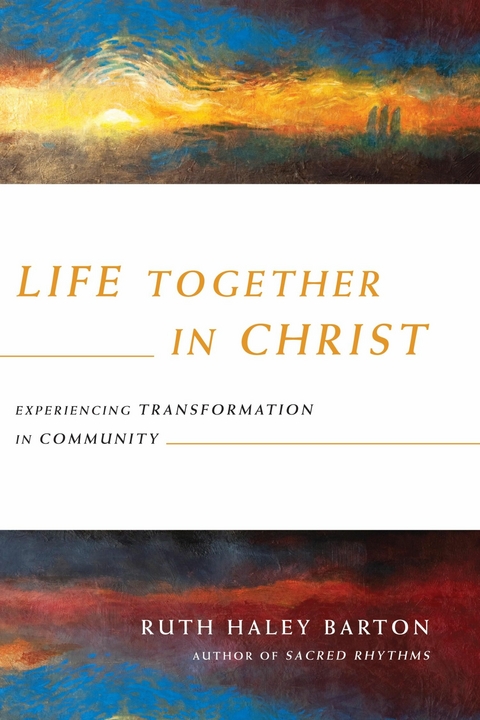
Life Together in Christ (eBook)
192 Seiten
IVP Formatio (Verlag)
978-0-8308-9638-7 (ISBN)
Ruth Haley Barton is a teacher, spiritual director, retreat leader and author. She is cofounder and president of The Transforming Center (www.thetransformingcenter.org), a ministry dedicated to caring for the souls of pastors. Ruth has ministered in several congregations, including Willow Creek Community Church. Her other books include Sacred Rhythms and Invitation to Solitude and Silence (both InterVarsity Press). This book was previously published by Waterbrook under the title The Truths That Free Us.
Ruth Haley Barton (DD, Northern Seminary) is founding president of the Transforming Center, a spiritual formation ministry to pastors and Christian leaders. A trained spiritual director (Shalem Institute for Spiritual Formation), teacher and retreat leader, she has served on the pastoral staff of several churches, including Willow Creek Community Church. A sought-after teacher, preacher and consultant to leadership teams, she is currently adjunct professor of spiritual transformation at Northern Seminary.Educated at Wheaton College, Northern Seminary and Loyola University Chicago Institute for Pastoral Studies, Ruth is the author of numerous books and resources on the spiritual life, including Invitation to Solitude and Silence, Sacred Rhythms, Longing for More and Strengthening the Soul of Your Leadership. She is also the author of an online resource titled eReflections, spiritual guidance via e-mail. She contributes regularly to Conversations: A Forum for Authentic Transformation.
1
BETWEEN THE NOW
AND THE NOT YET
Choosing to Walk Together
Now on that same day two of them were going to a
village called Emmaus, about seven miles from
Jerusalem, and talking with each other about
all these things that had happened . . .
Luke 24:13-14
What do you think of when you think of community? I’m serious. I want you to stop and think about what comes to your mind when you hear or see the word community. Do you see visions of backyard barbecues with adults talking and laughing easefully while children play in the yard? Earnest Christians sitting in well-appointed living rooms with coffee poured and Bibles open, searching the Scriptures? Do you see people caring for one another in times of crisis—meals brought when someone is sick, a pastor rushing to the bedside of a dying church member, childcare and other kinds of support offered when needed?
How about accountability groups where people confess their struggles with sin and check in with one another regularly about how it’s going? Or support groups gathering on the basis of affinity around issues like gender, marital status, life stage, various addictions or even a desire to lose weight? Maybe a community group of neighbors rallying together to lobby and raise money for improvements in their neighborhood or precinct?
Another possibility is that when you think of community you are flooded with painful memories—a church split you got caught up in, a small group that fell apart because of a disagreement or an unresolved conflict, a denomination that couldn’t resolve theological differences and splintered, a pastor who preached convincingly about community but then failed to live it out with his or her own community, a factious elder group or ministry board that stood publicly for Christian ideals but failed to practice them privately. Perhaps you have had a painful falling out with a close neighbor about a matter of shared concern, and even though you attempted to work things out, you are still in deep disagreement. Just living on the same street is now awkward and difficult—you find yourselves ducking quickly into your respective homes so as to avoid contact.
If any of these have been your experience, you may have quietly settled into a state of cynicism, going through the motions of being friendly in community contexts but knowing in the deep places of your heart that you have given up.
For Personal Reflection
What comes to your mind when you think of the word community? What experiences have shaped you?
When the Wish Dream Dies
The scenarios described above conjure up either pleasant or disturbing images of what can happen—the good, the bad and the ugly—when human beings come together on the basis of a shared cause or some kind of natural affinity. But clearly that’s not enough. While all of the experiences highlighted in the first two paragraphs can be wonderful and important aspects of community life, none of them capture what community really is.
It seems that one of the main reasons we are confused about community is that we make it primarily about us—our experiences and feelings, our natural affinities, our life situation, what we think we want or need, or some vision of what we’re going to accomplish together. We labor under the mistaken idea that we can create community through something we bring to the table—casting a compelling vision, developing the right curriculum or plan, choosing the latest, greatest Bible study guide, training and supporting small group leaders just so, coming up with good icebreaker questions, creating a “safe” environment—and then we are disappointed when things fall apart or relationships fail to satisfy.
Ironically, such experiences of disappointment seem to be necessary in order for us to learn what the essence of life together in Christ really is. In fact, German pastor and theologian Dietrich Bonhoeffer states boldly that the sooner our “wish dream” about what community should be is shattered, the better it is for everyone.
Innumerable times a whole Christian community has been broken down because it had sprung from a wish dream . . . but God’s grace speedily shatters such dreams. Just as surely as God desires to lead us to a knowledge of genuine Christian fellowship, so surely must we be overwhelmed by a great disillusionment with others, with Christians in general, and, if we are fortunate, with ourselves.1
I have to admit that my first impulse on reading this particular passage was a strong desire to throw the book against the wall. (Clearly, I was still a bit too attached to my wish dream.) But as I settled down, ruminated over it a bit more and endured a few more death blows to my own wish dreams, Bonhoeffer’s statements began to make sense. Christian community is not and never can be about us. When our dreams and convictions about what we think community should be are dashed against the jagged reef of human limitations and failure to live up to one another’s needs and expectations, then and only then are we ready to accept the fact that Christian community is not about us at all. It is about the transforming presence of Christ—all he will do in and through and for each of us.
In the end, the death of our wish dream is really an occasion for great hope. As Bonhoeffer goes on to say, “Thus the very hour of disillusionment with my brother [or sister] becomes incomparably salutary, because it so thoroughly teaches me that neither of us can live by our own words and deeds, but only by that one Word and Deed which really binds us together. . . . When the morning mists of dreams vanish, then dawns the bright day of Christian fellowship.”2
This is exactly where we find the two disciples on the road to Emmaus. Their “wish dream” about what life together with Christ was going to be like had vanished—violently ripped from them—and now a new day was dawning on a future they could not yet comprehend.
Between the Now and the Not Yet
The biblical account of this story begins with two dazed and distraught disciples traveling along the road from Jerusalem to Emmaus. It was Sunday, the third day of the most traumatic weekend of their lives, and they were on a roller coaster of emotion. On Friday these disciples along with many others had witnessed the painful, humiliating and violent death of their beloved leader, teacher and friend. That night and through the day on Saturday they sat with each other in utter despair. And now, on this day, a glimmer of hope had been introduced into the situation.
Some of the women in their group had visited the tomb in which their leader had been buried and found it empty. There was talk of resurrection, but it was too soon to tell whether it was a miracle or just a hoax of some sort. They had hung around in waiting mode as long as they could, and now it was time to get back to real life. Their dream of what the kingdom of God would look like as it had emerged from their little community, the hopes and dreams on which they had oriented the last three years of their lives, the vision that had caused them to give up fishing and tax collecting and the like in order to commit themselves to following Jesus—it was all gone. Each one who had been part of the community of Jesus now had to come to terms with life on the other side of the death of their wish dream. They had to figure out what to live for now that the vision that had brought order and purpose to their lives was no more.
Not knowing what else to do, Cleopas and an unnamed disciple were wandering home, trying to make sense of it all. They were suspended somewhere between loss and possible gain, grief and possible joy, profound human suffering and perhaps some kind of redemption, dashed hopes and maybe daring to hope again. They were wrung out—emotionally, spiritually and physically. They had been powerless to prevent the events of the last days, and they were powerless now to do anything to change their situation. The road from Jerusalem to Emmaus was the road between the now and the not yet.
Although they were probably not aware of it, these disciples were in what Richard Rohr calls “liminal space”—a particular spiritual position where human beings hate to be, but where the biblical God is always leading them. The Latin root limen literally means “threshold,” referring to that needed transition when we are moving from one place or one state of being to another.3 Liminal space usually induces some sort of inner crisis: you have left the tried and true (or it has left you), and you have not yet been able to replace it with anything else.
This is Abraham leaving his home country and his father’s house for a land he did not yet know.
It is Joseph in the pit.
It is the Israelites wandering in the wilderness between Egypt and the Promised Land.
It is Jonah in the belly of the fish.
It is Mary weeping at Jesus’ tomb.
It is the disciples huddled in the upper room.
It is Cleopas and the unnamed disciple on the Emmaus Road betwixt and between the life they had known and whatever was supposed to come next.
This was a time for intimate emotions and dangerous questions. Maybe...
| Erscheint lt. Verlag | 30.10.2014 |
|---|---|
| Reihe/Serie | Transforming Resources | Transforming Resources |
| Verlagsort | Lisle |
| Sprache | englisch |
| Themenwelt | Religion / Theologie ► Christentum ► Kirchengeschichte |
| Religion / Theologie ► Christentum ► Moraltheologie / Sozialethik | |
| Religion / Theologie ► Christentum ► Pastoraltheologie | |
| Schlagworte | authentic • Bible study • christian living • Church • church leader • Church Leadership • Community • Disciples • Discipleship • Emmaus road • Holy Spirit • Hospitality • intentional • Invitation to journey • Mentor • ministry • Personal Growth • Prayer • Relationship • relationship with God • relationship with Jesus • Sacred Rhythms • small group • Spirit-led • spiritual growth • spiritual journey • strengthening the soul of your leadership • Transformation • Transforming Church • transforming community • Worship |
| ISBN-10 | 0-8308-9638-4 / 0830896384 |
| ISBN-13 | 978-0-8308-9638-7 / 9780830896387 |
| Informationen gemäß Produktsicherheitsverordnung (GPSR) | |
| Haben Sie eine Frage zum Produkt? |
 EPUB (Wasserzeichen)
DRM: Digitales Wasserzeichen
Dieses eBook enthält ein digitales Wasserzeichen und ist damit für Sie personalisiert. Bei einer missbräuchlichen Weitergabe des eBooks an Dritte ist eine Rückverfolgung an die Quelle möglich.
Dateiformat: EPUB (Electronic Publication)
EPUB ist ein offener Standard für eBooks und eignet sich besonders zur Darstellung von Belletristik und Sachbüchern. Der Fließtext wird dynamisch an die Display- und Schriftgröße angepasst. Auch für mobile Lesegeräte ist EPUB daher gut geeignet.
Systemvoraussetzungen:
PC/Mac: Mit einem PC oder Mac können Sie dieses eBook lesen. Sie benötigen dafür die kostenlose Software Adobe Digital Editions.
eReader: Dieses eBook kann mit (fast) allen eBook-Readern gelesen werden. Mit dem amazon-Kindle ist es aber nicht kompatibel.
Smartphone/Tablet: Egal ob Apple oder Android, dieses eBook können Sie lesen. Sie benötigen dafür eine kostenlose App.
Geräteliste und zusätzliche Hinweise
Buying eBooks from abroad
For tax law reasons we can sell eBooks just within Germany and Switzerland. Regrettably we cannot fulfill eBook-orders from other countries.
aus dem Bereich