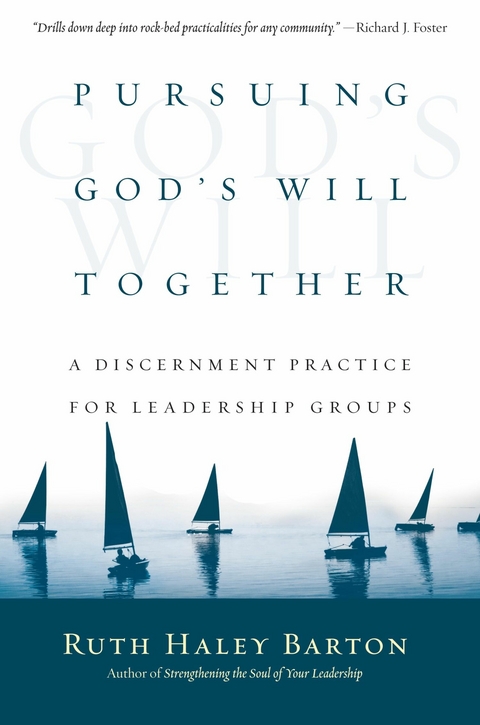
Pursuing God's Will Together (eBook)
256 Seiten
IVP Formatio (Verlag)
978-0-8308-6978-7 (ISBN)
Ruth Haley Barton is a teacher, spiritual director, retreat leader and author. She is cofounder and president of The Transforming Center (www.thetransformingcenter.org), a ministry dedicated to caring for the souls of pastors. Ruth has ministered in several congregations, including Willow Creek Community Church. Her other books include Sacred Rhythms and Invitation to Solitude and Silence (both InterVarsity Press). This book was previously published by Waterbrook under the title The Truths That Free Us.
Ruth Haley Barton (DD, Northern Seminary) is founding president of the Transforming Center, a spiritual formation ministry to pastors and Christian leaders. A trained spiritual director (Shalem Institute for Spiritual Formation), teacher and retreat leader, she has served on the pastoral staff of several churches, including Willow Creek Community Church. A sought-after teacher, preacher and consultant to leadership teams, she is currently adjunct professor of spiritual transformation at Northern Seminary. Educated at Wheaton College, Northern Seminary and Loyola University Chicago Institute for Pastoral Studies, Ruth is the author of numerous books and resources on the spiritual life, including Invitation to Solitude and Silence, Sacred Rhythms, Longing for More and Strengthening the Soul of Your Leadership. She is also the author of an online resource titled eReflections, spiritual guidance via e-mail. She contributes regularly to Conversations: A Forum for Authentic Transformation.
Introduction
The Heart of Spiritual Leadership
Decision making has its limits. We make decisions.
Discernment is given. The Spirit of God, which operates
at the deepest levels of the human psyche and within
the mysteries of the faith community,
brings to the surface gifts of wisdom and guidance
which we can only discover and name.
Danny Morris and Chuck Olsen
It was a conversation similar to many I have had with Christian leaders. An associate pastor from a large church was telling me that his church was going through a major transition as its leaders tried to respond to its growth. They had outgrown their facility (a good problem to have!), so the obvious question was, Will we add on to our facility or will we start another church?
As we talked, it became clear that this question was only the tip of the iceberg. Beneath the surface larger questions lurked: What should be our emphasis now? Does our mission still capture what we feel called to? Is our leadership structure effective for what is emerging now? Can we keep going at this pace, or will we burn ourselves out by adding a building campaign and more people and activities to our plates?
Sensing the weight this pastor was carrying, I probed a little deeper and asked, “How are you going about answering these questions together? Do you have a clearly articulated process for discerning God’s will in these matters?” A look of disorientation crossed his face as he realized that the answer to the question was no. After recovering a bit, he added, “But we always have a time of prayer at the beginning of our meetings!”
It was awkward, to say the least.
This pastor, like so many Christian leaders, had a vague sense that our approach to decision making should be different from secular models—particularly when we are leading a church or an organization with a spiritual purpose.[1] The problem is that we’re not quite sure what that difference is. In the absence of a clear consensus, that difference often gets reduced to an obligatory devotional (often viewed as irrelevant to the business portion of the meeting) or the perfunctory prayers that bookend the meeting. Sometimes even these well-meaning attempts at a spiritual focus get lost in the shuffle!
Leadership Discernment
Discernment, in a most general sense, is the capacity to recognize and respond to the presence and the activity of God—both in the ordinary moments and in the larger decisions of our lives. The apostle Paul says that we are to be transformed by the renewing of our minds so that we can discern what the will of God is, that which is good, acceptable and perfect (Rom 12:2). This includes not only the mind of each individual but also the corporate mind.
Discernment literally means to separate, to discriminate, to determine, to decide or to distinguish between two things. Spiritual discernment is the ability to distinguish or discriminate between good (that which is of God and draws us closer to God) and evil (that which is not of God and draws us away from God). There are many qualities that contribute to good leadership, but it is our commitment to discerning and doing the will of God through the help of the Holy Spirit that distinguishes spiritual leadership from other kinds of leadership.
Corporate or leadership discernment, then, is the capacity to recognize and respond to the presence and activity of God as a leadership group relative to the issues we are facing, and to make decisions in response to that Presence. Spiritual leaders are distinguished by their commitment to discern important matters together so they can affirm a shared sense of God’s desire for them and move forward on that basis.
It is hard to imagine that spiritual leadership could be about anything but seeking to know and do the will of God, and yet many leadership groups do not have this as their clear mandate and reason for existence. This raises a serious question: If we are not pursuing the will of God together in fairly intentional ways, what are we doing? Our own will? What seems best according to our own thinking and planning? That which is merely strategic or expedient or good for the ego?
Discernment together as leaders, on the other hand, opens us to an entirely different reality—the wisdom of God that is beyond human wisdom and is available to us as we learn how to open ourselves to it (1 Cor 2:6-16). This approach to leadership presents unique challenges because it requires us to move beyond reliance on human thinking and strategizing to a place of deep listening and response to the Spirit of God within and among us. This is not to dismiss what human wisdom and strategic thinking have to offer us. Our ability to think things through and apply reason to our decision making is a gift from God; however, the Scriptures are clear that human wisdom and the wisdom of God are not the same thing. Part of becoming more discerning is the ability to distinguish between the two (1 Cor 1:18-31).
One of the challenges to leadership discernment is that it can seem somewhat subjective and even mystical, which doesn’t always go over too well with hard-nosed business people and pragmatists—those who often make up boards and other leadership groups. It is one thing to rely on what feels like a more subjective approach when it pertains to our personal life, but it feels much riskier when our decisions involve large budgets, other people’s financial investments, the lives of multiple staff, reports to high-powered boards and serving a “customer base” (congregation or organization) with varying levels of expectation. And yet many leaders today are longing for a way of leading that is more deeply responsive to the will of God than to the latest ideas from a New York Times bestseller. We wonder, Is there a trustworthy process that enables Christian leaders to actively seek God relative to decisions we are making?
The answer is a resounding yes! and it is why I have written this book—to provide practical guidance for leaders and leadership teams who want to enter more deeply into the process of corporate discernment as a way of life in leadership.
Personal Reflection
How do you respond to the idea that discernment is what distinguishes spiritual leadership from other kinds of leadership? How would you describe the way your leadership group makes decisions currently?
A One-Stop Shop for Leadership Groups
While there are many books on personal discernment and a few resources on corporate discernment, this book is designed to be a one-stop-shop guide for leadership groups who wish to become a community for discernment. The process involves (1) preparing individual leaders for discernment, (2) becoming a community for discernment at the leadership level and (3) engaging an actual process for discerning God’s will together as leaders. This integration of spiritual transformation, community and discernment is based in part on Romans 12:2, in which Paul establishes a strong cause-and-effect relationship between spiritual transformation and the ability to discern and do the will of God in the context of the new community of believers gathered in Rome: “Do not be conformed to this world, but be transformed by the renewing of your minds, so that you may discern what is the will of God, what is good and acceptable and perfect” (emphasis added).
For the purposes of this book I have not made a strong distinction between churches and Christian ministry organizations because I believe that whenever and wherever Christians gather in Christ’s name to carry out his purposes in the world, we are the body of Christ. As an expression of Christ’s presence on earth there should be something about what we do and how we do it that is distinctly spiritual. Thus, when I use the word church or community, I am referring to any group of Christians who gather in the name of Christ and are seeking to be responsive to Christ’s purposes in the world. Whenever Christians gather we are, at the deepest level of reality, the community of Jesus (Mk 3:34-35), and we have the opportunity to make decisions in a way that reflects this reality. This book is intended, then, for leadership groups in churches and Christian organizations who are ready to be more intentional about becoming a spiritual community that exists to discern and do the will of God.
Preparation and Process
One of the things I have learned in my own practice of corporate discernment, and also in working with others, is that the preparation is actually more important than the process. If leaders and communities of leaders are prepared at the levels put forth in this book, discernment will happen even without a process. Conversely, if leaders are not prepared on the levels described here, there is a good chance discernment won’t happen even when they engage the process; there are too many human dynamics that will get in the way. That’s why two-thirds of the book is about preparation and one-third is about the actual practice of leadership discernment. It is also why the book is designed to function on two levels at once—to create space for each person’s personal journey of transformation and growth in discernment, while at the same time providing guidance for the...
| Erscheint lt. Verlag | 25.4.2012 |
|---|---|
| Reihe/Serie | Transforming Resources | Transforming Resources |
| Verlagsort | Lisle |
| Sprache | englisch |
| Themenwelt | Religion / Theologie ► Christentum ► Kirchengeschichte |
| Religion / Theologie ► Christentum ► Moraltheologie / Sozialethik | |
| Religion / Theologie ► Christentum ► Pastoraltheologie | |
| Schlagworte | Bible • Board • business • Christian • Christian leadership • christian living • christian non-profit board • Christian organization • Church • Church Board • church leader • Church Leadership • Community • Decision Making • Decisions • Development • Discern • Discernment • Elder • Experience • God • god's plan • lead • Leader • Leadership • leadership development • leadership practice • Leadership team • listening • Meetings • ministry • minstiry • mission agency • Model • non-profit • Opening • organization • Pastor • Pastoral Resources • Religious leader • Sacred Rhythms • seek • Spiritual Community • Spiritual Formation • spiritual growth • Spirituality • Spiritual Leadership • strengthening the soul of your leadership • Transformation • Transforming center |
| ISBN-10 | 0-8308-6978-6 / 0830869786 |
| ISBN-13 | 978-0-8308-6978-7 / 9780830869787 |
| Informationen gemäß Produktsicherheitsverordnung (GPSR) | |
| Haben Sie eine Frage zum Produkt? |
 EPUB (Wasserzeichen)
DRM: Digitales Wasserzeichen
Dieses eBook enthält ein digitales Wasserzeichen und ist damit für Sie personalisiert. Bei einer missbräuchlichen Weitergabe des eBooks an Dritte ist eine Rückverfolgung an die Quelle möglich.
Dateiformat: EPUB (Electronic Publication)
EPUB ist ein offener Standard für eBooks und eignet sich besonders zur Darstellung von Belletristik und Sachbüchern. Der Fließtext wird dynamisch an die Display- und Schriftgröße angepasst. Auch für mobile Lesegeräte ist EPUB daher gut geeignet.
Systemvoraussetzungen:
PC/Mac: Mit einem PC oder Mac können Sie dieses eBook lesen. Sie benötigen dafür die kostenlose Software Adobe Digital Editions.
eReader: Dieses eBook kann mit (fast) allen eBook-Readern gelesen werden. Mit dem amazon-Kindle ist es aber nicht kompatibel.
Smartphone/Tablet: Egal ob Apple oder Android, dieses eBook können Sie lesen. Sie benötigen dafür eine kostenlose App.
Geräteliste und zusätzliche Hinweise
Buying eBooks from abroad
For tax law reasons we can sell eBooks just within Germany and Switzerland. Regrettably we cannot fulfill eBook-orders from other countries.
aus dem Bereich