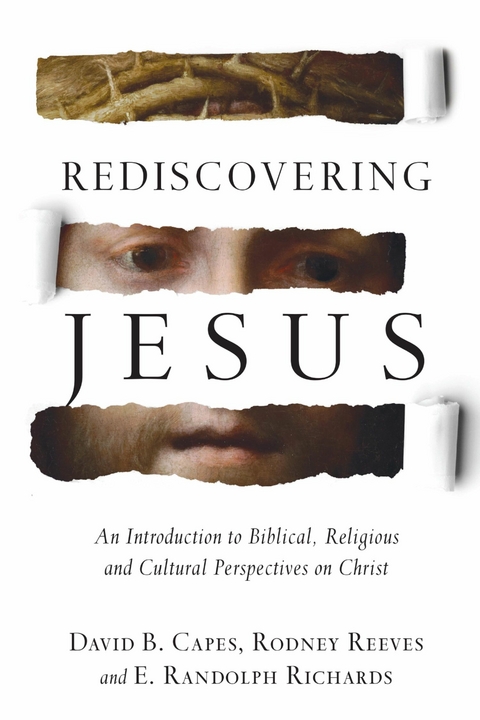
Rediscovering Jesus (eBook)
InterVarsity Press (Verlag)
978-0-8308-9856-5 (ISBN)
David B. Capes (PhD, Southwestern Baptist Theological Seminary) is associate dean of biblical and theological studies and professor of New Testament at Wheaton College. He has authored, coauthored, or coedited books such as Rediscovering Jesus, Old Testament Yahweh Texts in Paul's Christology, The Footsteps of Jesus in the Holy Land, The Last Eyewitness, Rebecca's Children, The Voice of Hebrews, and The Voice of Romans. Previously, Capes was academic dean and professor of New Testament at Houston Graduate School of Theology. He served as the lead scholar on a new Bible translation, The Voice Bible, and he cohosts a radio show called A Show of Faith on TALK RADIO 950 KPRC Houston.
Readers' Choice Awards Honorable MentionOne of Nijay Gupta's Best Academic New Testament BooksWho is your Jesus? Matthew's teacher? John's Word made flesh? Hebrews' great high priest? What if it turned out that your Jesus is a composite of your favorite selections from the New Testament buffet, garnished with some Hollywood and Americana?Rediscovering Jesus takes us on a gallery tour of biblical portraits of Jesus, from Matthew through Revelation. Our expert guides point out the background and highlights of each New Testament image of Jesus. Then we hit the streets to visit other houses of worship and their scriptures, examining the Jesus of the Book of Mormon and the Qur'an. Popping into a bookstore, we browse the latest on the Gnostic and the historical Jesus. Then we're off on a walking tour of Jesus in America, followed by a film festival of Jesus movies. All along the way our tour guides describe and interpret, but also raise questions: How is this Jesus different from other portraits? If this were our only portrait of Jesus, what would our faith be like?Rediscovering Jesus is an enjoyable, informative and challenging look at how we encounter Jesus in Scripture and our culture. With ample sidebars exploring contexts and the "e;so what?"e; questions, it takes us beyond other surveys by probing how our understanding of Jesus can make a difference for faith and life. From the authors of Rediscovering Paul, this is a textbook introduction to Jesus that guides us in our pilgrimage toward seeing Jesus truly.
David B. Capes (PhD, Southwestern Baptist Theological Seminary) is professor of New Testament in the School of Christian Thought at Houston Baptist University, where he was founding dean of the Honors College. He has authored, coauthored or coedited books such as Rediscovering Paul, Old Testament Yahweh Texts in Paul's Christology, The Footsteps of Jesus in the Holy Land, The Last Eyewitness, Rebecca's Children, The Voice of Hebrews and The Voice of Romans. In addition to contributing to a number of dictionaries, encyclopedias and professional journals, he served as the lead scholar on a new Bible translation, The Voice Bible.Since the early 1990s, Capes has been active in interfaith dialogue in Houston and co-hosts a radio show called A Show of Faith on TALK RADIO 950 KPRC Houston. He has served as pastor of several churches and has participated in a variety of professional organizations, including the Society of Biblical Literature, the Institute for Biblical Research and the National Association of Baptist Professors of Religion. E. Randolph Richards (PhD, Southwestern Baptist Theological Seminary) is dean and professor of biblical studies in the School of Ministry at Palm Beach Atlantic University. He is a popular speaker and has authored and coauthored dozens of books and articles, including Paul Behaving Badly, A Little Book for New Bible Scholars, Rediscovering Jesus, Misreading Scripture with Western Eyes, Rediscovering Paul, The Story of Israel, and Paul and First-Century Letter Writing. Early on in their ministry he and his wife Stacia were appointed as missionaries to east Indonesia, where he taught for eight years at an Indonesian seminary. Missions remain on the hearts of Randy and Stacia. Randy leads mission trips and conducts missionary training workshops and regularly leads tours of the Holy Land, Turkey, Greece, and Italy. He has served as interim pastor of numerous churches and is currently a teaching pastor. He and Stacia reside in Palm Beach, Florida. Rodney Reeves (PhD, Southwestern Baptist Theological Seminary) is dean of The Courts Redford College of Theology and Ministry and professor of biblical studies at Southwest Baptist University, both in Bolivar, Missouri. Previously a pastor with churches in Arkansas and Texas, Reeves is author or coauthor of A Genuine Faith: How to Follow Jesus Today, Spirituality According to Paul: Imitating the Apostle of Christ and Rediscovering Paul: An Introduction to his World, Letters and Theology. His articles have appeared in journals such as Perspectives in Religious Studies, Biblical Illustrator, Southwestern Journal of Theology and Preaching.
Introduction
“MY JESUS”
I was sitting in the seminary cafeteria, enjoying a cup of coffee, and reminding myself that Jesus wouldn’t mind if I skipped chapel that day. After all, didn’t Jesus himself withdraw from the crowds for a little “down time”? I was sitting there with some fellow seminary students. A colleague was waxing eloquently about Jesus turning the water into wine, joking that if Jesus had been a Baptist, he would have turned the wine back into water. One of my tablemates wasn’t enjoying the joke as much, judging from his stern look of disapproval. He reminded us that Jesus was a teetotaler. When someone else pointed out that Jesus drank wine, he informed us that the wine that Jesus drank was nonalcoholic. This caught my attention, and I asked him where Jesus would get such wine. He announced with righteous indignation, “I don’t know, but my Jesus would not drink alcoholic wine.” The discussion was over, but I was left wondering if my Jesus was the same one as his.
We recognize that not everyone in the world sees Jesus the same way as we do, but in our heart of hearts, each of us believes that “my Jesus” is closest to the real Jesus. Others also have the real Jesus, if they have a Jesus that doesn’t differ significantly from mine—that is, only minor differences, which really means as long as the differences involve issues that don’t overly concern me. Although I will concede that at other times and in other places people have misinterpreted Jesus, I am fairly confident that I have Jesus somewhat “right.” Jesus tells the story of a slave owner who commands his slave to serve him even when the slave is weary (Lk 17:7-10). I have baggage from my American history that makes me uncomfortable with Jesus talking about real slaves. Surely, Jesus is referring to some sort of spiritual slavery, I posit. At the very least, I want my translation to change the word from “slave” to “servant.” Or perhaps this is some minor illustration that Jesus was making, and I am best served by skipping over that story. I feel certain that it would misrepresent Jesus for us to highlight that parable. Although Luke included the story, we would not list it as one of our top ten favorite parables.
We are all aware that others reinterpret Jesus, reading Jesus through their own cultural and religious lenses. Tolerance is highly regarded in our society. I don’t like the story where Jesus equates a woman with a dog (Mt 15:21-28). My Jesus wouldn’t offend anyone—unless it was a bad person. My Jesus didn’t really mean it when he said, “Woe to you who are rich, for you have received your consolation” (Lk 6:24). Even though I live comfortably, my Jesus was talking about someone far richer than me, and, I reason, someone who probably got rich by oppressing honest folks. However, deep down inside, I believe that I don’t have an interpreted Jesus; I am simply “reading” the Bible or taking the Bible “literally.” I have the “real Jesus.”
Not only do I have a misinterpreted or reinterpreted Jesus, but also my Jesus is commonly a composite Jesus—a Jesus we can’t find in any one of the Gospels. He ministers in a composite world that I have created by joining together the stories and characters that I think belong together. For example, my Jesus, the real Jesus, cared about the rich young ruler, but actually no Gospel identifies the man that way. He is rich in Mark 10, a rich young man in Matthew 19, and a rich ruler in Luke 18. Only by combining all the stories do we conclude that he is a rich young ruler. Likewise, often we think that Mary, the sister of Lazarus, was a sinful woman. We conclude this only by combining stories across Gospels. In Luke 7 we are told that a sinful woman anointed Jesus. In John 11–12 we read that Mary anointed Jesus, so we conclude that Mary was a sinful woman (rescued by Jesus). We may be slandering Mary’s character. So, my Jesus often is the product of combined stories. In Christmas plays, the shepherds and the magi visit the newborn Jesus in the manger on the same night. These composite accounts require us to gloss over differences in order to combine the stories. According to Matthew, the magi actually visit the toddler Jesus, who was living in a house. The rich ruler in Luke 18 insists that he had been keeping all the commandments ever since he was young. When we create a composite Jesus, we risk losing Luke’s Jesus or Matthew’s Jesus, leaving us a Jesus of the lowest common denominator or, worse, a Jesus made up of the parts I like.
My Jesus is often a smorgasbord Jesus, a Jesus who doesn’t look like the one in the Bible. Just like a buffet in the cafeteria, where I go through the line and pick out what I want, I read through the Gospels, pulling out the stories I like. I see Brussels sprouts. I know that they’re good for me, but I don’t like them, so I skip past them. So likewise, this smorgasbord Jesus doesn’t hurl epithets at women or make demands of slaves. In the cafeteria buffet, I like dessert. I likewise want a sweet, agreeable Jesus, one who likes what I like and hates what I hate. Everyone agrees that child trafficking is bad, so let’s talk about a Jesus who loves children. But I’m uncomfortable with a Jesus who might disapprove of my purchase of the latest hi-tech gadget when there are millions of children who don’t have enough to eat, so I avoid sayings of Jesus that might suggest that. Frankly, my Jesus isn’t overly concerned with the things I’m not overly concerned about.
But we can see that it can’t be all about me. The British rock band Depeche Mode sang about “my personal Jesus.” Yet, I know it cannot just be about my personal experience with the risen Christ. So, how do we rediscover the real Jesus? We suggest first allowing each picture of Jesus to speak for itself. As evangelicals, we believe that it was the inspiration of the Spirit that led to producing four portraits of Jesus rather than a single composite one. Although each of our Gospels probably arose in its own community, why didn’t early Christians bring the four stories into one, at least when they were gathering writings into a collection? An early church father, Tatian (ca. A.D. 120–180), thought it would be better just to have one Gospel, so he wove our four together. The result is his book the Diatessaron (meaning “through four”). Collecting all the unique stories and blending the shared stories creates what is called a “harmony of the Gospels.” Early Christians rejected Tatian’s well-intended efforts—although, in practice, we still combine stories. Having different images of Jesus is somehow better. So, we are going to look at the New Testament Jesus from a number of angles. Clearly, we privilege the four canonical Gospels, but the New Testament has other pictures of Jesus as well. Beyond the New Testament, individuals and groups through the ages have also interpreted Jesus. As much as we would like to think otherwise, we have been influenced by how Jesus has been viewed before us. We also no longer have the luxury of pretending that white Western males are the only ones whose opinions matter. Could African and Asian voices help us to see Jesus better? Those outside our faith also have interpretations of Jesus: righteous angel, rightly guided prophet, enlightened sage, darling of heaven. When Jesus asked his followers, “Who do people say that I am?” he wasn’t just curious about what his followers believed; he wanted to know what the crowds were saying. In effect, he set up a question that can be and must be asked by all peoples down through the ages.
As each chapter in this book explores a different view of Jesus, we will ask first, “What does this picture of Jesus look like?” For example, in chapter three we pose the question “Who does Luke say that I am?” narrowing the focus of Jesus’ famous question. In other words, we are going to look at each story individually, what Mark Strauss calls reading “vertically,” from top to bottom—without looking “horizontally” to other Gospels—to discover the meaning of Jesus in each Gospel, on its own terms, from beginning to end. Strauss contends that since each Gospel has a story to tell (and since the Holy Spirit chose to inspire four and not just one), “we should respect the integrity of each story.”1 Looking at Mark’s Jesus allows us to see the picture that Mark wanted us to see, from how he introduces Jesus, to the rise of followers and opponents and the seemingly inevitable conflict, to God’s grand resolution.
The second section of each chapter looks at how a particular portrayal of Jesus differs from other images or even from the composite image that we have of Jesus. So, we will ask, for example, “How is Luke’s Jesus different?” Luke paints a different image than John does. That statement might make some uncomfortable, but even a casual reader can see that it is immediately true. We need to see the distinctives of each picture of Jesus. The dangers of Tatian’s approach of reading harmonistically are that we blend stories and we lose uniqueness, both of which distort the message. For example, most of us are familiar with the “Seven Sayings of Jesus on the Cross.” Yet, there are seven only if one collects the sayings from the four Gospels.2 When we add all of them together, however, we miss the emphasis of each writer. Mark’s Jesus utters only one line from the cross: “My God, my God, why have you forsaken me?” (Mk 15:34). In Mark, the crucifixion is an ominous and dark moment. But Luke’s Jesus speaks to the crowds around him, offering warnings as he carries his cross, “Do not weep for me, but weep for...
| Erscheint lt. Verlag | 8.7.2015 |
|---|---|
| Verlagsort | Lisle |
| Sprache | englisch |
| Themenwelt | Geisteswissenschaften ► Religion / Theologie ► Christentum |
| Schlagworte | American Jesus • Bible • Book of Mormon • Cinema • cinematic jesus • gnostic gospels • Gnostic Jesus • Gospels • Historical Jesus • Hollywood • Jesus • Jesus Christ • jesus images • jesus in movies • jesus in popular culture • mormon jesus • muslim jesus • New Testament • pictures of jesus • Quran • Scripture • Textbook • who is jesus • who was jesus |
| ISBN-10 | 0-8308-9856-5 / 0830898565 |
| ISBN-13 | 978-0-8308-9856-5 / 9780830898565 |
| Informationen gemäß Produktsicherheitsverordnung (GPSR) | |
| Haben Sie eine Frage zum Produkt? |
 EPUB (Adobe DRM)
Kopierschutz: Adobe-DRM
Adobe-DRM ist ein Kopierschutz, der das eBook vor Mißbrauch schützen soll. Dabei wird das eBook bereits beim Download auf Ihre persönliche Adobe-ID autorisiert. Lesen können Sie das eBook dann nur auf den Geräten, welche ebenfalls auf Ihre Adobe-ID registriert sind.
Details zum Adobe-DRM
Dateiformat: EPUB (Electronic Publication)
EPUB ist ein offener Standard für eBooks und eignet sich besonders zur Darstellung von Belletristik und Sachbüchern. Der Fließtext wird dynamisch an die Display- und Schriftgröße angepasst. Auch für mobile Lesegeräte ist EPUB daher gut geeignet.
Systemvoraussetzungen:
PC/Mac: Mit einem PC oder Mac können Sie dieses eBook lesen. Sie benötigen eine
eReader: Dieses eBook kann mit (fast) allen eBook-Readern gelesen werden. Mit dem amazon-Kindle ist es aber nicht kompatibel.
Smartphone/Tablet: Egal ob Apple oder Android, dieses eBook können Sie lesen. Sie benötigen eine
Geräteliste und zusätzliche Hinweise
Buying eBooks from abroad
For tax law reasons we can sell eBooks just within Germany and Switzerland. Regrettably we cannot fulfill eBook-orders from other countries.
aus dem Bereich