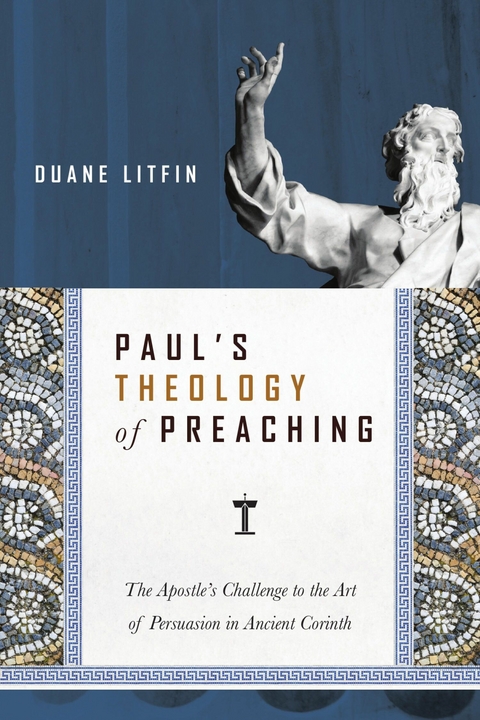
Paul's Theology of Preaching (eBook)
InterVarsity Press (Verlag)
978-0-8308-9855-8 (ISBN)
Duane Litfin (DPhil, Oxford University; PhD, Purdue University) is president emeritus of Wheaton College, where he served for seventeen years. He is the author of numerous articles and books, including most recently Conceiving the Christian College and Word vs. Deed: Resetting the Scales to a Biblical Balance.
"e;We preach Christ crucified: a stumbling block to Jews and foolishness to Gentiles, but to those whom God has called, both Jews and Greeks, Christ the power of God and the wisdom of God."e; When Paul preached about the crucified and risen Jesus Christ to the church at Corinth and elsewhere, did he follow the well-established rhetorical strategy of his day or did he pursue a different path? And what does that mean for the preaching of the church today? Through a detailed analysis of 1 Corinthians 1-4, Duane Litfin explores the rhetorical context of Paul?s preaching and his own understanding of his task as a preacher. What is revealed in this investigation is a sharp distinction between Greco-Roman rhetorical strategies, which sought to persuade, and Paul?s theology of preaching, which was based on the model of an obedient herald. This revised and expanded version of Litfin's previous St. Paul's Theology of Proclamation will provide insight to those engaged in Pauline and New Testament studies, rhetorical theory, and Greco-Roman studies. Moreover, by offering a better understanding of Paul's method as well as the content of his declaration concerning "e;the power and wisdom of God"e; revealed in Jesus, this book will help preachers as they undertake the ongoing task to "e;preach Christ crucified."e;
Duane Litfin (DPhil, Oxford University; PhD, Purdue University) is president emeritus of Wheaton College where he served for seventeen years. He previously served as senior pastor of First Evangelical Church in Memphis, Tennessee, and as an associate professor at Dallas Theological Seminary. He also taught at Purdue University and Indiana University. He is the author of numerous articles and books, including most recently Conceiving the Christian College and Word vs. Deed: Resetting the Scales to a Biblical Balance. He and his wife Sherri have three married children and nine grandchildren.
Preface
I begin this book with a personal account. I offer it not because it’s important in its own right but because it will be useful in setting the context for what follows.
The Beginning
I first began thinking on the subject of this book in the early 1970s while pursuing a doctoral program in rhetorical theory at Purdue University. With eight years of biblical and theological studies behind me, and with a special interest in the subject of preaching, I plunged for the first time into the arcane world of Greco-Roman rhetoric. Primed as I was, the intersection of classical rhetoric and Christian preaching—indeed, we may say the clash of these two worlds1—at 1 Corinthians 1–4 became immediately apparent.
My first public attempt to explore this clash appeared in a Christianity Today article titled (by the editors; it was not a title I would have chosen) “The Perils of Persuasive Preaching.”2 In this article I argued that in 1 Corinthians 1–4 the Apostle Paul was calling into question the use of human persuasive techniques in Christian preaching. The article generated a range of strong responses. Most were positive, but some signaled that if my argument were to stand it would require a good deal more support than such a popular treatment could provide. Thus began an extensive search to find someone, anyone, who had explored the issues in detail. It was a search that would prove futile. No one, it seemed, had produced the study I was after.3 It occurred to me that perhaps I should attempt it.
Looking back it is sometimes difficult to recall that Greco-Roman backgrounds were at that point still out of favor in New Testament studies. Though this ancient cultural milieu had traditionally played a prominent role in the interpretation of the New Testament, and of 1 Corinthians 1–4 in particular, over the previous half century several alternatives had come to the fore. Various theories about Gnosticism or the Philonic Wisdom of the syncretistic Hellenistic synagogue had crowded into the spotlight, particularly among German scholars. As it would happen, a dramatic resurgence of Greco-Roman backgrounds would soon emerge, but as of the 1970s this development was still only a cloud on the horizon. It scarcely seemed a promising time to make the case that Greco-Roman rhetoric might be the appropriate backdrop for Paul’s argument in 1 Corinthians 1–4 after all.
Yet, convinced that I was on to something, I decided to give it a try. When the opportunity presented itself in the early eighties, we moved to England to pursue this research at Oxford University.
The Oxford Years
I vividly recall my first meeting with my supervisor, Anthony Harvey. Having by then spent a decade thinking through the relevant issues, both in classical rhetoric and in 1 Corinthians, I had submitted an unusually detailed research proposal. But Canon Harvey—halfway through my program he became a Canon of London’s Westminster Abbey, a destination to which I happily commuted for our periodic consultations—was at first skeptical. “I don’t know if you have a study here or not,” he commented. “What would you like me to do?” To this I remember stammering something like, “Well, you know quality research when you see it. Just look over my shoulder and tell me if I’m doing good work.” “I can certainly do that,” was his cryptic reply. It was not, it seemed to me at the time, an auspicious beginning.
With a heightened sense of trepidation I nonetheless plunged into my work, and soon in that first Michaelmas term I caught a glimpse of my supervisor’s budding interest. I joined a small doctoral seminar with the renowned Pauline scholar G. B. Caird. When I was introduced to Professor Caird he nodded and said, “Ah, you’re the fellow Anthony spoke to me about. You must come to my rooms and tell me about your work.” Flattered, but also wary—What had Anthony said about me?—I made an appointment to meet the following week.
On the day of my appointment I knocked on Caird’s door in the stately Queens College on Oxford’s High Street. Professor Caird greeted me cordially, sat us down and poured tea. Then, filling and lighting his pipe, he leaned back and asked me to describe my project. I recall taking seven or eight minutes to line out my work, during which time Caird said not a word. He just studied me through a wreath of pipe smoke, offering a periodic “Hmmmm.” I finished my summary with no idea of what he thought of my proposal.
“So, that’s what I’m proposing to do,” I said. There followed one of those dramatic moments one never forgets. Professor Caird paused, leaned toward me over the coffee table, tapped out his pipe into the ash tray and said, “No, no, Mr. Litfin, this will never do.” It was a withering comment. All of my uncertainties flooded in. Why did I think I had something to contribute to the important discussion of Paul and his preaching? I had come halfway around the world to pursue this research, but with Caird’s single comment my reason for being at Oxford collapsed like the proverbial house of cards.
It was a deflating moment. But thankfully it didn’t last. I had done my homework before venturing into this arena and when Caird began plying me with questions I produced some ready answers. Soon his resistance began to change. An hour later Professor Caird sent me on my way with his encouragement, urging me to keep him apprised of my work. What had momentarily seemed an end became instead a delightful beginning. I left Queens that day reassured that I was on to something worthwhile.
I was only a few months into my work when Anthony, who had quickly moved from skepticism to genuine interest, decided we should bring in a second supervisor. Anthony had read “Greats” (classics) at Oxford but had since focused on the New Testament, and he wanted me to have a professional classicist. Thus he teamed up with Latin scholar Michael Winterbottom to oversee my work. The research and writing went well—with no little credit to my two supervisors—and in the end, when my project was completed, this dual supervision was followed by dual examination in the persons of F. F. Bruce (New Testament) and D. A. Russell (classics).
The dreaded viva, the oral examination by a panel of world-class experts on one’s topic, is typically a moment of truth for an Oxford doctoral candidate. All hangs in the balance, not only your years of study and writing but also the gaining of the necessary credential for any future in the academy. Everything winnows down to this decisive event. With the stakes so high, the moment can be terrifying.
But this was not my experience. My viva proved to be a wonderful occasion. As chair of the proceedings, Professor Bruce began by introducing us to the audience (the examination was conducted in a public setting). Then he turned to me and said, “Professor Russell and I have conferred and we are in agreement that there is no question but that this work is of DPhil quality. So our purposes today are twofold. First, we want to be assured that you are the one who wrote this; and second, we wish to talk to you about your research.”
Was I hearing this right? You pass; now we just want to talk with you about your work? Thus began a doctoral student’s dream viva: two hours of conversation with two of the world’s leading experts on your subject, both of whom have examined your work in detail, found it convincing and now wish only to explore it with you. I could not have asked for more. I was deeply honored, and their affirming comments on my finished work proved invaluable.
Following the viva, as we were preparing to leave I asked Professor Bruce if he thought I should seek to publish my study. He abruptly answered, “Why, of course. I’ve waited years for someone to write this.” He was pleased, he said, to see at least this aspect of Greco-Roman backgrounds emerging from the shadows.4
The dissertation’s publication may have seemed obvious to F. F. Bruce, but it required his encouragement for it to become obvious to me. Later that year over a pleasant lunch in another part of the world, Bruce graciously volunteered to write a foreword for the work. Regrettably, he died before the other demands on my schedule permitted me to have the manuscript ready for publication.
A Decade Later
It was not until the early nineties that I got around to revising my research for publication. The resulting book was titled St. Paul’s Theology of Proclamation. By this time, of course, what had been a trickle in the late seventies had grown to a torrent; rhetorical studies of the biblical text were now ubiquitous. During my Oxford years I had discovered considerably more relevant literature than I was aware of when I started—though still no study such as I was attempting—but this was only the beginning. Throughout the 1980s Greco-Roman backgrounds roared back into favor and rhetorical studies began popping up everywhere. So plentiful had the literature become by 1994 that Alan Hauser and Duane Watson would compile a comprehensive book-length bibliography titled Rhetorical Criticism of the Bible. An impressive proportion of the entries had been published during the previous decade.
What’s more, there finally appeared during the early and mid-nineties four book-length studies focused on my passage in particular, 1 Corinthians 1–4. First came Stephen Pogoloff’s Logos and Sophia (1992); then my own St. Paul’s Theology of Proclamation (1994; hereinafter SPTOP); and then...
| Erscheint lt. Verlag | 22.6.2015 |
|---|---|
| Verlagsort | Lisle |
| Sprache | englisch |
| Themenwelt | Geisteswissenschaften ► Religion / Theologie ► Christentum |
| Schlagworte | 1 Corinthians • 1 Corinthians 1-4 • Bible • First Corinthians • Greco-Roman • homiletics • Jesus • ministry • New Testament • new testament letters • Pastor • Paul • Paul’s letters • Paul’s theology • preach • Preacher • Preaching • proclaim • proclamation • rhetoric • speak |
| ISBN-10 | 0-8308-9855-7 / 0830898557 |
| ISBN-13 | 978-0-8308-9855-8 / 9780830898558 |
| Informationen gemäß Produktsicherheitsverordnung (GPSR) | |
| Haben Sie eine Frage zum Produkt? |
 EPUB (Adobe DRM)
Kopierschutz: Adobe-DRM
Adobe-DRM ist ein Kopierschutz, der das eBook vor Mißbrauch schützen soll. Dabei wird das eBook bereits beim Download auf Ihre persönliche Adobe-ID autorisiert. Lesen können Sie das eBook dann nur auf den Geräten, welche ebenfalls auf Ihre Adobe-ID registriert sind.
Details zum Adobe-DRM
Dateiformat: EPUB (Electronic Publication)
EPUB ist ein offener Standard für eBooks und eignet sich besonders zur Darstellung von Belletristik und Sachbüchern. Der Fließtext wird dynamisch an die Display- und Schriftgröße angepasst. Auch für mobile Lesegeräte ist EPUB daher gut geeignet.
Systemvoraussetzungen:
PC/Mac: Mit einem PC oder Mac können Sie dieses eBook lesen. Sie benötigen eine
eReader: Dieses eBook kann mit (fast) allen eBook-Readern gelesen werden. Mit dem amazon-Kindle ist es aber nicht kompatibel.
Smartphone/Tablet: Egal ob Apple oder Android, dieses eBook können Sie lesen. Sie benötigen eine
Geräteliste und zusätzliche Hinweise
Buying eBooks from abroad
For tax law reasons we can sell eBooks just within Germany and Switzerland. Regrettably we cannot fulfill eBook-orders from other countries.
aus dem Bereich