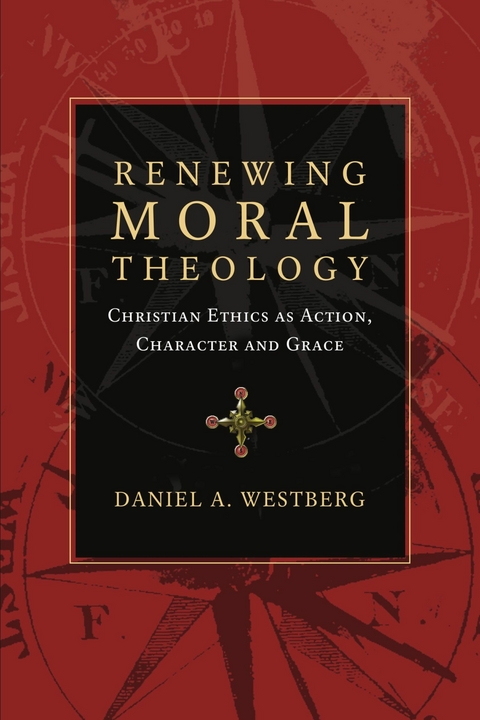
Renewing Moral Theology (eBook)
281 Seiten
IVP Academic (Verlag)
978-0-8308-9770-4 (ISBN)
Daniel A. Westberg (1949-2017) was professor of ethics and moral theology at Nashotah House Theological Seminary. His books include Right Practical Reason: Action, Aristotle and Prudence in Aquinas.
Daniel A. Westberg (1949-2017) was professor of ethics and moral theology at Nashotah House, a seminary of the Episcopal Church in Nashotah, Wisconsin. He grew up in Japan where his parents were missionaries and after his ordination he served as an Anglican priest in the Diocese of Toronto for ten years, in both rural and city parishes. He also taught ethics at the University of Virginia for eight years. Westberg is the author of Right Practical Reason: Action, Aristotle and Prudence in Aquinas and many articles in journals such as The Anglican Theological Review, The Thomist and New Blackfriars, as well as several short articles in The New Dictionary of Christian Ethics and Pastoral Theology. He divides his time between Wisconsin and Sweden, where his wife Lisa lives and works, and together they have four adult children.
2
Purpose, Reason and Action
We tend to separate the ordinary “everyday” actions of our lives from the difficult choices and from what we consider to be the more genuinely “moral” decisions that occasionally need to be made. Thus brushing one’s teeth, writing an email, going for a walk, washing the dishes and so on are not seen as ethical decisions or part of moral theology, whereas the decision to report to your superior someone at work whom you suspect of misusing funds would be an ethical or moral decision, as, of course, would thinking about whether or not to get a divorce.
There are several reasons for this. First, the everyday, mundane decisions are usually quick and easy. These decisions often are made with little reflection, and with no moral agonizing or pondering. There is no need to “figure out” what to do. Occasionally, one may not “feel like” doing the dishes or getting exercise, but that seems to be a matter of mood rather than of morality. Second, in many mundane decisions there are no major moral rules or principles at stake, such as telling the truth or the duty to protect life. If there is no moral problem to be solved, no conflict between duty and inclination, it does not seem to belong to ethics.
This sense of what moral actions are has been reinforced by the traditions of both moral theology and philosophical ethics that focused on “cases of conscience” (the dubitantium or matters of doubt) or on crisis situations. Should I let myself starve, or should I save my life by becoming a cannibal? Would it be possible and ethical to find a way for one or two on this overcrowded lifeboat to volunteer (or be selected at random) as sacrificial victims so that the rest of the group could have a chance to make it back to land?
Human Action Is Moral Action
In reality, all of our genuine actions (setting aside unconscious actions such as doodling while on the telephone or drumming your fingers while thinking of something else) have moral import and are moral actions.1 That is, they are expressions of purpose, desires and attitudes revealed in a decision to do something. Brushing your teeth is not just a mechanical habit or piece of learned behavior; it reflects a well-founded concern for hygiene and good health, which has a social dimension as well as individual benefit. Having a meal with friends or family can serve a number of different purposes besides simple nourishment. It might be the occasion for trying new cuisine, honoring someone’s birthday or retirement, or sharing joys and disappointments.
Motivation. Many students of ethics in the twentieth century were taught to distinguish between schools of ethics based on a sense of duty (deontological ethics) and those based on producing good results (teleological or consequentialist ethics). There are purely philosophical (or secular) versions of these systems of ethics, with long-standing discussions about the assumptions, claims and procedures. For many Christians, an ethical system based on duty seems more obviously compatible with the Christian life that is taught to us from an early age as involving commands given to us by God and obedience to the Lord’s will. An ethical system that is looking primarily for good results seems inevitably misguided and unspiritual, betraying an inherent element of selfishness and presumption. Better to do what is right and leave the results to God.
The ethical system presented in this book is unabashedly teleological (from the Greek word telos, “end” or “result”), but it has little in common with utilitarianism or consequentialist ethics that attempt to generate the best outcome. That is because the ultimate end or purpose in Thomistic ethics is based on acting for a purpose that can be described as the supreme good, sheer joy and complete fulfillment. The term that Thomas Aquinas used is beatitudo, and this is really the guiding principle of human action. As Fergus Kerr puts it, “We need to notice that the a priori condition of moral agency is Thomas’ characterization of God as ‘object’ of the bliss of all the blessed—objectum in the mediaeval sense, not of something inertly over against us, waiting for our subjectivity to impose a significance; but as something which provokes and evokes response from us.”2 We find agreement in the Westminster Catechism: “What is the chief end of man? The chief end of man is to love God and enjoy him forever.” With some conceptual dexterity one can possibly turn loving God into a duty; but it is more than a little contradictory to conceive of a God-given duty to enjoy him.
The French philosopher Henri Bergson (1859–1941) divided morality and religion into two basic groups: those that operate from “pressure” and those that are based on “attraction.”3 Moralities and religions that specialize in pressure describe morality in terms of duty and obligation, while a morality or a religion of attraction or aspiration points to a fundamental motivation of growth, fulfillment and happiness.
The Christian life presented in the Scriptures, in the life of Christ and described in sermons and saints’ lives is obviously a combination of duty and joy, of obligation and fulfillment. But which is more fundamental? Jesus in the garden of Gethsemane prayed that the cup of suffering might be avoided, but he accepted that God’s will and not his own was to be done. On the other hand, the Epistle to the Hebrews says that our Lord, “who for the sake of the joy that was set before him endured the cross, disregarding its shame” (Heb 12:2), speaking of an ultimate joyful purpose.
The assumption that an ethics based on duty is more “ethical” or more Christian is understandable when we think of morality in the restricted sense of special decisions where we sense difficulty, confusion and especially conflict. It is especially in times of temptation when inclination and desire lead to a course of action more attractive to us, but if we are honest, we know that the right thing to do is what we ought to do—that is our “duty.” But if we expand morality from these special situations of doubt, conflict and temptation, and we accept that all of our conscious actions reflect our morality, then it is easier to see that the more fundamental picture of being attracted to good things (such as marriage, friends and career) and through them to the good itself is sounder philosophically, psychologically and biblically. The sense of duty is secondary to overall purpose. Laws and lists of duties, job descriptions, and responsibilities are important and essential, but they do not furnish fundamental motivation, except at certain stages of immaturity or training.
In an Aristotelian-Thomist view of human action the motivation prompting action is a desire for fulfillment—to achieve a more complete level of being. The ultimate goal, that final purpose that exists as the remote purpose behind all other actions, is perfect well-being and happiness.4
The classical and medieval model of action in nature included a metaphysics in which natural objects were described as “desiring” or “seeking” a form corresponding to their natures. Fire would “seek” to rise to its proper sphere; acorns would “seek” the form of an oak tree, the completion of their nature.
Modern physics and biology no longer allow us to describe the operations of nature in this fashion, except metaphorically. And there are alternatives to metaphysics of the desire for the good, based more on empirical study of the behavior of human beings. Abraham Maslow’s hierarchy of human needs is an outline of the varying types and levels of human needs that provide the basis for human motivation. At the bottom level are physiological needs for food, warmth, activity, sex and so on. The next level is safety and security needs, which a person can focus on when the basic survival is no longer problematic. Once security needs are met, one may turn to the need for belonging in groups or relationships, then for esteem (both from others and from one’s self), and finally for self-actualization.
Another alternative to an Aristotelian scheme, developed within conservative Roman Catholic circles, is to take a phenomenological approach and simply identify, from observation, certain “basic human goods” that describe what all people make fundamental to their behavior. According to this school, these basic goods are life (including health), knowledge, play, aesthetic experience, friendship, practical reasonableness (living with freedom and reason and integrity) and religion.5 The advantage of a system of goods like this is that while universal claims about human nature are made, the starting point is observable reality with no dependence on an underlying metaphysical explanation. As fixed characteristics of human beings, without a hierarchy of value, these basic goods become the foundation for a new “natural law” furnishing binding moral axioms, based on not violating any of the basic human goods.
We need not give up the Aristotelian-Thomist picture completely, however. If one takes a theological starting point with a doctrine of creation as expressive of God’s will, then there is a certain truth in speaking of the “desire” of the acorn to become an oak tree, of stars to shine and of cats to hunt. This language is not explanatory in a strictly scientific sense, but it is descriptive of creatures’ actions in that they are living in accordance with purposes immanent in the created world.
Actions and...
| Erscheint lt. Verlag | 2.5.2015 |
|---|---|
| Verlagsort | Lisle |
| Sprache | englisch |
| Themenwelt | Geisteswissenschaften ► Philosophie ► Allgemeines / Lexika |
| Geisteswissenschaften ► Philosophie ► Ethik | |
| Religion / Theologie ► Christentum ► Kirchengeschichte | |
| Schlagworte | anglican • Anglican ethics • Catholic • ethics • evangelical • Moral Formation • Moral Theology • moral tradition • Thomis Aquinas • virtue • Virtue Ethics |
| ISBN-10 | 0-8308-9770-4 / 0830897704 |
| ISBN-13 | 978-0-8308-9770-4 / 9780830897704 |
| Informationen gemäß Produktsicherheitsverordnung (GPSR) | |
| Haben Sie eine Frage zum Produkt? |
 EPUB (Wasserzeichen)
DRM: Digitales Wasserzeichen
Dieses eBook enthält ein digitales Wasserzeichen und ist damit für Sie personalisiert. Bei einer missbräuchlichen Weitergabe des eBooks an Dritte ist eine Rückverfolgung an die Quelle möglich.
Dateiformat: EPUB (Electronic Publication)
EPUB ist ein offener Standard für eBooks und eignet sich besonders zur Darstellung von Belletristik und Sachbüchern. Der Fließtext wird dynamisch an die Display- und Schriftgröße angepasst. Auch für mobile Lesegeräte ist EPUB daher gut geeignet.
Systemvoraussetzungen:
PC/Mac: Mit einem PC oder Mac können Sie dieses eBook lesen. Sie benötigen dafür die kostenlose Software Adobe Digital Editions.
eReader: Dieses eBook kann mit (fast) allen eBook-Readern gelesen werden. Mit dem amazon-Kindle ist es aber nicht kompatibel.
Smartphone/Tablet: Egal ob Apple oder Android, dieses eBook können Sie lesen. Sie benötigen dafür eine kostenlose App.
Geräteliste und zusätzliche Hinweise
Buying eBooks from abroad
For tax law reasons we can sell eBooks just within Germany and Switzerland. Regrettably we cannot fulfill eBook-orders from other countries.
aus dem Bereich