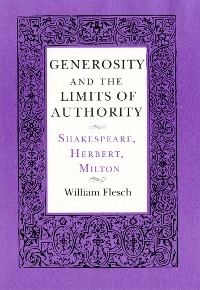
Generosity and the Limits of Authority (eBook)
296 Seiten
Cornell University Press (Verlag)
978-1-5017-3287-4 (ISBN)
Drawing on the work of such theorists as Mauss, Blanchot, Bourdieu, Wittgenstein, Bloom, Cavell, and Greenblatt, Flesch maintains that the literary power of Shakespeare, Herbert, and Milton is at its most intense when they are exploring the limits of generosity.
Generosity is an ambiguous quality, William Flesch observes; while receiving gifts is pleasant, gift-giving both displays the wealth and strength of the giver and places the receiver under an obligation. In provocative new readings of Shakespeare, Herbert, and Milton, Flesch illuminates the personal authority that is bound inextricably with acts of generosity. Drawing on the work of such theorists as Mauss, Blanchot, Bourdieu, Wittgenstein, Bloom, Cavell, and Greenblatt, Flesch maintains that the literary power of Shakespeare, Herbert, and Milton is at its most intense when they are exploring the limits of generosity. He considers how in Herbert's Temple divine assurance of the possibility of redemption is put into question and how the poet approaches such a gift with the ambivalence of a beneficiary. In his readings of Shakespeare's Richard II, Henry IV, King Lear, Antony and Cleopatra, and the sonnets, Flesch examines the perspective of the benefactor-including Shakespeare himself-who confronts the decline of his capacity to give. Turning to Milton's Paradise Lost, Flesch identifies two opposing ways of understanding generosity-Satan's, on the one hand, and Adam and Eve's, on the other - and elaborates the different conceptions of poetry to which these understandings give rise. Scholars of Shakespeare and of Renaissance culture, Miltonists, literary theorists, and others interested in the relationship between philosophy and literature will want to read this insightful and challenging book.
William Flesch is Associate Professor of English at Brandeis University.
| Erscheint lt. Verlag | 31.10.2018 |
|---|---|
| Verlagsort | Ithaca |
| Sprache | englisch |
| Maße | 150 x 150 mm |
| Themenwelt | Literatur ► Biografien / Erfahrungsberichte |
| Literatur ► Essays / Feuilleton | |
| Geisteswissenschaften ► Sprach- / Literaturwissenschaft ► Anglistik / Amerikanistik | |
| Geisteswissenschaften ► Sprach- / Literaturwissenschaft ► Literaturgeschichte | |
| Geisteswissenschaften ► Sprach- / Literaturwissenschaft ► Literaturwissenschaft | |
| ISBN-10 | 1-5017-3287-0 / 1501732870 |
| ISBN-13 | 978-1-5017-3287-4 / 9781501732874 |
| Informationen gemäß Produktsicherheitsverordnung (GPSR) | |
| Haben Sie eine Frage zum Produkt? |
 EPUB (Adobe DRM)
Kopierschutz: Adobe-DRM
Adobe-DRM ist ein Kopierschutz, der das eBook vor Mißbrauch schützen soll. Dabei wird das eBook bereits beim Download auf Ihre persönliche Adobe-ID autorisiert. Lesen können Sie das eBook dann nur auf den Geräten, welche ebenfalls auf Ihre Adobe-ID registriert sind.
Details zum Adobe-DRM
Dateiformat: EPUB (Electronic Publication)
EPUB ist ein offener Standard für eBooks und eignet sich besonders zur Darstellung von Belletristik und Sachbüchern. Der Fließtext wird dynamisch an die Display- und Schriftgröße angepasst. Auch für mobile Lesegeräte ist EPUB daher gut geeignet.
Systemvoraussetzungen:
PC/Mac: Mit einem PC oder Mac können Sie dieses eBook lesen. Sie benötigen eine
eReader: Dieses eBook kann mit (fast) allen eBook-Readern gelesen werden. Mit dem amazon-Kindle ist es aber nicht kompatibel.
Smartphone/Tablet: Egal ob Apple oder Android, dieses eBook können Sie lesen. Sie benötigen eine
Geräteliste und zusätzliche Hinweise
Buying eBooks from abroad
For tax law reasons we can sell eBooks just within Germany and Switzerland. Regrettably we cannot fulfill eBook-orders from other countries.
aus dem Bereich