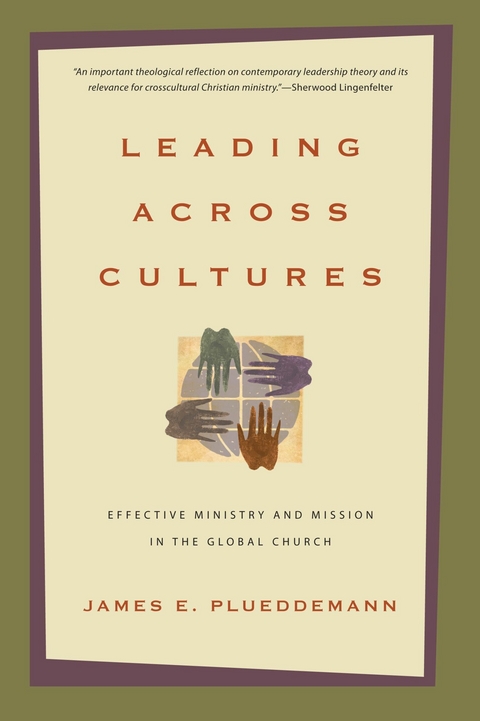
Leading Across Cultures (eBook)
313 Seiten
IVP Academic (Verlag)
978-0-8308-6630-4 (ISBN)
James E. Plueddemann (PhD, Michigan State), now retired, taught for many years as professor of missions at Trinity Evangelical Divinity School. He also previously served as the chair of the educational ministries department at Wheaton College. He is the author of Leading Across Cultures: Effective Ministry and Mission in the Global Church.
The worldwide church is more interconnected than ever before, with missionaries going from everywhere to everywhere. Africans work with Australians in India. Koreans plant churches in London and Los Angeles. But globalization also creates challenges for crosscultural tension and misunderstandings, as different cultures have conflicting assumptions about leadership values and styles.Missiologist James E. Plueddemann presents a roadmap for crosscultural leadership development in the global church. With keen understanding of current research on cultural dynamics, he integrates theology with leadership theory to apply biblical insights to practical issues in world mission.Savvy discernment of diverse cultural underpinnings allows multicultural teams to work together with mutual respect for more effective ministry. The author shows how leaders can grow from an individualistic egocentric practice of leadership to a more global-centric approach.The future of the global church depends on effective multicultural leadership. God has called people from various contexts to minister and lead in every land for the sake of the gospel. Whether you are teaching English in China, directing information technology in Africa or pastoring a multiethnic church in North America, discover how you can better work and lead across cultures.
James E. Plueddemann (Ph.D., Michigan State) is Professor of Missions and Chair, Department of Missions and Evangelism at Trinity Evangelical Divinity School. He is the author of God's Heart for the World: Missionary Themes from Genesis to Revelation, James: Growing in Maturity, Spiritual Hunger: Filling Your Deepest Longings, and Meekness: Claiming Your Inheritance (all with Carol Plueddemann).
1
Leadership for a New Day in World Missions
Christian mission in the twenty-first century has become the responsibility of a global church.
Samuel Escobar
I was a bit reticent about conducting official business in my supervisor’s living room so late in the evening, long after office hours. As I waited, a rerun of Hawaii Five-O blared on the television in the corner, and the room was packed with more than a dozen pastors all waiting their turn to consult with my Nigerian boss.
As the director of theological education for this large West African denomination, I was responsible for the administration of twenty-one Bible colleges and seminaries. I often needed to consult with my boss about major decisions, so I made regular appointments through his secretary. Seldom did we meet during the scheduled time. Most often he would be away on an emergency trip, or an important pastor or village chief would show up at the last minute and usurp my time slot.
On this night I was frantic. I needed a decision from my boss for a crucial board meeting. My flight left very early the next morning. One of the Bible colleges had run out of money halfway through the last semester, and the board was recommending that we close the school and send the students home! I needed to tell my boss this news and get his advice. After missing another appointment he simply told me to come to his house that evening. Even though I felt it would be rude for me to interrupt his personal and family time with my official business, I went. As I entered his living room, I noticed every chair was filled with pastors coming to him for advice or decisions. I waited my turn, somewhat embarrassed to overhear what seemed to be confidential conversations about various church discipline problems, but no one else seemed uncomfortable. At that moment I sat there feeling frustrated, impatient and confused about Nigerian leadership style.
The Challenge
The good news is that the body of Christ has been planted and is growing in every country of the world to the extent that churches in the non-Western world are now the majority. The globalization of the church and the general accessibility of cheap air travel have led to unprecedented international interconnectedness.
- Millions of short-termers travel from scores of countries every year to just about every country of the world.
- Tens of thousands of long-term missionaries from Africa, Asia and Latin America now serve in every country of the world.
- Christian colleges and universities are becoming intentionally globalized.
- Urban centers worldwide are forging new multicultural ministries.
- Global business people often see their work as ministry.
- A high percentage of missionaries are working under the leadership of national church leaders.
- Hundreds of churches are forming mission partnerships with other churches around the world.
- Whole denominations in the West are coming under the direction of African leaders.
- Crosscultural leadership development may be the most important task in missions.
This globalization of the church brings fresh challenges. Many individuals and organizations remain unaware of cultural leadership differences, often leading to confusion and bitter misunderstanding.
In spite of profound yet hidden differences, many pastors naively lead short-term teams and attempt to create crosscultural partnerships. I have noticed a growing number of voices suggesting that anyone can do crosscultural missions. Missiologists call this “the amateurization of missions,” while the amateurs call it “the democratization of missions.” Mission pastors rightly react against purists who would like to require that all missionaries have a doctorate in anthropology before serving in another culture. The other extreme is even more dangerous. I’ve heard youth pastors tell their mission team, “Just be yourself, and everyone will love you.” This is a formula for crosscultural disaster. After being burned by bitter cultural misunderstandings, church leaders are recognizing the need for a deeper understanding of cultural differences in leadership.
For God’s people to work together effectively, implicit assumptions about leadership need to be made explicit. They must be evaluated in light of sound social science research and biblical principles. The church in the North and South, the East and West acts out of unconscious and often confusing assumptions about leadership. We must appreciate the differences and challenge some of the misconceptions in order to work together as the worldwide body of Christ.
You don’t have to travel from Australia to Afghanistan to bump into cultural leadership differences. Remarkable variations exist in the same country, even a few blocks from each other! Cultural assumptions about leadership between young business graduates and very senior executives frustrate both age groups. Those growing up in rural communities experience leadership shock when they share office space with colleagues from London, Manhattan or Lagos. Disagreements between ethnically diverse neighbors are often the result of conflicting cultural values. Several research studies indicate that women and men tend to lead with dissimilar cultural values.[1] Radical differences exist between the leadership culture of a for-profit corporation and that of a volunteer association.[2] First-generation immigrants are puzzled by the leadership expectations of second- and third-generation children. Anyone who leads or is led—in other words, everyone—is inescapably impacted by cultural assumptions about leadership.
Our global economy thrusts together people with radically divergent assumptions about leadership. Thomas Friedman writes of the fascinating manufacturing history of his Dell computer. In story after story, he describes computer components made by British-owned companies in India, China and Malaysia; by Japanese and Taiwanese and Irish-owned companies in China; by American-owned companies in Malaysia; as well as by companies in the Philippines, Costa Rica, South Korea, Thailand and Israel.[3] The globalization of business has spawned hundreds of studies investigating the effects of culture on leadership. These insightful analyses provide a rich source for forging understanding and cooperation in the global church.
Mission agencies today are increasingly and delightfully multicultural. This is a moment in history when the whole church faces an unprecedented opportunity to reach out to the whole world. I witnessed a mission team in northern India made up of Canadians, Guatemalans, Japanese, Koreans, North Americans, Ethiopians and Indians sharing the gospel with Muslims along the Ganges River. The message of the gospel takes on significant credibility when communicated by such an international team. The skeptic who says that Christianity is a Western religion must give pause when those communicating the good news come from diverse cultures. World missions must be multicultural because the gospel is for everyone and the Great Commission is for all believers. But being an effective multicultural leader is not easy, especially when false expectations and hidden assumptions exist about what it means to be a leader or follower.
Tens of millions of business people, scholars, migrants, immigrants and refugees are flooding countries that traditionally contained one or two dominant cultures. Countries such as Korea, China, Brazil, India and Nigeria are now contributing astounding numbers of missionaries worldwide.[4] This brings phenomenal opportunities for crosscultural church cooperation—along with serious challenges.
The following scenarios illustrate the interplay of leadership and culture. Some names and places have been changed, but these are actual stories from my personal experience that reflect the challenges of crosscultural leadership.
Scenario 1: North Americans in Peru. The short-term team from a North American church spent months preparing to partner with a church in Peru. Church leaders in Peru asked the multigenerational church team to conduct a marriage enrichment seminar. The American team recruited people who had the experience and training to teach a marriage-enrichment seminar, and they worked hard to adapt their materials to Peruvian culture. But when the Americans arrived in Peru they were told that the marriage-enrichment seminar had been cancelled. Brian was furious at the apparent dishonesty of bringing a well-trained team all the way to Peru, with all the planning, costs and time involved, just to cancel the program. But Margaret, who didn’t speak a word of Spanish, decided that she would simply get to know the Peruvian family in whose home she was staying. Long into the night, she found ways to communicate, as she and her host family shared photographs and stories about their families. Margaret came back a changed person, with many new Peruvian friends. Brian came home frustrated and resentful. What was the difference? Perhaps Margaret understood that some individuals and cultures are goal-oriented while others are explicitly relationship-oriented.
Scenario 2: Multicultural team building in Liberia. As a silent observer, I sat in a back corner of the living room in northern Liberia and listened as missionaries discussed strategy. Tension grew as Canadians, Koreans, New Zealanders and Nigerians debated what it meant to be a team. The Nigerian missionary suggested that the team do everything together; the Korean missionary urged a daily 5 a.m. prayer meeting; and the New Zealand family...
| Erscheint lt. Verlag | 4.11.2012 |
|---|---|
| Verlagsort | Lisle |
| Sprache | englisch |
| Themenwelt | Religion / Theologie ► Christentum ► Kirchengeschichte |
| Schlagworte | assumption • Bias • Christian leader • christian missionary • Christian Missions • Church • ConText • cross-cultural • crosscultural • cross-culturally • Cross Culture • Cultural • cultural dynamics • Culture • Global • Global Church • Globalization • Global mission • God • Gospel • Great Commission • helpful • Invitation to World Missions • lead • Leader • Leading Cross-Culturally • Mentor Like Jesus • ministry • Missiology • Missionary • missions • misunderstanding • Multicultural • Pastoral Resources • Practical • Role • share the gospel • situations • Understanding |
| ISBN-10 | 0-8308-6630-2 / 0830866302 |
| ISBN-13 | 978-0-8308-6630-4 / 9780830866304 |
| Informationen gemäß Produktsicherheitsverordnung (GPSR) | |
| Haben Sie eine Frage zum Produkt? |
 EPUB (Adobe DRM)
Kopierschutz: Adobe-DRM
Adobe-DRM ist ein Kopierschutz, der das eBook vor Mißbrauch schützen soll. Dabei wird das eBook bereits beim Download auf Ihre persönliche Adobe-ID autorisiert. Lesen können Sie das eBook dann nur auf den Geräten, welche ebenfalls auf Ihre Adobe-ID registriert sind.
Details zum Adobe-DRM
Dateiformat: EPUB (Electronic Publication)
EPUB ist ein offener Standard für eBooks und eignet sich besonders zur Darstellung von Belletristik und Sachbüchern. Der Fließtext wird dynamisch an die Display- und Schriftgröße angepasst. Auch für mobile Lesegeräte ist EPUB daher gut geeignet.
Systemvoraussetzungen:
PC/Mac: Mit einem PC oder Mac können Sie dieses eBook lesen. Sie benötigen eine
eReader: Dieses eBook kann mit (fast) allen eBook-Readern gelesen werden. Mit dem amazon-Kindle ist es aber nicht kompatibel.
Smartphone/Tablet: Egal ob Apple oder Android, dieses eBook können Sie lesen. Sie benötigen eine
Geräteliste und zusätzliche Hinweise
Buying eBooks from abroad
For tax law reasons we can sell eBooks just within Germany and Switzerland. Regrettably we cannot fulfill eBook-orders from other countries.
aus dem Bereich