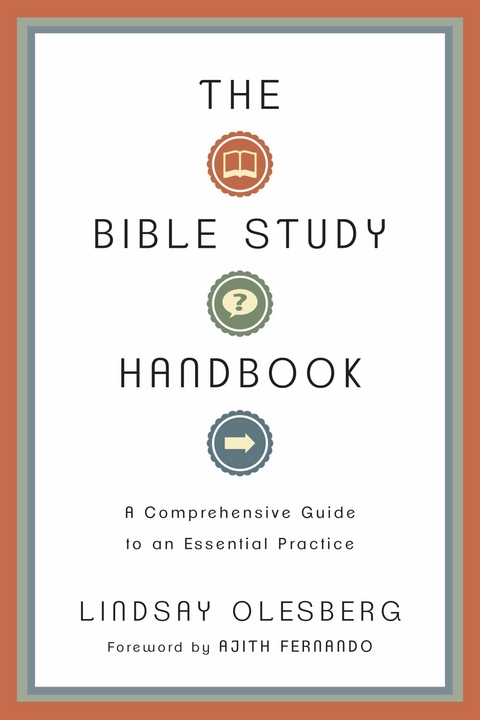
The Bible Study Handbook (eBook)
253 Seiten
IVP Bible Studies (Verlag)
978-0-8308-6344-0 (ISBN)
Lindsay Olesberg is a Bible teacher and Scripture Engagement leader with the Lausanne Movement. She has overseen Bible study and exegesis at major evangelical gatherings throughout the world.
Lindsay Olesberg is the Scripture manager for the Urbana Student Missions Convention. She has overseen Bible study and exegesis at major evangelical gatherings throughout the world.
Introduction:
Solid
King David? Who’s that?” The other teens in the room looked at me like I was from Mars. I flinched ever so slightly as I saw incredulity followed quickly by criticalness pass across some of their faces. I was new to youth group and already felt self-conscious. Not knowing about King David, it turns out, was like not knowing about George Washington or Abraham Lincoln.
Wishing I had kept my questions to myself or asked the leader later, I listened carefully to the answer given: “The greatest king of Israel and forefather of Jesus.” The answer didn’t help much. I only had a vague idea of where Israel is and absolutely no sense of what it or its kings had to do with me as a new follower of Jesus.
I had been overjoyed at age twelve to hear for the first time that there is a God who created me and loves me. I found it remarkable that this God would want a relationship with me and had sent his Son to the cross to make that relationship possible. Becoming a Christian was the most wonderful thing that ever happened to me, better than a Disney vacation or winning the lottery. But it also plunged me into a very foreign world.
I grew up in a completely secular home. No one read stories to me from a children’s Bible with a picture of shepherd Jesus on the cover. I had never attended Sunday School or acted out the story of David and Goliath. It seemed to me that the kids in my youth group were natives of a culture that, until recently, I hadn’t known existed.
As an only child being raised by a single mom, I was eager to fit in and to be liked. As a young girl yearning to grow in a newly discovered relationship with her Heavenly Father, I was eager to learn as much as I could. This meant learning the lingo, discerning the unspoken rules of how to behave in church settings and figuring out the right questions to ask.
After enough experiences of feeling stupid, confused or unsatisfied in youth group because I didn’t understand most of what was being said, I made one of the most important decisions of my young life. I decided to study the Bible on my own.
Now, I had absolutely no idea how to go about studying the Bible by myself. But nonetheless, during the summer between ninth and tenth grade I studied the Bible for over an hour a day. I wrote down thoughts and questions in a notebook. I made lists. I looked up cross-references. Slowly I began to feel like I could make out the basic story.
Discovering Manuscript Study
It was great to not feel stupid in youth group and to understand the lessons. But soon a subtle shift took place in my heart. As I continued to read and study the Bible, pride crept in.
In addition to my hunger for connecting with God, I also became motivated by a different desire: to be a “top student.” Rather than deepening my relationship with Jesus, I grew increasingly focused on accumulating facts and knowledge. In fact, when I arrived at the Claremont Colleges and was invited to join a small group Bible study for freshmen, I declined. By that point I was so self-assured that I assumed a Bible study for freshmen would be too basic for me. That’s embarrassing to admit, but it’s the ugly truth.
And then something remarkable happened to me.
I was invited to what my InterVarsity group called a “Dig-In.” Yes, the name is corny, but it captures the spirit of the event well. A dig-in is a ten- to fifteen-hour intensive study of a single book of the Bible, using something called the “manuscript method.” It’s not a retreat weekend in a beautiful setting with a dynamic speaker, moving worship and funny skits or games. A dig-in is simply an extended time of hard work, digging deeply into God’s Word, with a few meals and prayer tucked around the edges.
I liked the campus minister who invited me to the dig-in, and I was looking for deeper relationships with the Christian community on campus, so I said yes to the invitation. I felt confident about my Bible knowledge and figured that it was a setting in which I would shine. (The ego is an amazing motivator.) But when I walked into the classroom where my group met, my heart sank a little. I didn’t recognize any of the students seated around the table. I became a little anxious and thought, What have I gotten myself into?
You wouldn’t expect lots of students to give up their weekends to participate in such an intense study. But fifteen students did, and I soon discovered why. The leader, Tom, briefly explained the inductive method, and then he passed out the book of James. It was printed on standard paper. I was intrigued, but flipping through the James manuscript and realizing that I could read it all in less than fifteen minutes made me wonder, How in the world can we spend twelve hours on this?
That first night, Tom encouraged us to look closely at the first page and a half of the manuscript. He encouraged us to look closely and mark what we observed. As I read through the first page I noticed words like trial and testing and decided to circle them with a pink pen. I highlighted all the commands in green (like “ask God”) and wrote a question mark next to the sentence about being joyful in trials. After a few minutes of quiet reading and studying, Tom invited us to share with each other what we had seen in the text.
For the next twenty minutes the comments came fast and furious. Paul, a sophomore, had seen variations of the word give six times. A girl with big glasses and long braids said, “There is a contrast between line six, where it says ‘God gives generously’ to all who ask for wisdom, and line nine, where it says the double-minded ‘must not expect to receive anything from the Lord.’” Each time someone shared an observation I hadn’t seen, I added it to my manuscript. Before too long my sheet was littered with observations about the text.
Figure I.1.
The next few hours were glorious. We talked, discussed, laughed, even argued as we worked to understand the meaning of the text. Tom taught us to challenge each other gently with questions such as “Where do you see that in the text?” When we would ask Tom for “the answer,” he would refuse to give it to us and direct us back into the text to dig deeper. Our work paid off as God gave us more and more clarity. We felt as if we were in a lively conversation with God himself and that he was actively speaking to us. The book of James had come alive.
Figure I.2.
By the end of that dig-in, I was hooked on manuscript Bible study. For the first time I understood how faith and works are connected, and I had some very specific ways that I wanted to act on the Word in the coming week. I felt energized, stimulated and met by Jesus. I even had the beginnings of some real relationships with other Christian students. My earlier motivations for Bible study melted away. My drive to know a lot and be thought well of was replaced by fascination with the Bible and a hunger to experience Jesus through his Word and with his people. God had given me far more than I had given him. I couldn’t wait for the next dig-in.
Shifting Motivations
Our campus fellowship spent a week every summer at Campus-By-The-Sea, a camp on Catalina Island off the coast of California. We immersed ourselves in manuscript study of Mark’s Gospel. As we studied, Jesus seemed to jump off the page. Studying Mark that week caused me to fall in love with Jesus and to know him deeply with my both my head and my heart. Not only my group but many InterVarsity chapters across the Los Angeles area were gripped with zeal to make Jesus known on campus and to take huge risks of faith together because of those Mark studies.
Throughout my twenties, I threw myself into practicing and teaching manuscript study. In my spare time, I created manuscripts of new books of the Bible to share with InterVarsity students and staff. In my early thirties I brought a new motivation to Bible study: the need for stability. Though my fascination and hunger had not waned, I hit a point in life where I felt pressed beyond my limits. My husband and I had two young children; my husband was finishing graduate school, and I had shifted from full-time to part-time work as an area director for InterVarsity Christian Fellowship. I was trying to do in twenty hours a week what I had previously done in fifty. Our church had lost its pastor and was slowly falling apart. I was disoriented by the shift from full-time ministry training dynamic young leaders to endless hours of changing diapers, stacking wooden blocks and folding laundry. To top it off, I was deeply shaken by the recent divorce of an important mentor.
During that time, I read a line from my favorite psalm: “I keep my eyes always on the LORD. / With him at my right hand, I will not be shaken” (Psalm 16:8 NIV). But I did feel shaken—and shaky. My life was like a tiny rowboat on a stormy ocean. I felt disoriented, vulnerable and scared. I needed an anchor, something to tie my boat down so that it didn’t drift off to sea or get caught on the rocks.
As I prayed, God showed me that he had already given me an anchor. Through meditating on the Bible every day I could experience the Lord at my right hand. Like Joshua as he faced the formidable challenge of attacking the Canaanites without Moses’ strong presence, I needed to keep God’s law ever before me and not turn from it to the right or the left (Joshua 1:7-8). I didn’t pick up my Bible because of commitment to spiritual disciplines. Meeting God through the Bible was an utter necessity. During those...
| Erscheint lt. Verlag | 2.8.2012 |
|---|---|
| Vorwort | Ajith Fernando |
| Verlagsort | Lisle |
| Sprache | englisch |
| Themenwelt | Religion / Theologie ► Christentum ► Kirchengeschichte |
| Religion / Theologie ► Christentum ► Moraltheologie / Sozialethik | |
| Schlagworte | Bible • Bible study • Bible verse • Christian • God • how to study the bible • Jesus • read the bible • study the bible • Understand the Bible |
| ISBN-10 | 0-8308-6344-3 / 0830863443 |
| ISBN-13 | 978-0-8308-6344-0 / 9780830863440 |
| Informationen gemäß Produktsicherheitsverordnung (GPSR) | |
| Haben Sie eine Frage zum Produkt? |
 EPUB (Wasserzeichen)
DRM: Digitales Wasserzeichen
Dieses eBook enthält ein digitales Wasserzeichen und ist damit für Sie personalisiert. Bei einer missbräuchlichen Weitergabe des eBooks an Dritte ist eine Rückverfolgung an die Quelle möglich.
Dateiformat: EPUB (Electronic Publication)
EPUB ist ein offener Standard für eBooks und eignet sich besonders zur Darstellung von Belletristik und Sachbüchern. Der Fließtext wird dynamisch an die Display- und Schriftgröße angepasst. Auch für mobile Lesegeräte ist EPUB daher gut geeignet.
Systemvoraussetzungen:
PC/Mac: Mit einem PC oder Mac können Sie dieses eBook lesen. Sie benötigen dafür die kostenlose Software Adobe Digital Editions.
eReader: Dieses eBook kann mit (fast) allen eBook-Readern gelesen werden. Mit dem amazon-Kindle ist es aber nicht kompatibel.
Smartphone/Tablet: Egal ob Apple oder Android, dieses eBook können Sie lesen. Sie benötigen dafür eine kostenlose App.
Geräteliste und zusätzliche Hinweise
Buying eBooks from abroad
For tax law reasons we can sell eBooks just within Germany and Switzerland. Regrettably we cannot fulfill eBook-orders from other countries.
aus dem Bereich