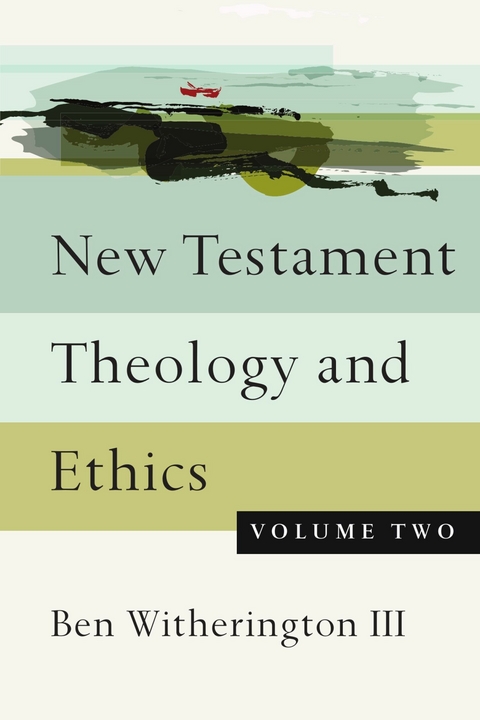
New Testament Theology and Ethics (eBook)
838 Seiten
IVP Academic (Verlag)
978-0-8308-9984-5 (ISBN)
Ben Witherington III (PhD, University of Durham) is professor of New Testament at Asbury Theological Seminary. He is the author of a full set of commentaries on the books of the New Testament, many of which focus on their socio-rhetorical perspectives. His numerous other books on the New Testament include New Testament History, Jesus the Seer, Jesus the Sage, The Jesus Quest, The Paul Quest and A Week in the Life of Corinth.
Ben Witherington III (PhD, University of Durham) is Jean R. Amos Professor of New Testament for Doctoral Studies at Asbury Theological Seminary. A prominent evangelical scholar, he is also on the doctoral faculty at St. Andrews University in Scotland.Witherington has written over forty books, including The Jesus Quest and The Paul Quest, both of which were selected as top biblical studies works by Christianity Today. His other works include The Indelible Image, Women and the Genesis of Christianity, The Gospel Code, A Week in the Life of Corinth and commentaries on the entire New Testament. He also writes for many church and scholarly publications and is a frequent contributor to Patheos and Beliefnet.Witherington is an elected member of the prestigious Studiorum Novi Testamenti Societas, a society dedicated to New Testament studies. He is a John Wesley Fellow for Life, a research fellow at Cambridge University and a member of numerous professional organizations, including the Society of Biblical Literature, Society for the Study of the New Testament and the Institute for Biblical Research. He previously taught at institutions like Ashland Theological Seminary, Vanderbilt University, Duke Divinity School and Gordon-Conwell Theological Seminary.An ordained pastor in the United Methodist Church and a popular lecturer, Witherington has presented seminars for churches, colleges and biblical meetings around the world. He has led numerous study tours through the lands of the Bible and is known for bringing the text to life through incisive historical and cultural analysis. Along with many interviews on radio and television networks across the country, Witherington has been seen in programs such as 60 Minutes, 20/20, Dateline and the Peter Jennings ABC special Jesus and Paul—The Word and the Witness.
PROLEGOMENA
Is New Testament Theology or Ethics Possible?
The Bible tells us not how we should talk to God, but what he says to us; not how we find the way to him, but how he has sought and found the way to us. . . . The Word of God is within the Bible.
KARL BARTH1
If one is a student of the scholarly work that has earned the label “New Testament theology,” it becomes obvious, after only a little study, that in the modern era New Testament theology, like Old Testament theology, has largely been a Protestant preoccupation until the last ten years or so. The recent study of the subject was set in motion by the landmark work in German by Rudolf Bultmann undertaken between 1948 and 1953 and translated into English in the 1950s and by his German and Swiss successors Hans Conzelmann, Joachim Jeremias, Oscar Cullmann, and Leonhard Goppelt, to mention but a few. As profound and rich as Bultmann’s work was, it was overwhelmingly a study of Paul and the Johannine corpus, not the whole of the New Testament by any means. It also had the odd feature of combining a reading of the New Testament through an existentialist lens with a history-of-religions approach to a good deal of the subject matter, not to mention resting on the judgment that Jesus and his teaching were only the presupposition of New Testament theology and not a part of it.2 Today, few scholars would follow Bultmann’s lead in these approaches if the subject is New Testament theology, and rightly so. But a historical approach to the subject does not require a history of religions approach, as we will see. Frank Matera puts it this way: “Inasmuch as the New Testament communicates its theology through specific narrative and epistolary forms, a theology of the New Testament ought to be a literary and theological analysis of the New Testament writings rather than a history of early Christian thought.”3
Bultmann’s successors fared only a little better, with Jeremias providing a corrective by focusing in his first volume on Jesus, and the others providing more comprehensive approaches than Bultmann undertook.4 The landmark work of Bultmann also intimated and set a precedent for two notions: (1) New Testament theology is a subject that could and should be treated separately from New Testament ethics (which was seen as a less lofty subject); (2) only certain portions of the New Testament have enough theological ore in them to be worth mining. The present study, in both its focus and emphases, will attempt to overcome and correct both of these presuppositional and methodological deficiencies, which are all too common even in much more recent studies of New Testament theology. Surprisingly, what few of those German and Swiss studies that set the modern discussion in motion were even willing to admit or discuss is that if one talks about New Testament theology or New Testament ethics, one must have some sort of presumption or view about what allows one to undertake such a study, what unifies a subject such as that. In fact, the invisible elephant in the room that such commentators were unwilling to actually discuss was the revealer God who inspired various persons to speak his truth. We have gotten to an odd place indeed when one is not prepared to talk at all about God’s possible role in producing books that talk about God!
In other words, before one can do or discover a New Testament theology or ethic, there must be in place a certain way of viewing the New Testament. One must assume that a New Testament theology or ethic exists and can be found in or ferreted out of the diverse texts we call “the New Testament.” Unlike the enterprise of looking at the theologies in the New Testament that can be a purely historical and descriptive one that presupposes no faith commitments necessarily, the enterprise undertaken in the present volume presupposes a view of the whole New Testament, namely, that it is in some sense a unity, and more specifically that this unity is given by God. This in turn implies a theory about the way God has revealed himself, his will, and his salvation to diverse persons. It also implies a theory of revelation leading to inspiration leading to inscripturation.5
I do not intend here to retread all the ground that I have already covered in my book The Living Word of God6 and that I will touch on briefly when I discuss the symbolic universe of the New Testament writers. Here it must suffice to say that in my view, the main issue is not whether we view the Bible, and in this case the New Testament in particular, as God’s Word or Scripture, although that is important, but whether the New Testament in fact is, and presents itself as, God’s living Word. In my view, the Bible is God’s Word whether I believe it or not, know it or not, trust it or not. In short, it is the ontology of the Bible itself that is at issue, not my belief in it or even what I believe about it. This is another way of saying that the New Testament conveys, and claims to convey, the truth about God and his relationships with human beings.
The New Testament makes certain inherent truth claims, and what often happens when we encounter the New Testament with an open heart is that we are “seized by truth”—to borrow the title of an important book by Joel Green.7 I realize, of course, that whether the Bible functions as Scripture for me depends on how I relate to the Bible, but in my view, that is a second-order question, not the main question. In the rest of this prolegomena I wish to talk more about the New Testament as sacred text, as Word of God, in the context of interacting with Green’s book.
THE NEW TESTAMENT AS THE WORD OF GOD: CRITICAL REFLECTIONS ON JOEL B. GREEN’S SEIZED BY TRUTH
Green begins his study by pointing out that while it has been something of a mantra in biblical studies that the Bible should be read as we would read any other book, this very approach impedes a reading of the Bible as Scripture.8 Embracing the Bible as a revelation from God, as a coherent whole, as Scripture is a step of faith, and it requires that we attend better to “what we bring with us when we bring ourselves to the task of reading the Bible.”9
Green stresses that to call the Bible Scripture or the Word of God is to make a theological statement, and it not only draws attention to the origin, role, and aim of these texts in God’s self-communication, but also reveals something about the person making the statement. It reveals that person’s faith commitments. Nevertheless, it is not the faith commitment that makes the Bible the Word of God or changes information into revelation. Many persons know the Bible well but do not know the God of the Bible. Faith is not required to recognize that the Bible tells the truth about this or that historical or geographical or other sort of factual matter, but to recognize that the Bible is telling the truth about God and the divine human encounter and about the theological interpretation of all of reality requires more than a keen intellect. In short, I am suggesting that the order of things is from the text to faith, not from my faith to the text, for it is the truth in the text that helped form my faith in the first place. The Bible and its truth claims are logically prior to and, as applied by the Holy Spirit, are what prompt or engender anyone’s faith response.
In an interesting comparison, Green stresses that whereas paintings are experienced as a whole and at once, texts, by their very nature, are linear, and they reveal their secrets progressively, rather like listening to a sermon.10 I would insist, however, that with rare exceptions, the New Testament texts that we have were meant to be heard whole in their literary content, exactly like a sermon, and not be taken as sound bites. Is, then, the doing of New Testament theology or ethics a violation of the intended character of how this revelation was meant to be heard, received, and believed? By this I mean, is the extracting of theological or ethical ore from the New Testament working at cross-purposes with how these texts were meant to be heard? I think that the answer to this question can be yes, especially if we take a history-of-ideas sort of approach to New Testament theology and ethics rather than attending to the symbolic universe and narrative thought world in which these ideas are embedded and expressed. Green is right: “Reading the whole text, and reading the text as a whole, together with attention to sequence, thus become nonnegotiable protocols for the competent interpreter.”11
Green goes on to stress that “more necessary than familiarity with ancient peoples, and their cultures, more basic than learning the biblical languages, and more essential than good technique in interpretation are such dispositions and postures as acceptance, devotion, attention and trust. Accordingly, we acknowledge and invite the ongoing work of Scripture’s divine author as the One capable and desirous of authoring a community, the church.”12 It appears that he is suggesting a prioritizing of things that I would not entirely agree with. You have to know what and whom you are submitting to before making a viable and vital faith commitment. This in turn requires a certain familiarity with the historical substance of the text. In other words, historical study of the text must not be placed behind faith commitment to the text if we want to both understand and adore our God; rather, it must be seen as an indispensible part of such an undertaking. A deep appreciation of the historical context of the Bible is, at the end of the day, required to...
| Erscheint lt. Verlag | 21.3.2016 |
|---|---|
| Reihe/Serie | New Testament Theology and Ethics | New Testament Theology and Ethics |
| Verlagsort | Lisle |
| Sprache | englisch |
| Themenwelt | Geisteswissenschaften ► Religion / Theologie ► Christentum |
| Schlagworte | Bible ethics • biblical ethics • Biblical Theology • New Testament • new testament ethics • New Testament Theology • NT ethics • NT theology |
| ISBN-10 | 0-8308-9984-7 / 0830899847 |
| ISBN-13 | 978-0-8308-9984-5 / 9780830899845 |
| Informationen gemäß Produktsicherheitsverordnung (GPSR) | |
| Haben Sie eine Frage zum Produkt? |
 EPUB (Wasserzeichen)
DRM: Digitales Wasserzeichen
Dieses eBook enthält ein digitales Wasserzeichen und ist damit für Sie personalisiert. Bei einer missbräuchlichen Weitergabe des eBooks an Dritte ist eine Rückverfolgung an die Quelle möglich.
Dateiformat: EPUB (Electronic Publication)
EPUB ist ein offener Standard für eBooks und eignet sich besonders zur Darstellung von Belletristik und Sachbüchern. Der Fließtext wird dynamisch an die Display- und Schriftgröße angepasst. Auch für mobile Lesegeräte ist EPUB daher gut geeignet.
Systemvoraussetzungen:
PC/Mac: Mit einem PC oder Mac können Sie dieses eBook lesen. Sie benötigen dafür die kostenlose Software Adobe Digital Editions.
eReader: Dieses eBook kann mit (fast) allen eBook-Readern gelesen werden. Mit dem amazon-Kindle ist es aber nicht kompatibel.
Smartphone/Tablet: Egal ob Apple oder Android, dieses eBook können Sie lesen. Sie benötigen dafür eine kostenlose App.
Geräteliste und zusätzliche Hinweise
Buying eBooks from abroad
For tax law reasons we can sell eBooks just within Germany and Switzerland. Regrettably we cannot fulfill eBook-orders from other countries.
aus dem Bereich