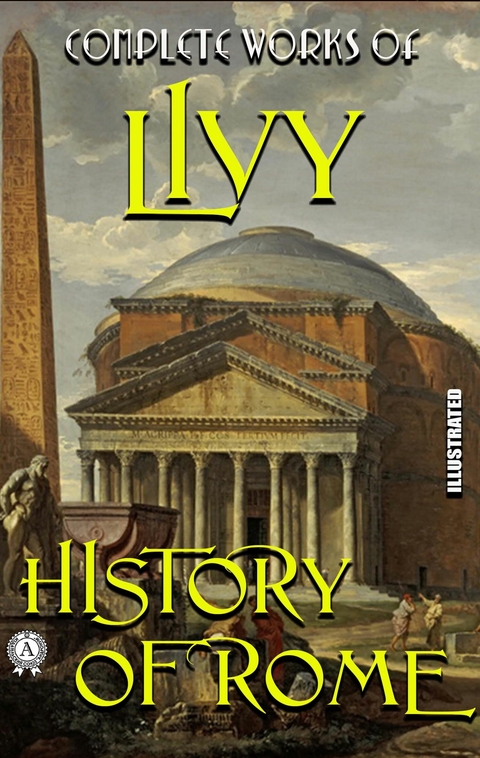
Complete Works of Livy. Illustrated (eBook)
6319 Seiten
Strelbytskyy Multimedia Publishing (Verlag)
978-0-88001-113-6 (ISBN)

Livy wrote a monumental history of Rome and the Roman people, titled Ab Urbe Condita
Livy wrote a monumental history of Rome and the Roman people, titled Ab Urbe Condita
BOOK I
Translated by B. O. Foster
1. Whether I am likely to accomplish anything worthy of the labour, if I record the achievements of the Roman people from the foundation of the city, I do not really know, nor if I knew would I dare to avouch it; [2] perceiving as I do that the theme is not only old but hackneyed, through the constant succession of new historians, who believe either that in their facts they can produce more authentic information, or that in their style they will prove better than the rude attempts of the ancients. [3] Yet, however this shall be, it will be a satisfaction to have done myself as much as lies in me to commemorate the deeds of the foremost people of the world; and if in so vast a company of writers my own reputation should be obscure, my consolation would be the fame and greatness of those whose renown will throw mine into the shade. [4] Moreover, my subject involves infinite labour, seeing that it must be traced back above seven hundred years, and that proceeding from slender beginnings it has so increased as now to be burdened by its own magnitude; and at the same time I doubt not that to most readers the earliest origins and the period immediately succeeding them will give little pleasure, for they will be in haste to reach these modern times, in which the might of a people which has long been very powerful is working its own undoing. [5] I myself, on the contrary, shall seek in this an additional reward for my toil, that I may avert my gaze from the troubles which our age has been witnessing for so many years, so long at least as I am absorbed in the recollection of the brave [6] days of old, free from every care which, even if it could not divert the historian’s mind from the truth, might nevertheless cause it anxiety.
[7] Such traditions as belong to the time before the city was founded, or rather was presently to be founded, and are rather adorned with poetic legends than based upon trustworthy historical proofs, I purpose neither to affirm nor to refute. It is the privilege of antiquity to mingle divine things with human, and so to add dignity to the beginnings of cities; [8] and if any people ought to be allowed to consecrate their origins and refer them to a divine source, so great is the military glory of the Roman People that when they profess that their Father and the Father of their Founder was none other than Mars, the nations of the earth may well submit to this also with as good a grace as they submit to Rome’s dominion. [9] But to such legends as these, however they shall be regarded and judged, I shall, for my own part, attach no great importance. Here are the questions to which I would have every reader give his close attention — what life and morals were like; through what men and by what policies, in peace and in war, empire was established and enlarged; then let him note how, with the gradual relaxation of discipline, morals first gave way, as it were, then sank lower and lower, and finally began the downward plunge which has brought us to the present time, when we can endure neither our vices nor their cure.
[10] What chiefly makes the study of history wholesome and profitable is this, that you behold the lessons of every kind of experience set forth as on a conspicuous monument; from these you may choose for yourself and for your own state what to imitate, from these mark for avoidance what is shameful in the conception and shameful in the result. [11] For the rest, either love of the task I have set myself deceives me, or no state was ever greater, none more righteous or richer in good examples, none ever was where avarice and luxury came into the social order so late, or where humble means and thrift were so highly esteemed and so long held in honour. [12] For true it is that the less men’s wealth was, the less was their greed. Of late, riches have brought in avarice, and excessive pleasures the longing to carry wantonness and licence to the point of ruin for oneself and of universal destruction.
But complaints are sure to be disagreeable, even when they shall perhaps be necessary; let the beginning, at all events, of so great an enterprise have none. [13] With good omens rather would we begin, and, if historians had the same custom which poets have, with prayers and entreaties to the gods and goddesses, that they might grant us to bring to a successful issue the great task we have undertaken.
1. First of all, then, it is generally agreed that when Troy was taken vengeance was wreaked upon the other Trojans, but that two, Aeneas and Antenor, were spared all the penalties of war by the Achivi, owing to long-standing claims of hospitality, and because they had always advocated peace and the giving back of Helen. [2] They then experienced various vicissitudes. Antenor, with a company of Eneti who had been expelled from Paphlagonia in a revolution and were looking for a home and a leader — for they had lost their king, Pylaemenes, at Troy — came to the inmost bay of the Adriatic. [3] There, driving out the Euganei, who dwelt between the sea and the Alps, the Eneti and Trojans took possession of those lands. And in fact the place where they first landed is called Troy, and the district is therefore known as Trojan, while the people as a whole are called the Veneti. [4] Aeneas, driven from home by a similar misfortune, but guided by fate to undertakings of greater consequence, came first to Macedonia; thence was carried, in his quest of a place of settlement, to Sicily; and from Sicily laid his course towards the land of Laurentum. This place too is called Troy. [5] Landing there, the Trojans, as men who, after their all but immeasurable wanderings, had nothing left but their swords and ships, were driving booty from the fields, when King Latinus and the Aborigines, who then occupied that country, rushed down from their city and their fields to repel with arms the violence of the invaders. From this point the tradition follows two lines. Some say that Latinus, having been defeated in the battle, made a peace with Aeneas, and later an alliance of marriage. [6] Others maintain that when the opposing lines had been drawn up, Latinus did not wait for the charge to sound, but advanced amidst his chieftains and summoned the captain of the strangers to a parley. [7] He then inquired what men they were, whence they had come, what mishap had caused them to leave their home, and what they sought in landing on the coast of Laurentum. [8] He was told that the people were Trojans and their leader Aeneas, son of Anchises and Venus; that their city had been burnt, and that, driven from home, they were looking for a dwelling-place and a site where they might build a city. Filled with wonder at the renown of the race and the hero, and at his spirit, prepared alike for war or peace, he gave him his right hand in solemn pledge of lasting friendship. [9] The commanders then made a treaty, and the armies saluted each other. Aeneas became a guest in the house of Latinus; there the latter, in the presence of his household gods, added a domestic treaty to the public one, by giving his daughter in marriage to Aeneas. [10] This event removed any doubt in the minds of the Trojans that they had brought their wanderings to an end at last in a permanent and settled habitation. [11] They founded a town, which Aeneas named Lavinium, after his wife. In a short time, moreover, there was a male scion of the new marriage, to whom his parents gave the name of Ascanius.
2. War was then made upon Trojans and Aborigines alike. Turnus was king of the Rutulians, and to him Lavinia had been betrothed before the coming of Aeneas. Indignant that a stranger should be preferred before him, he attacked, at the same time, both Aeneas and Latinus. [2] Neither army came off rejoicing from that battle. The Rutulians were beaten: the victorious Aborigines and Trojans lost their leader Latinus. [3] Then Turnus and the Rutulians, discouraged at their situation, fled for succour to the opulent and powerful Etruscans and their king Mezentius, who held sway in Caere, at that time an important town. Mezentius had been, from the very beginning, far from pleased at the birth of the new city; he now felt that the Trojan state was growing much more rapidly than was altogether safe for its neighbours, and readily united his forces with those of the Rutulians. [4] Aeneas, that he might win the goodwill of the Aborigines to confront so formidable an array, and that all might possess not only the same rights but also the same name, called both nations Latins; and from that time on the Aborigines were no less ready and faithful than the Trojans in the service of King Aeneas. [5] Accordingly, trusting to this friendly spirit of the two peoples, which were growing each day more united, and, despite the power of Etruria, which had filled with the glory of her name not only the lands but the sea as well, along the whole extent of Italy from the Alps to the Sicilian Strait, Aeneas declined to defend himself behind his walls, as he might have done, but led out his troops to battle. [6] The fight which ensued was a victory for the Latins: for Aeneas it was, besides, the last of his mortal labours. He lies buried, whether it is fitting and right to term him god or man, on the banks of the river Numicus; men, however, call him Jupiter Indiges.
3. Ascanius, Aeneas’ son, was not yet ripe for authority; yet the authority was kept for him, unimpaired, until he arrived at manhood. Meanwhile, under a woman’s regency, the Latin State and the kingdom of his father and his grandfather stood unshaken — so strong was Lavinia’s character — until the boy could claim it....
| Erscheint lt. Verlag | 15.9.2021 |
|---|---|
| Übersetzer | B. O. Foster, William A. McDevitte |
| Verlagsort | Mikhailovka village |
| Sprache | englisch |
| Themenwelt | Literatur ► Romane / Erzählungen |
| Sachbuch/Ratgeber ► Geschichte / Politik | |
| Geisteswissenschaften ► Geschichte | |
| Schlagworte | ancient literature • Dialogues • English • Essays • history of rome • oratory • speeches • Strelbytskyy Multimedia Publishing • treatise |
| ISBN-10 | 0-88001-113-0 / 0880011130 |
| ISBN-13 | 978-0-88001-113-6 / 9780880011136 |
| Informationen gemäß Produktsicherheitsverordnung (GPSR) | |
| Haben Sie eine Frage zum Produkt? |
 EPUB (Wasserzeichen)
DRM: Digitales Wasserzeichen
Dieses eBook enthält ein digitales Wasserzeichen und ist damit für Sie personalisiert. Bei einer missbräuchlichen Weitergabe des eBooks an Dritte ist eine Rückverfolgung an die Quelle möglich.
Dateiformat: EPUB (Electronic Publication)
EPUB ist ein offener Standard für eBooks und eignet sich besonders zur Darstellung von Belletristik und Sachbüchern. Der Fließtext wird dynamisch an die Display- und Schriftgröße angepasst. Auch für mobile Lesegeräte ist EPUB daher gut geeignet.
Systemvoraussetzungen:
PC/Mac: Mit einem PC oder Mac können Sie dieses eBook lesen. Sie benötigen dafür die kostenlose Software Adobe Digital Editions.
eReader: Dieses eBook kann mit (fast) allen eBook-Readern gelesen werden. Mit dem amazon-Kindle ist es aber nicht kompatibel.
Smartphone/Tablet: Egal ob Apple oder Android, dieses eBook können Sie lesen. Sie benötigen dafür eine kostenlose App.
Geräteliste und zusätzliche Hinweise
Buying eBooks from abroad
For tax law reasons we can sell eBooks just within Germany and Switzerland. Regrettably we cannot fulfill eBook-orders from other countries.
aus dem Bereich