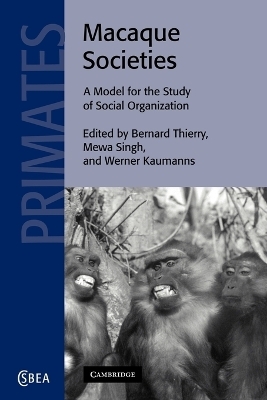
Macaque Societies
Cambridge University Press (Verlag)
9780521521680 (ISBN)
Animal and human societies are multifaceted. In order to understand how they have evolved, it is necessary to investigate each of the constituent facets including individual abilities and personalities, life-history traits, mating systems, demographic dynamics, gene flows, social relationships, ecology and phylogeny. By exploring the nature and evolution of macaque social organization, this book develops our knowledge of the rise of societies and their transformation during the course of evolution. Macaques are the most comprehensively studied of all monkey groups, and the 20 known species feature a broad diversity in their social relationships, making them a particularly good group for exploring the evolution of societies. This book will be of primary interest to those studying animal behaviour and primatology, but will also be useful to those involved in the study of human societies.
BERNARD THIERRY is Research Director at the Centre National de la Recherche Scientifique in Strasbourg, France. He has studied the social behaviour of non-human primates for the past 25 years, and is particularly interested in how internal constraints channel the evolutionary changes of social organisations. MEWA SINGH is a Professor of Psychology at the University of Mysore, India. His main research focus is on the evolution of sociality, and he is especially interested in bridging the gap between conservation biology and behavioural biology. WERNER KAUMANNS is Curator of Primates and Head of the Primatology Working Group at Cologne Zoo, Germany. His special interest is also in conservation biology, and he has been involved in research on lion-tailed macaques with special reference to the effects of habitat fragmentation.
List of contributors; Acknowledgements; Introduction: 1. Why macaque societies? Bernard Thierry, Mewa Singh and Werner Kaumanns; Part I. Individual Attributes: 2. Personality factors between and within species John P. Capitanio; Box 2. Social intelligence Josep Call; 3. The role of emotions in social relationships Filippo Aureli and Gabriele Schino; Box 3. Power and communication Signe Preuschoft; 4. Reproductive life history Fred Bercovitch and Nancy Harvey; Box 4. Life history traits: ecological adaptations or phylogenetic relics? Mewa Singh and Anindya Sinha; Part II. Demography and Reproductive Systems: 5. Demography: a window to social evolution Wolfgang Dittus; Box 5. Patterns of group fission Kyoko Okamoto; 6. Gene flow, dispersal patterns, and social organization Hélène Gachot-Neveu and Nelly Ménard; Box 6. Dominance and paternity Andreas Paul; 7. Mating systems Joseph Soltis; Box 7. Homosexual behavior Paul L. Vasey; Part III. Social Relationships and Networks: 8. Dominance style, social power, and conflict management: a conceptual framework Jessica C. Flack and Frans B. M. de Waal; Box 8. Social space and degrees in freedom Marina Butovskaya; 9. How kinship generates dominance structures: a comparative perspective Bernard Chapais; Box 9. Inter-group relationships Matthew A. Cooper; 10. Intergenerational transmission of behavior Christophe Chauvin and Carol M. Berman; Box 10. Maternal behavior, infant handling, and socialization Dario Maestripieri; Part IV. External and Internal Constraints: 11. Do ecological factors explain variation in social organizations? Nelly Ménard; Box 11. Intraspecific variation: implications for interspecific comparisons David A. Hill; 12. Social epigenesis Bernard Thierry; Box 12. The role of contingency in evolution Christophe Abegg; 13. The use of artificial-life models for the study of social organization Charlotte K. Hemelrijk; Box 13. Primate behaviors and natural selection William A. Mason; Part V. An Outside Viewpoint: 14. An anthropologist among macaques Maurice Godelier; Box 14. Do macaque species have a future? Yasuyuki Muroyama and Ardith A. Eudey; Conclusion: 15. Toward integrating the multiple dimensions of societies Bernard Thierry, Mewa Singh and Werner Kaumann; References; Index.
| Erscheint lt. Verlag | 10.6.2010 |
|---|---|
| Reihe/Serie | Cambridge Studies in Biological and Evolutionary Anthropology |
| Zusatzinfo | Worked examples or Exercises |
| Verlagsort | Cambridge |
| Sprache | englisch |
| Maße | 152 x 229 mm |
| Gewicht | 640 g |
| Themenwelt | Geisteswissenschaften ► Psychologie ► Verhaltenstherapie |
| ISBN-13 | 9780521521680 / 9780521521680 |
| Zustand | Neuware |
| Informationen gemäß Produktsicherheitsverordnung (GPSR) | |
| Haben Sie eine Frage zum Produkt? |
aus dem Bereich