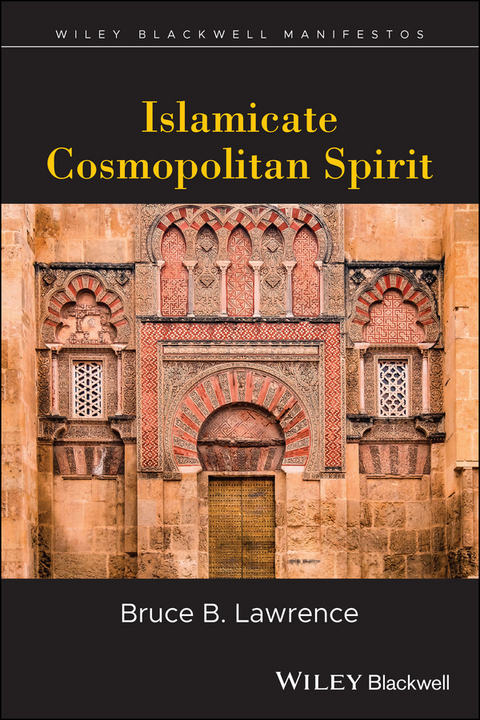
Islamicate Cosmopolitan Spirit (eBook)
John Wiley & Sons (Verlag)
978-1-118-78000-8 (ISBN)
Discover the essence of the Islamicate Cosmopolitan Spirit and what it has contributed to societies across the ages
In Islamicate Cosmopolitan Spirit, author and expert, Bruce B. Lawrence, delivers a spiritual elan filtered through cultural practices and artefacts. Neither juridical nor creedal, the book expresses a desire for the just and the beautiful. The author sets out an original and fascinating theory, that Islamicate cosmopolitanism marks a new turn in global history. An unceasing, self-critical pursuit of truth, hitched to both beauty and justice, its history is marked by male elites who were scientific exemplars in the pre-modern period.
In the modern period, these exemplars include women as well as men, artists as well as scientists. The Islamicate Cosmopolitans have had special impact across the Afro-Eurasian ecumene at the heart of civilized exchange between multiple groups with competing yet convergent interests. The Islamicate Cosmopolitan Spirit is a boundary busting challenge to those who think of the world merely in terms of an 'Arab' Middle East.
Readers will also benefit from:
- A thorough introduction to the Islamicate Cosmopolitan Spirit across time and space
- An exploration of premodern Afro-Eurasia and Persianate Culture in the Indian Ocean
- A practical discussion of the future of the Islamicate Cosmopolitan Spirit
Perfect for all students of Islamicate civilization, both traditional and progressive, Islamicate Cosmopolitan Spirit will also earn a place in the libraries of general readers of world history and those grounded in the larger history of Islamicate Asia will find a perspective that centers their own contribution to the Islamicate Cosmopolitan Spirit.
BRUCE B. LAWRENCE is Marcus Family Humanities Distinguished Professor of Religion Emeritus at Duke University and Adjunct Professor of the Alliance of Civilizations Institute, Ibn Haldun University in Istanbul. His research focuses on contemporary Islam as religious ideology, south Asian Sufism, and Islamicate cosmopolitanism.
Acknowledgments ix
Preamble xii
Overview: A Manifesto in Three Words and Six Chapters xv
1 Tracing Islamicate Cosmopolitan Spirit Across Time and Space 1
2 Eastward Into India 8
3 Westward Into Spain 22
4 Premodern Afro-Eurasia 46
5 Persianate Culture Across the Indian Ocean 66
6 Islamicate Cosmopolitan Spirit Beyond 2020 92
Conclusion 121
Bibliography 125
Index 142
"An excellent work on Islamic history, its greatest strengths are: the level of theoretical discussion, the call to a reflection on terminology, the emphasis on post-15th century Islamic history and on geographical regions outside the Arab world."
--Roberto Totolli, Universita degli Studi di Napoli L'Orientale
"Learned, inventive and highly perceptive.... With an astounding energy, the six chapters, plus an overview and a conclusion, stretch boundaries of Muslim subjectivities and possibilities across time and space."
--Babak Rahimi, UC San Diego
Overview: A Manifesto in Three Words and Six Chapters
In the aftermath of the 2003 US invasion of Iraq, the blogger Riverbend observed: “What is civilization? It’s not mobile phones, computers, skyscrapers, and McDonalds. It’s having enough security in your own faith and culture to allow people the sanctity of theirs …”1
How do we define civilization as the deepest recognition of mutual and interactive sanctities? Riverbend’s shibboleth is mine: finding the connection and fostering the opportunity to recognize, then engage seeming opposite, even hostile others who are no less human for being unlike us.
No global civilization can exclude Islam, but how to include it? The search for an inclusive civilizational ethos worthy of the name reached a tipping point for me in the United Kingdom last year. It was mid-February 2019. I was at the University of Exeter as a visiting scholar in residence. We had just completed a 2-hr lunchtime workshop. I got to pick the topic and the title for the talk. My title: “Islamicate Cosmopolitan?”
The title, posed as a question, was intended to be provocative. What is Islamicate? And who qualifies as an Islamicate cosmopolitan?
After an intense exchange that went beyond the usual lunch hour, we were about to disperse when a senior colleague asked: “So what?”
“So what?!” I rejoined, in surprise.
“You have made our lunch hour into two hours,” he joked, adding “You have reflected on all the options and argued for a new tongue twister—Islamicate cosmopolitan. But do you really feel that this phrase is an epistemic turn worth pursuing? Where can one find a guide for the perplexed, some text illumining our understanding of both Islamicate and its coordinate term, cosmopolitan?”
This manifesto is my answer to my colleague’s challenge. My motive is also my hope: to enliven each term with the other, Islamicate as cosmopolitan, cosmopolitan as Islamicate. But each needs a further referent, and so I am introducing a still broader trope: Islamicate Cosmopolitan Spirit, itself the entry way to civilizational options at once inclusive and enduring.
Islamicate Cosmopolitan Spirit
Since a manifesto is an extended general essay rather than a specialized monograph, I want to stress each word in my chosen topic: Islamicate Cosmopolitan Spirit. At the most basic level each connotes a surplus: Islamicate is more than Islamic or Muslim, Cosmopolitan is more than congenial or civil, and Spirit is more than subject or agent. Together Islamicate Cosmopolitan Spirit projects the presence of a tidal wave in world history that remains hidden for most, opaque for many, and misunderstood even by experts.
Each of these three key terms requires a brief history. But they also elicit a prior question about history itself: is historical revision desirable, even necessary? If so, is it possible without revising the categories or key terms in which history is framed?
For Islam, there is a need for revisionist terminology. I would argue that the need is even more urgent because “Islam” has become encumbered with misinterpretation in public discourse since 1979 and the Iranian revolution but even more since the terrorist attacks of 9/11 and two wars in largely Muslim countries: first Afghanistan, then Iraq. What must be foregrounded at the outset is stubborn resistance, from many quarters, to moving beyond “Islam” or “Muslim” in order to describe the 1,400-year experience that marked the birth, growth, and expansion of a 7th-century Arabian political-religious movement into a transregional presence. Islam did originate from Arabia but it quickly extended westward to Spain and eastward to China. Far from being Arab centered, the Islam movement redefined much of Africa and Asia, while itself being redefined by Africa and Asia, before impacting what became Western Europe and North America. The nagging question persists: what has been the surplus of value beyond Arab origins and Arabic language in its continued expansion and adaptation to multiple contexts in myriad cultures? In cultural studies, “Islamic music,” “Islamic literature,” and “Islamic art” persist as labels. In philosophical studies, “Islamic philosophy” continues to be invoked, while in historical studies one must look hard to find alternatives to “Islamic history.” Even revisionists balk at changing their key terms, but I want to argue from the outset that unless that change is made, and unless it is consistently applied, there can be no revisionism worthy of the name. Old habits die slowly but die they must if a fresh vision is to emerge. A new day is dawning for understanding the long shadow of early 7th-century Arabia. The path will not be just through micro-analysis or regional studies but through meta-discourse, at the heart of which is salient and defensible key terms. A meta-discursive provocation is the goal of what follows.
What is Islamicate? Islamicate is neither a first nor a second but a third order of identity beyond “Muslim” and “Islamic,” its two precursors, both crowded with religious valence. Despite its prevalence, religion itself can become a veil rather than a catalyst for understanding broad historical movements. Neither “Muslim” nor “Islamic” because of their close association with “religion” can reveal the tapestry of culture and cultural networks, and without being revealed that tapestry remains occluded, undervalued, too often minimalized, or ignored.
“Muslim” marks a religious but also a social identity. In 2020 “Muslim” is the first order of identity for about 2 billion out of nearly 8 billion of the world’s population. One can be a Muslim by birth or by decision. In Arabic there are no capital letters, yet in English one is able to distinguish between two kinds of Muslim/muslim, one capitalized, the other not. In a revisionist vocabulary one should be able to note the distinction. Who is a muslim with a small “m”? Who is a Muslim with a capital “M”? In the latter case, to be Muslim is to avow Islam as a pious, practicing individual but one can also be muslim, in the lower case, by association as the member of a collective, whether family, country, region, or the globe, that has been marked by Islam without professing or practicing Islam. Non-Muslims, of course, can also be muslims. If I were a thoroughgoing revisionist, I would distinguish between both categories in what follows, but since English does not yield to such lexical subtleties without constant bracketing in inverted commas, that endeavor would distract from my major purpose: to underscore the need for an alternative to religious monikers, both “Islamic” and “Muslim.” In what follows, I will refer to Muslim, even though “muslim” remains an undertone of Muslim for those who are non-Muslim but also for many who may be neither devout nor observant as Muslims yet are routinely assumed to be cradle-to-grave believers in Allah as God, Muhammad as His last prophet, and the Qur’an as the final revelation for humankind.
Equally valuable but also ambivalent is “Islamic.” Reflexively, “Islamic” serves as the second order of identity for one who is Muslim. To be Muslim is to connect with Islam across centuries and borders, always acknowledging the norms and values linked to Islamic texts, leaders, and institutions. Yet the intrusion of English and the now commonplace usage of “Islamist” with a violent connotation makes it imperative to rethink the larger contour of Islamicate history. Over 1,400 years Islam has often been portrayed with negative stereotypes, from the medieval Crusades to modern colonialism but added to that multiply layered identity of Muslim/Islamic is the recent history of Islam, often defined by headlines of violence during the past half-century. The 1970s were marked by two eruptions: the Iranian Revolution (February 1979), followed by the Soviet invasion of Afghanistan (December 1979). These two events inaugurated a series of wars and crises that highlight Muslims and Islam as, in Elaine Sciolino’s phrase, “the Green menace,” replacing the disappearing (but now reappearing) “Red menace,” that is, the Soviet Union or Greater Russia.
While I oppose the contemporary or presentist bias, I also cannot ignore its pervasive influence. It produces a stigma, the stigma attached to Islam and, by extension, Muslims—too often riffed as Islamists—in 21st-century Euro-America. Unavoidable is the gaze of global media that defines events and actors through soundbites and images, usually negative. With the ubiquitous instant info world that we now take for granted, where tweets often count more than books, newspapers, or even television, one must ask: can Islam ever be free of the weaponizing proclivity of terror images? There are more than 1 billion Muslims worldwide, and few have anything to do with terror, yet if every Muslim is deemed a potential Islamist, can Islam itself be retained as a category of analysis without further exceptionalizing, minoritizing, and negativizing Muslims? For “Muslim” cosmopolitanism to work, it must extract the category “Islam” from the baggage it has acquired through daily, media saturation with negative images of Arab/Muslim/Islamic. If bad or violent, “Muslims” will appear in headlines, TV news, and tweets, but if good or cosmopolitan, they are relegated...
| Erscheint lt. Verlag | 8.9.2021 |
|---|---|
| Reihe/Serie | Blackwell Manifestos |
| Blackwell Manifestos | Wiley-Blackwell Manifestos |
| Sprache | englisch |
| Themenwelt | Geisteswissenschaften ► Religion / Theologie ► Islam |
| Schlagworte | Comparative & World Religions • Historical Islam • historical islamicate </p> • historical muslims • Islam • islamicate Africa • islamicate asia • islamicate middle east • Islamic cosmopolitanism • islam on the world stage • Kosmopolitismus • <p>Islam • Modern Islam • modern muslims • muslim cosmopolitanism • Religion & Theology • Religion, Issues & Current Affairs • Religionsfragen u. aktuelle Probleme • Religion u. Theologie • Vergleichende Religionswissenschaft • World religions |
| ISBN-10 | 1-118-78000-0 / 1118780000 |
| ISBN-13 | 978-1-118-78000-8 / 9781118780008 |
| Informationen gemäß Produktsicherheitsverordnung (GPSR) | |
| Haben Sie eine Frage zum Produkt? |
 EPUB (Adobe DRM)
Kopierschutz: Adobe-DRM
Adobe-DRM ist ein Kopierschutz, der das eBook vor Mißbrauch schützen soll. Dabei wird das eBook bereits beim Download auf Ihre persönliche Adobe-ID autorisiert. Lesen können Sie das eBook dann nur auf den Geräten, welche ebenfalls auf Ihre Adobe-ID registriert sind.
Details zum Adobe-DRM
Dateiformat: EPUB (Electronic Publication)
EPUB ist ein offener Standard für eBooks und eignet sich besonders zur Darstellung von Belletristik und Sachbüchern. Der Fließtext wird dynamisch an die Display- und Schriftgröße angepasst. Auch für mobile Lesegeräte ist EPUB daher gut geeignet.
Systemvoraussetzungen:
PC/Mac: Mit einem PC oder Mac können Sie dieses eBook lesen. Sie benötigen eine
eReader: Dieses eBook kann mit (fast) allen eBook-Readern gelesen werden. Mit dem amazon-Kindle ist es aber nicht kompatibel.
Smartphone/Tablet: Egal ob Apple oder Android, dieses eBook können Sie lesen. Sie benötigen eine
Geräteliste und zusätzliche Hinweise
Buying eBooks from abroad
For tax law reasons we can sell eBooks just within Germany and Switzerland. Regrettably we cannot fulfill eBook-orders from other countries.
aus dem Bereich