


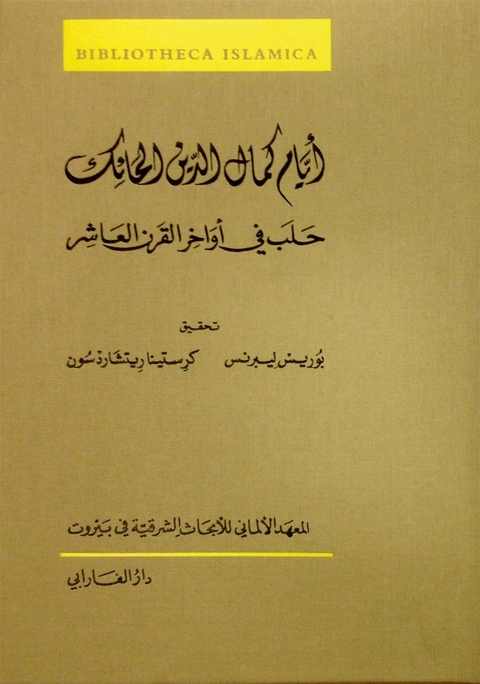
The Notebook of Kamāl al-Dīn the Weaver
Aleppine notes from the end of the 16th century
Seiten
Bibliotheca Islamica (BI) is the Orient-Institut Beirut’s platform for the critical edition of mainly Arabic texts. The series dates back to 1929, when Hellmut Ritter edited the Kitāb Maqālat al-islamīyīn wa-ḫtilāf al-muṣallīn of Abū l-Ḥasan ʿAlī al-Ašʿarī, a seminal text on dogmatic positions in the early Islamic period. Since then, the OIB has published more than fifty titles in this series.
At the end of the 10th / 16th century in Aleppo, a weaver, cloth merchant, and poet named Kamāl al-Dīn would regularly take his time to fill blank pages with his varied observations. But it was not a linear narrative he produced, nor was it a diary. Rather, he scribbled down accounts on the political and social life of his city and the region; the climate; economic developments; his craft; poetry, much of it his own; anecdotes; reading excerpts; obituaries of dignitaries and friends; history. In doing so, Kamāl al-Dīn upends assumptions about literary agency, faith, and class in the Ottoman Arab provinces and thus gives us insights rarely seen in other contemporary works. Only a fragment of what once must have been a sizeable work survives, now preserved in the Forschungsbibliothek Schloss Friedenstein in Gotha under the shelfmark MS orient. A 114. It represents the earliest known Arabic notebook of an artisan or merchant.
At the end of the 10th / 16th century in Aleppo, a weaver, cloth merchant, and poet named Kamāl al-Dīn would regularly take his time to fill blank pages with his varied observations. But it was not a linear narrative he produced, nor was it a diary. Rather, he scribbled down accounts on the political and social life of his city and the region; the climate; economic developments; his craft; poetry, much of it his own; anecdotes; reading excerpts; obituaries of dignitaries and friends; history. In doing so, Kamāl al-Dīn upends assumptions about literary agency, faith, and class in the Ottoman Arab provinces and thus gives us insights rarely seen in other contemporary works. Only a fragment of what once must have been a sizeable work survives, now preserved in the Forschungsbibliothek Schloss Friedenstein in Gotha under the shelfmark MS orient. A 114. It represents the earliest known Arabic notebook of an artisan or merchant.
lt;strong>Kristina Richardson, Queens College, New York, USA; Boris Liebrenz, Sächsische Akademie der Wissenschaften , Leipzig.
| Erscheinungsdatum | 23.09.2021 |
|---|---|
| Reihe/Serie | Bibliotheca Islamica ; 59 |
| Verlagsort | Berlin/Boston |
| Sprache | arabisch |
| Gewicht | 597 g |
| Themenwelt | Geisteswissenschaften ► Religion / Theologie ► Islam |
| Schlagworte | History • Islam • Islamic Studies • Koran & Sacred Writings • Literary criticism • Middle Eastern • Religion • Theologie |
| ISBN-13 | 9783110688870 / 9783110688870 |
| Zustand | Neuware |
| Informationen gemäß Produktsicherheitsverordnung (GPSR) | |
| Haben Sie eine Frage zum Produkt? |
Mehr entdecken
aus dem Bereich

aus dem Bereich


