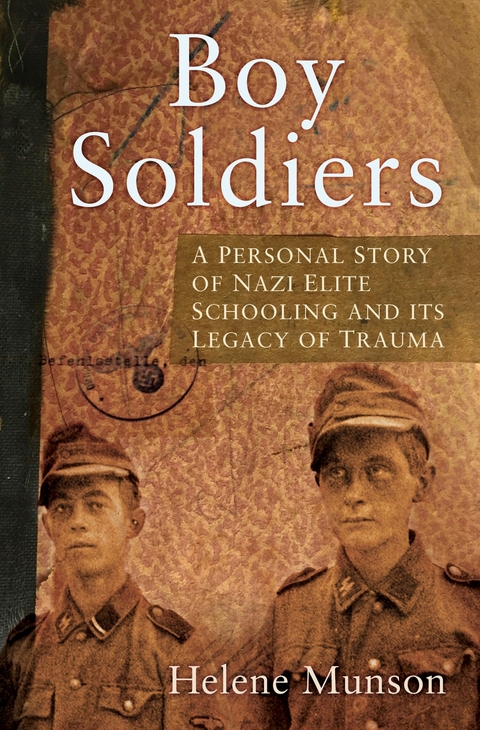
Boy Soldiers (eBook)
272 Seiten
The History Press (Verlag)
978-0-7509-9908-3 (ISBN)
With a Chilean-born father and a German mother, HELENE MUNSON grew up in Brazil, Liberia and Germany, spending most of her adult life in New York and Berlin. She has journeyed to over 75 countries, writes short stories in English and German, and inspired by her family history, her Masters' degree was partly about the impact of armed conflicts on children. She lives in New York.
Introduction
Závada Revisited
Some of us have family members who had fascinating lives that inspire us – some of us have relatives whose lives were memorable, but troubling to contemplate. I had both in my father, known as Dr Hans Dunker – a PhD in History, Ambassador for the Federal Republic of Germany, a family man and a dedicated church alderman. But he was also one of Hitler’s boy soldiers and saw violence and evil that no child should witness, let alone be party to. The dark days of his childhood left him unable to talk about it. Instead, he bequeathed to me his boxes of carefully collected documents and the Second World War diary he had written.
After my father’s death, I banished the document boxes into the basement of my apartment in Berlin-Kreuzberg, unable to face whatever they contained. What could have been so important that my father had kept those papers, transporting them from country to country as his diplomatic career required him to move around the world?
Six years later, I attended a course at Oxford Brookes University focusing on armed conflicts and children in war-torn countries like the Democratic Republic of the Congo (DRC) or Afghanistan, making me realise the importance of my father’s child soldier’s eyewitness account.
But the boxes contained much more: albums of sepia-coloured photos, expired IDs from countries that no longer existed, letters written on translucent, thin airmail paper and once-urgent telegrams. A second diary had been written when he attended Feldafing, an elite Nazi school.
As I unpacked the containers, the story unfolded. Being singled out as an extremely gifted child at age 9, he was separated from his parents who lived in South America. They, in the misguided belief that a German boarding school would best serve their son’s potential, inadvertently turned him over to an elite Nazi educational system so controversial and inhumane that, until recently, post-war Germany has worked hard to keep it secret. When the school sent him into active combat at age 17, he was already accustomed to seeing death. He and his classmates had been shooting down enemy planes since they were 15 years old. But what happened in a small eastern village just before the end of the war would devastate and cripple him.
Hans’ poignant account, starting in early spring 1945, detailed how he and his schoolfriends, badly trained, with neither enough ammunition nor sufficient food rations, were sent to the front wearing makeshift uniforms – at a time when the war was already lost.
Originally, I intended to publish the war diary on its own, as a warning to a world still sending children into battles, oblivious to the true cost to society, not just to the underage soldiers, but their families and future generations. After working on the diary – translating it, researching its historical context and interviewing eyewitnesses to substantiate its accounts – my work felt incomplete. I needed a deeper emotional connection to understand what had really happened to my father, leaving him with a post-traumatic stress disorder that had affected our family for decades.
On the first page of my father’s yellowed and brittle diary was one word: Zawada.
I discovered that Zawada was a little village with great significance for him. Eventually I located it, after cross-referencing the name with surrounding towns mentioned in the diary and determining that the German ‘Zawada’ was now the Czech ‘Závada’, spelled with a ‘v’ instead of a ‘w’. I ruled out several other villages with the same name in Poland, since I knew that my father had fought in what is now the Czech Republic but until 1993 was part of Czechoslovakia, in an area Sudeten Germans had inhabited since the Middle Ages. Using a place-name dictionary published by displaced Sudeten Germans, I reconstructed a pre-Second World War map of the area.
In old age, my father could have returned to Zawada, once West Germans were allowed to travel into the former communist states after 1990, when the Cold War had ended. But my mother told me he had refused. They had only travelled as far as Pirna. By the time I read the diary, he was dead. I felt obliged to complete the journey for him. After translating the village’s Czech website, I sent an email in English to Závada’s mayor.
The mayor’s English-speaking assistant, Andrea Lorkova, sent me a kind reply and invited me to visit. In March 2013, I started out from Berlin and headed towards Dresden on the autobahn, rebuilt with several lanes after Germany’s reunification in 1990. The new highway system once again connected the two parts of Germany. I followed my father’s original route from Berlin; his cattle train had stopped on the outskirts of the city on the way to the Eastern Front.
When I first read the diary, the place names Hans mentioned meant nothing to me. For my generation of West Germans, the areas south and east of Berlin were blank parts of the map, hidden behind the Iron Curtain. Now these places appeared before my eyes. The weather was just as cold and unpleasant as it must have been when my father was deployed in the spring of 1945, with snow flurries and a still-frozen ground. After a two-hour drive, I reached Dresden and enjoyed a stroll through its carefully rebuilt historic city centre; the city once more a magnet for culture and art.
Dresden was in total ruins when Hans travelled through. When the Allies dropped a record number of bombs on the city in 1945, Dresden was overflowing with thousands of desperate refugees. Among them, hundreds of children were killed.
After Dresden, my route narrowed to a single lane, involving hairpin curves over mountain ranges and winding through farming villages with speed restrictions. I stopped at the small city of Pirna, 16 miles south of Dresden, where Hans had stayed in a hospital for several weeks. The kindness of Pirna’s inhabitants, who had shared their own meagre rations with the injured boy soldiers, left a lasting impression on him. I passed the turn to the small town of Bad Gottleuba, where my father spent another month in a sanatorium, recuperating from his injuries. I decided not to stop, as I wanted to reach the Czech Republic before dark. The drive took me through ‘the Switzerland of Saxony’, with its dramatic mountain ranges and deep forests. In the fading light, I drove through the valley of the River Elbe with its spooky, bizarre rock formations – just as Hans had described it.
I spent the first night in the Czech border town of Děčín, once known as the Sudeten German town of Tetschen. I chose to stay at the Hotel Faust, an image of the devil Mephisto gracing its entrance hall. Goethe’s play with the same name had been my father’s favourite. He carried the book with him during his whole ordeal.
The next day, I drove over a mountain range through several villages in which the famous Bohemian crystal is still produced. Glistening chandeliers could be seen in small shop windows that advertised outlet sales. I passed several antique shops and decided to stop at one. Many items had German writing on it – a first aid kit, kitchen utensils and toys. I found some Karl May books in German and imagined that a little boy, just like my father, must have once considered them among his most cherished possessions. Photo albums had been torn apart and the images were sold by the piece. Presumably these things, which still filled the entire antique shop from floor to ceiling, had belonged to the 3.5 million Sudeten Germans who had to leave everything behind when they were driven out by the Czech population at the end of the war. I picked up a heavy, rusty, black metal helmet with hardened brown leather straps. The store clerk informed me it was German. I wondered what had happened to the man who had once worn it. The items were quite inexpensive, and I would have liked a souvenir of this trip, but every piece had a sad story to tell and I wanted none of it.
The next day, I noticed a large, grey concrete bunker by the roadside. I stopped the car and walked around it. Here was some tangible evidence of the war I had come to rediscover. The bunker’s interior was accessible, but I was hesitant to walk into the dark, cavernous space without a torch.
As I continued, I saw so many more bunkers. Soon I did not bother to stop – I later learned that more than 10,000 still exist. Originally, I assumed that the German Army had built them, but learned that, instead, the Czechoslovak government had constructed them between 1935 and 1938 to defend its people against the Germans. In a tragic irony, the 1938 Munich Agreement turned the situation around. By granting Hitler the Czechoslovak areas settled by ethnic Germans as protectorates, those lines of defence fell into German hands.
Shortly after lunch, I arrived in Závada, exhilarated to have made it to the place I had imagined so many times while reading the diary. Looking at a few remaining older buildings, I realised that my father would have seen them too. In the middle of the village stood a small, pink church and, next to it, a stone crucifix. A German inscription at the stone base, dated 1898, used the original German spelling of the village name: Zawada. It felt strange standing at the spot where the fighting took place. I stood where my father had stood, separated by sixty-eight years, almost to the day.
Andrea Lorkova, whom I had corresponded with, met me in the village square and took me to the mayor’s office. Jan Stacha, a handsome man of 62 with strikingly blue eyes, straw-blonde hair and a light...
| Erscheint lt. Verlag | 1.10.2021 |
|---|---|
| Verlagsort | London |
| Sprache | englisch |
| Themenwelt | Literatur ► Biografien / Erfahrungsberichte |
| Literatur ► Briefe / Tagebücher | |
| Geschichte ► Teilgebiete der Geschichte ► Kulturgeschichte | |
| Sozialwissenschaften ► Pädagogik ► Allgemeines / Lexika | |
| Sozialwissenschaften ► Politik / Verwaltung ► Politische Systeme | |
| Sozialwissenschaften ► Politik / Verwaltung ► Politische Theorie | |
| Sozialwissenschaften ► Soziologie | |
| Schlagworte | A Story of Nazi Elite Schooling and its Legacy of Trauma • child soldiers • Denazification • elite schooling • Fascism • Feldafing • history of education • history of teaching • mini nazis • napolas • nazi children • nazi education • Nazi Germany • nazi germany, nazism, fascism, A Story of Nazi Elite Schooling and its Legacy of Trauma, nazi youth, nazi children, youth soldiers, mini nazis, nazi education, napolas, feldafing, the ss, elite schooling, history of teaching, history of education, child soldiers, nsdap, denazification • Nazism • nazi youth • NSDAP • The SS • youth soldiers |
| ISBN-10 | 0-7509-9908-X / 075099908X |
| ISBN-13 | 978-0-7509-9908-3 / 9780750999083 |
| Informationen gemäß Produktsicherheitsverordnung (GPSR) | |
| Haben Sie eine Frage zum Produkt? |
DRM: Digitales Wasserzeichen
Dieses eBook enthält ein digitales Wasserzeichen und ist damit für Sie personalisiert. Bei einer missbräuchlichen Weitergabe des eBooks an Dritte ist eine Rückverfolgung an die Quelle möglich.
Dateiformat: EPUB (Electronic Publication)
EPUB ist ein offener Standard für eBooks und eignet sich besonders zur Darstellung von Belletristik und Sachbüchern. Der Fließtext wird dynamisch an die Display- und Schriftgröße angepasst. Auch für mobile Lesegeräte ist EPUB daher gut geeignet.
Systemvoraussetzungen:
PC/Mac: Mit einem PC oder Mac können Sie dieses eBook lesen. Sie benötigen dafür die kostenlose Software Adobe Digital Editions.
eReader: Dieses eBook kann mit (fast) allen eBook-Readern gelesen werden. Mit dem amazon-Kindle ist es aber nicht kompatibel.
Smartphone/Tablet: Egal ob Apple oder Android, dieses eBook können Sie lesen. Sie benötigen dafür eine kostenlose App.
Geräteliste und zusätzliche Hinweise
Buying eBooks from abroad
For tax law reasons we can sell eBooks just within Germany and Switzerland. Regrettably we cannot fulfill eBook-orders from other countries.
aus dem Bereich