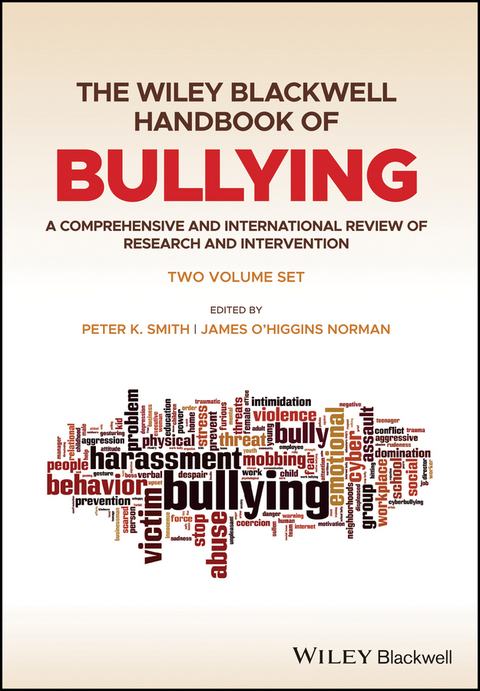
The Wiley Blackwell Handbook of Bullying (eBook)
Explore the latest research and theory on bullying with this international reference from leading voices in the field
The two-volume Wiley-Blackwell Handbook of Bullying delivers a comprehensive exploration of a wide range of research on bullying, broadly defined. School bullying is dealt with at length, but there is also coverage of college and workplace bullying and bullying within sports settings, prisons, families, and elder care residential homes.
Containing contributions from leading scholars on five continents, the book summarizes the latest theories, findings, developmental aspects, and interventions relevant to bullying in a variety of settings. With up-to-date information on rapidly developing topics like sibling bullying, cyberbullying, bias-based bullying, migration and bullying, dating violence, and economic evaluation of bullying prevention programs, The Wiley-Blackwell Handbook of Bullying offers readers a complete view of a wide array of bullying behaviors.
The insightful and up-to-date information contained within the two volumes is destined to become the standard reference for bullying-related research and theory. Readers will benefit from:
- Fulsome material covering research and practice conventions in countries and regions including Europe, North America, South America, Australasia, Japan, South Korea, India, Mainland China and Hong Kong, the Arab countries, and sub-Saharan Africa
- A comprehensive discussion on the correlates and outcomes of taking part in bullying, as well as being a victim of bullying
- An exploration of a variety of strategies to deal with bullying incidents, including proactive, reactive, and peer support approaches
- An analysis of different kinds of bullying, faith-based bullying, and disablist bullying, including racist and ethnic bullying, sexist and sexual bullying, and homophobic and transphobic bullying
Perfect for postgraduate students in programs dealing with bullying in virtually any conceivable context, The Wiley-Blackwell Handbook of Bullying will also earn a place in the libraries of researchers and practitioners in fields as diverse as psychology, sociology, social work, medicine, criminology, child care, and elder studies.
Peter K. Smith is Emeritus Professor of Psychology at Goldsmiths University of London, England. He has served on the editorial board of nine scholarly journals, written or edited 35 books, and over 200 research papers. He is the lead author of the Sixth Edition of Understanding Children's Development.
James O'Higgins Norman is Professor of Sociology and holds the prestigious UNESCO Chair on Tackling Bullying in Schools and Cyberspace at Dublin City University, where he is also Director of the National Anti-Bullying Research and Resource Centre. James is a co-founding Editor-in-Chief of the International Journal on Bullying Prevention and in 2019 he was Chair of the World Anti-Bullying ForumExplore the latest research and theory on bullying with this international reference from leading voices in the field The two-volume Wiley-Blackwell Handbook of Bullying delivers a comprehensive exploration of a wide range of research on bullying, broadly defined. School bullying is dealt with at length, but there is also coverage of college and workplace bullying and bullying within sports settings, prisons, families, and elder care residential homes. Containing contributions from leading scholars on five continents, the book summarizes the latest theories, findings, developmental aspects, and interventions relevant to bullying in a variety of settings. With up-to-date information on rapidly developing topics like sibling bullying, cyberbullying, bias-based bullying, migration and bullying, dating violence, and economic evaluation of bullying prevention programs, The Wiley-Blackwell Handbook of Bullying offers readers a complete view of a wide array of bullying behaviors. The insightful and up-to-date information contained within the two volumes is destined to become the standard reference for bullying-related research and theory. Readers will benefit from: Fulsome material covering research and practice conventions in countries and regions including Europe, North America, South America, Australasia, Japan, South Korea, India, Mainland China and Hong Kong, the Arab countries, and sub-Saharan Africa A comprehensive discussion on the correlates and outcomes of taking part in bullying, as well as being a victim of bullying An exploration of a variety of strategies to deal with bullying incidents, including proactive, reactive, and peer support approaches An analysis of different kinds of bullying, faith-based bullying, and disablist bullying, including racist and ethnic bullying, sexist and sexual bullying, and homophobic and transphobic bullying Perfect for postgraduate students in programs dealing with bullying in virtually any conceivable context, The Wiley-Blackwell Handbook of Bullying will also earn a place in the libraries of researchers and practitioners in fields as diverse as psychology, sociology, social work, medicine, criminology, child care, and elder studies.
Peter K. Smith is Emeritus Professor of Psychology at Goldsmiths University of London, England. He has served on the editorial board of nine scholarly journals, written or edited 35 books, and over 200 research papers. He is the lead author of the Sixth Edition of Understanding Children's Development. James O'Higgins Norman is Professor of Sociology and holds the prestigious UNESCO Chair on Tackling Bullying in Schools and Cyberspace at Dublin City University, where he is also Director of the National Anti-Bullying Research and Resource Centre. James is a co-founding Editor-in-Chief of the International Journal on Bullying Prevention and in 2019 he was Chair of the World Anti-Bullying Forum.
1
Definitions of Bullying
Lisa Hellström, Robert Thornberg, & Dorothy L. Espelage
According to Harper’s (2001–2019a) online etymology dictionary, the word bully (as a noun) can be traced back to the 1530s, but the definition differed remarkably from definitions that pervade the academic literature during the last five decades. In the 1500s, bully was defined as “sweetheart,” which might derive from the Dutch word boel, meaning “lover” and “brother.” Furthermore, according to Crawford (1999), bully was used by Shakespeare in Henry V to demonstrate expression of approval and affection:
The king’s bawcock and heart of gold,
A lad of life, an imp of fame,
Of parents good, of fist most valiant:
I kiss his dirty shoe, and from my heart-string
I love the lovely bully.
The meaning of the word “bully” changed during the seventeenth century from a connotation of admiration to descriptors such as “fine fellow” to “blusterer” to “harasser of the weak” (Harper, 2001–2019a). During the eighteenth century, the word was then used to refer to “pimp” or “villain,” which was seen as “perhaps an early link between the word bully and the male exploiting the female” (Crawford, 1999, p. 86). As a verb, the word bully can be traced back to 1710, derived from the noun bully and where individuals were thought to engage in behaviors that functioned to “overbear with bluster and menaces” (Harper, 2001–2019a), whereas the word bullying – a gerund – can be found to originate in the 1770s where individuals were described as actively engaging in “insolent tyrannizing, personal intimidation” (Harper, 2001–2019b).
A century before the modern international research field of school bullying emerged, Burk (1897) reported a survey study that examined teasing and bullying in the school context in New Jersey, the United States. In this report, bullying was conceptualized as “cases of tyranny among boys and girls from college hazing and school fagging down to the nursery. Cases where threats of exposure, injury, or imaginary dangers were the instruments of subjection and control” (p. 336). Two distinct components can be inferred from this definition. First, there is a presence of a power imbalance (often reported in the article in terms of strength and age differences between the perpetrator and victim). Second, bullying is also portrayed as a form of proactive aggression where there is some instrumentality associated with the aggression (e.g., “The child uses his authority to obtain property, service or obedience,” Burk, 1897, p. 346). These components of power imbalance and instrumentality are often central to the current discussions and debates surrounding the more contemporary definition of bullying (e.g., Volk, Dane, & Marini, 2014).
To fully understand the ongoing definitional issues of the word “bullying,” it is important to be familiar with the origins of this research in social sciences. Indeed, the international research field of school bullying has its origin in Sweden and started with the psychologist Olweus’s (1973, 1978) first series of scientific studies on bullying among schoolboys in Stockholm in the early 1970s. A precursor to this seminal work was a debate article from 1969 written by the Swedish physician Heinemann (1969) who introduced the term “mobbing” in Sweden, and then later and in greater depth, the term “mobbning” in his book Mobbning: Gruppvåld bland barn och ungdomar (Heinemann, 1972). “Mobbning” would go on to be the Swedish word for bullying. According to Heinemann (1969, 1972), bullying is a form of group violence toward deviant members, rooted in our human biology and produced by crowding and lack of stimulation. These ideas were not, however, based on empirical research on bullying among children, adolescents, or adults, but more speculative and based on the work of ethologist Lorenz (1968), who was the first to coin the word “mobbing.” The Swedish word for bullying and Heinemann’s ideas became widespread in Sweden in 1969 through a series of articles in one of Sweden’s most influential daily newspaper, Dagens Nyheter, initiated by Heinemann’s (1969) debate article in Liberal Debatt (Larsson, 2008; Nordgren, 2009).
Recognizing the need for empirical studies to identify distinguishing characteristics of bullying, the pioneering aggression researcher Dan Olweus (1973, 1978) designed and conducted a series of studies to examine the characteristics of victims and bullies. These studies addressed definitional issues, and risk and protective factors associated with bullying involvement within the family, peer, classroom, and school contexts. Olweus’s scholarship called into question Heinemann’s focus on the group dynamic and the idea of collective violence toward a deviant member, which could detract from the type of youth who participate in bullying as bullies and victims. In 1978, his book Aggression in the Schools: Bullies and Whipping Boys attracted attention internationally and aroused scientific interest in bullying as an object of research across the globe and sparked 50 years of scholarship in this area with increasing complexity in measurement studies of bullying.
Definition of Bullying
In his early writings about bullying, Olweus (1986, 1993) provided the following definition: “A student is being bullied or victimized when he or she is exposed, repeatedly and over time, to negative actions on part of one or more other students” (Olweus, 1993, p. 9). More specifically, negative actions refer to “when someone intentionally inflicts, or attempts to inflict, injury or discomfort upon another – basically what is implied in the definition of aggressive behavior” (p. 9). In addition, Olweus (1993) further elaborated that “in order to use the term bullying, there should be an imbalance in strength (an asymmetric power relationship)” (p. 10), in which the victim has “difficulty defending him/herself and is somewhat helpless against the student or students who harass” (p. 10). In other words, Olweus’s early conceptualizations of bullying consisted of three definitional criteria: intention to inflict harm, repetition, and imbalance of power. According to this definition, bullying is a type of aggression with unique and distinct components of repetition and power imbalance that are not present with more reactive and time-limited aggression (e.g., physical fight).
Although Olweus’s definition continues to be widely cited in the bullying research literature, scholars have also elaborated on this definition with reference to empirical research on bullying measurement. For example, in 2014, the US Centers for Disease Control and Prevention, the Department of Education, and the Health Resources and Services Administration developed a uniform research definition together with a number of international experts across various fields. It states that:
Bullying is any unwanted aggressive behavior(s) by another youth or group of youths who are not siblings or current dating partners that involves an observed or perceived power imbalance and is repeated multiple times or is highly likely to be repeated. Bullying may inflict harm or distress on the targeted youth including physical, psychological, social, or educational harm. (Gladden, Vivolo-Kantor, Hamburger, & Lumpkin, 2014, p. 7)
This definition varied slightly from Olweus’s definition; the nuances of repetition and power imbalance in Gladden et al.’s definition were guided by findings from the academic literature. More specifically, the addition of “highly likely to be repeated” was critical given the research that shows that victims often change their behaviors to reduce the likelihood of being bullied (e.g., stop riding a bus, drop out of sport, avoid lunchroom; Kingsbury & Espelage, 2007). Also, Gladden et al.’s definition emphasizes “observed or perceived power imbalance” to acknowledge that determination of power imbalance can be perceived differently across individuals (Espelage & Astor, 2013; Sharkey et al., 2015). Olweus and Limber (2018) acknowledge this definition and argue that it is basically the same as Olweus’s definition. Indeed, Gladden et al.’s definitional work was largely influenced by Olweus’s pioneering scholarship decades ago.
Following the rapid developments in information and communication technology and its widespread use in society during the last few decades, including increased internet access and use, the forms and platforms for bullying have inevitably changed. In relation to defining cyberbullying, there is a debate concerning differences and similarities between traditional bullying and cyberbullying (Englander, Donnerstein, Kowalski, Lin, & Parti, 2017; Olweus, 2017). Some researchers define cyberbullying as bullying that occurs through electronic devices or digital means (Berne, Frisén, & Berne, 2019; Campbell & Bauman, 2018; Kowalski, Giumetti, Schroeder, & Lattanner, 2014; Smith, Del Barrio, & Tokunaga, 2013), while others argue that cyberbullying requires its own scrutiny and definition that does not necessarily originate from bullying definitions (Cross, Lester, & Barnes, 2015). Indeed,...
| Erscheint lt. Verlag | 10.8.2021 |
|---|---|
| Sprache | englisch |
| Themenwelt | Geisteswissenschaften ► Psychologie |
| Schlagworte | bullying intervention • bullying perpetrators • bullying research • bullying victims • Educational & School Psychology • Erziehungs- u. Schulpsychologie • ethnic bullying homophobic bullying • Mobbing • participant roles • prison bullying • Psychologie • Psychology • racist bullying • residential bullying • School bullying • Sexual bullying • sibling bullying • workplace bullying |
| ISBN-13 | 9781118482711 / 9781118482711 |
| Informationen gemäß Produktsicherheitsverordnung (GPSR) | |
| Haben Sie eine Frage zum Produkt? |
 EPUB (Adobe DRM)
Kopierschutz: Adobe-DRM
Adobe-DRM ist ein Kopierschutz, der das eBook vor Mißbrauch schützen soll. Dabei wird das eBook bereits beim Download auf Ihre persönliche Adobe-ID autorisiert. Lesen können Sie das eBook dann nur auf den Geräten, welche ebenfalls auf Ihre Adobe-ID registriert sind.
Details zum Adobe-DRM
Dateiformat: EPUB (Electronic Publication)
EPUB ist ein offener Standard für eBooks und eignet sich besonders zur Darstellung von Belletristik und Sachbüchern. Der Fließtext wird dynamisch an die Display- und Schriftgröße angepasst. Auch für mobile Lesegeräte ist EPUB daher gut geeignet.
Systemvoraussetzungen:
PC/Mac: Mit einem PC oder Mac können Sie dieses eBook lesen. Sie benötigen eine
eReader: Dieses eBook kann mit (fast) allen eBook-Readern gelesen werden. Mit dem amazon-Kindle ist es aber nicht kompatibel.
Smartphone/Tablet: Egal ob Apple oder Android, dieses eBook können Sie lesen. Sie benötigen eine
Geräteliste und zusätzliche Hinweise
Buying eBooks from abroad
For tax law reasons we can sell eBooks just within Germany and Switzerland. Regrettably we cannot fulfill eBook-orders from other countries.
aus dem Bereich