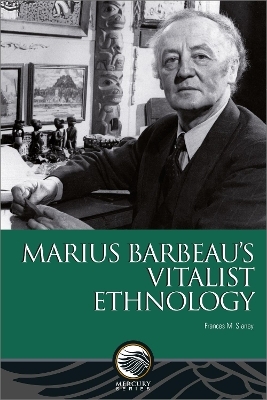
Marius Barbeau’s Vitalist Ethnology
University of Ottawa Press (Verlag)
978-0-7766-3712-9 (ISBN)
This book examines Marius Barbeau’s career at Canada’s National Museum (now the Canadian Museum of History), in light of his education at Oxford and in Paris (1907–1911)._x000D_
_x000D_
Based on archival research in England, France and Canada, Marius Barbeau’s Vitalist Ethnology presents Barbeau’s anthropological training at Oxford through his meticulous course notes, as well as archival photographs at the Pitt Rivers Museum and the Bibliothèque et Archives nationales du Québec. It also draws upon Barbeau’s professional correspondence at Library and Archives Canada, the BC Archives, and, above all, the National Museum, where he worked for over four decades._x000D_
_x000D_
The author, Frances M. Slaney, sheds light on the professional life of this founder of Canadian anthropology, exploring his difficult working relationships with Edward Sapir, his collaborations with Franz Boas, and his outstanding fieldwork in rural Quebec and with Indigenous communities on British Columbia’s Northwest Coast._x000D_
_x000D_
Barbeau penned over 1,000 books and articles, in addition to curating innovative museum exhibitions and art shows. He invited Group of Seven artists into his field sites, convinced that their works could better capture the “vitality” of Quebec’s rural culture than his own abundant photographs. _x000D_
_x000D_
For these—and many other—contributions, the Historic Sites and Monuments Board of Canada recognized him as a “person of national historic importance” in 1985.
Frances M. Slaney received her BA in Anthropology from the University of British Columbia and her MA and PhD from Laval University in Québec City. She was Assistant Professor of Anthropology at the University of Regina and then Associate Professor of Anthropology at Carleton University. Following her doctoral thesis based on fieldwork among the Tarahumara, or Rarámuri, of the Sierra Tarahumara in northwestern Mexico, she turned to archival research into the history of anthropology.
Land Acknowledgement/Reconnaissance territoriale
Abstract
Résumé
List of Illustrations
A Note on Language/Une note sur le langage
Foreword
Introduction
Acknowledgements
Section I – Animism to Vitalism: Learning Anthropology at Oxford and Paris
Evolutionism: An Escape from Quebec’s Catholicism
Chapter 1 – Animism at Oxford, 1907–1910
Tylor’s Animism: A Theory of Interconnecting Life Forms
Tylor’s “Intellectualism”
Classical Greece before Ethnographic Diversity at Oxford
Anthropology, the Classics, and Tylor’s Eclipse
Barbeau’s Struggle to Grasp Anthropology
Oxford’s Anthropological Society.
Chapter 2 – Social Anthropology in Paris
En Route
Studying Religion with Marcel Mauss
Barbeau’s Thesis
Securing a Job in Canada
Tylor’s Animism versus James’s “Pluriverse”
Souls and Solidarity
Chapter 3 – Technology: Museum Studies in France and England
Museum Studies at Saint-Germain-en-Laye
Museology at the Pitt Rivers
From Technology to Visual Arts
Technology as Art Appreciation
Durkheimian Technology as Social Creation
Extracurricular Lessons in Art
Section II – Vital Voices: Oral Narratives and Songs
Part A: Collecting Oral Narratives
Chapter 4 – First Fieldwork for Canada’s National Museum
Collecting Quebec’s Indigenous Narratives
Reporting Back to Oxford
Boas Provides a Diffusionist Perspective on Oral Culture
The Clergy’s Collaboration
Storytelling Preserved across Time and Space
Chapter 5 – A Broader Range of Voices: Narratives in Northern British Columbia
Critiquing Boas
Totemism Revisited
Anthropogeography and the Sources of Local Artistry
Barbeau’s Intercontinental Anthropogeography of Souls
Christian Narratives as Pagan Folk Tales
A Program for Ethnological Research in North America
Chapter 6 – Creating Literature from Oral Culture Collections
Writing for Tourists
A Collaborative Publication of First Nations Narratives
Writing a World of Song
Working with an Illustrator
Part B: Ethnomusicology
Chapter 7 – Encountering Songs and Singers
Songs and Singers in Rural Quebec
Note Taking
Luddite Fears of Music’s Mechanization
Indigenous Songs and Singers
Indigenous Voices in the Northwest
Transcription Difficulties
Consulting Sir Ernest MacMillan
Marguerite d’Harcourt’s Transcription Advisory
Moving Pictures with Sound
Chapter 8 – Performing, Publishing, and Arranging Ethnomusicology Collections
Music among Museum Curators
Publishing French-Canadian Songs with Sapir
Performance and New Music
Barbeau’s Compositions
Section III – Visions of Vitality: Material Culture and Visual Arts
Exploring Europe’s Visual Arts
Enduring Oxford Vision of Art
A “Pioneer Collector”
Part A: Collecting Material Cultures
Chapter 9 – Early Museum Work in Ottawa
A Meeting Ground of Boasian, Paris, and Oxford Practices
Collection Controversies
Sapir’s Departure Causes a Rift
Chapter 10 – Divergent Perspectives: Curators’ Conflicts
Sapir’s Depreciation of Visual Arts
Sapir Uses Carl Jung for Culture-and-Personality Theory
Alternatives to Sapir’s Intellectualism
Chapter 11 – Totem Poles: Collection, Documentation, and Relocation
Documenting Gitxsan Totem Poles
Totem Poles as Art History
Preserving Totem Poles In Situ
Barbeau’s Totem Pole Report
Totem Pole Restoration Aesthetics
Totem Poles as a “Modern Growth”
Museumizing Totem Poles
The Pole for Paris
A French Attempt to Avoid Conservation Problems
Barbeau’s Museum Aesthetics Condemned
Totem Poles in B.C. Settler Museums
William Beynon Raises a Totem Pole at Gitsegukla
Part B: Work with Modern Settler Painters and Late Discoveries
Chapter 12 – Fieldwork with Settler Society’s Visual Artists
Lifelines
Art and Souls
Drawings versus Photographs
Langdon Kihn
A. Y. Jackson and Arthur Lismer in Rural Quebec, 1925
An Arts and Crafts Perspective
Discovering Louis Jobin
Settler Artists in Northwestern B.C., 1926
Chapter 13 – Art and Artifacts: Curating for Urban Galleries, 1926–1927
Art Gallery of Toronto Show, 1926
Homespuns
Woodcarvings
Placing Quebec Woodcarvers in European Art History
Art and Anthropology
National Gallery of Canada, 1927
Curatorial Statements
Barbeau’s Inclusion of Emily Carr
Barbeau’s Appreciation for Carr’s Totem-Pole Paintings
Conflict and Damage: Hanging the 1927 Show
Carr Sees Opposition to Barbeau’s Co-curation
The Demands of a Travelling Show
Curating World Fairs
Section IV – Abroad Again and Late Works on Haida Gwaii
Chapter 14 – Barbeau’s 1931 “Holiday” in France and England: Historicizing Indigenous Handcrafts
Working at the Trocadéro
Paris between the Wars
Mauss Shifts Barbeau’s Vision Seaward
Visiting England’s Museums
Paris and the Intercontinental “Origins” of Totem Poles
The Paris Totem Pole
Chapter 15 – Late Fieldwork on Haida Gwaii: Argillite Carving
Barbeau’s Talks on Northwest Coast Craftsmanship, 1939
The Unique Properties of Argillite
Scrimshaw as a Product of Boredom
Boston Whalers among the Haida
Haida Myths: Illustrated in Argillite Carvings, 1953
Lingering Classicism from Oxford
Making Sense of Argillite Collections
Tsimshian Myths versus Haida Carvings
Museum Evidence for Argillite Carvings’ Marine Travels
Narrative Themes of Argillite Carvings
Haida Carvers in Argillite, 1957
Musical Instruments Carved of Argillite
Plate and Dish Makers and Miniature Totems
Beynon’s Contribution to the Argillite Volumes
Conclusion
Bibliography
Notes
Index
| Erscheinungsdatum | 27.06.2022 |
|---|---|
| Sprache | englisch |
| Maße | 152 x 229 mm |
| Themenwelt | Kunst / Musik / Theater ► Kunstgeschichte / Kunststile |
| Geschichte ► Teilgebiete der Geschichte ► Kulturgeschichte | |
| Sozialwissenschaften ► Ethnologie | |
| Sozialwissenschaften ► Soziologie | |
| ISBN-10 | 0-7766-3712-6 / 0776637126 |
| ISBN-13 | 978-0-7766-3712-9 / 9780776637129 |
| Zustand | Neuware |
| Informationen gemäß Produktsicherheitsverordnung (GPSR) | |
| Haben Sie eine Frage zum Produkt? |
aus dem Bereich