


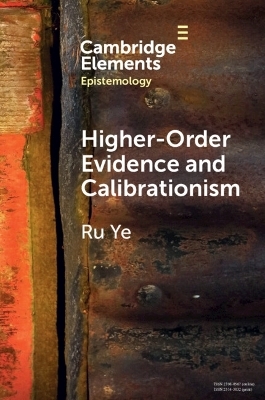
Higher-Order Evidence and Calibrationism
Seiten
2023
Cambridge University Press (Verlag)
978-1-009-12419-5 (ISBN)
Cambridge University Press (Verlag)
978-1-009-12419-5 (ISBN)
This Element aims to explain why the higher-order evidence debate is interesting and important and proposes a new version of calibrationism to respond to higher-order evidence.
The higher-order evidence debate concerns how higher-order evidence affects the rationality of our first-order beliefs. This Element has two parts. The first part (Sections 1 and 2) provides a critical overview of the literature, aiming to explain why the higher-order evidence debate is interesting and important. The second part (Sections 3 to 6) defends calibrationism, the view that we should respond to higher-order evidence by aligning our credences to our reliability degree. The author first discusses the traditional version of calibrationism and explains its main difficulties, before proposing a new version of calibrationism called 'Evidence-Discounting Calibrationism.' The Element argues that this new version is independently plausible and that it can avoid the difficulties faced by the traditional version.
The higher-order evidence debate concerns how higher-order evidence affects the rationality of our first-order beliefs. This Element has two parts. The first part (Sections 1 and 2) provides a critical overview of the literature, aiming to explain why the higher-order evidence debate is interesting and important. The second part (Sections 3 to 6) defends calibrationism, the view that we should respond to higher-order evidence by aligning our credences to our reliability degree. The author first discusses the traditional version of calibrationism and explains its main difficulties, before proposing a new version of calibrationism called 'Evidence-Discounting Calibrationism.' The Element argues that this new version is independently plausible and that it can avoid the difficulties faced by the traditional version.
1. Introduction; 2. Major positions in the HOE debate; 3. Calibrationism and its main motivations; 4. The problem of ignoring evidence; 5. The conflict with conditionalization; 6. Evidence-discounting calibrationism; 7. Conclusion; References.
| Erscheinungsdatum | 18.10.2021 |
|---|---|
| Reihe/Serie | Elements in Epistemology |
| Zusatzinfo | Worked examples or Exercises |
| Verlagsort | Cambridge |
| Sprache | englisch |
| Maße | 154 x 230 mm |
| Gewicht | 150 g |
| Themenwelt | Geisteswissenschaften ► Philosophie ► Erkenntnistheorie / Wissenschaftstheorie |
| Geisteswissenschaften ► Philosophie ► Ethik | |
| Geisteswissenschaften ► Psychologie ► Verhaltenstherapie | |
| ISBN-10 | 1-009-12419-6 / 1009124196 |
| ISBN-13 | 978-1-009-12419-5 / 9781009124195 |
| Zustand | Neuware |
| Informationen gemäß Produktsicherheitsverordnung (GPSR) | |
| Haben Sie eine Frage zum Produkt? |
Mehr entdecken
aus dem Bereich

aus dem Bereich
Buch | Softcover (2023)
Reclam, Philipp (Verlag)
CHF 9,80
die Evolution des Geistes
Buch | Softcover (2025)
Suhrkamp (Verlag)
CHF 41,95


