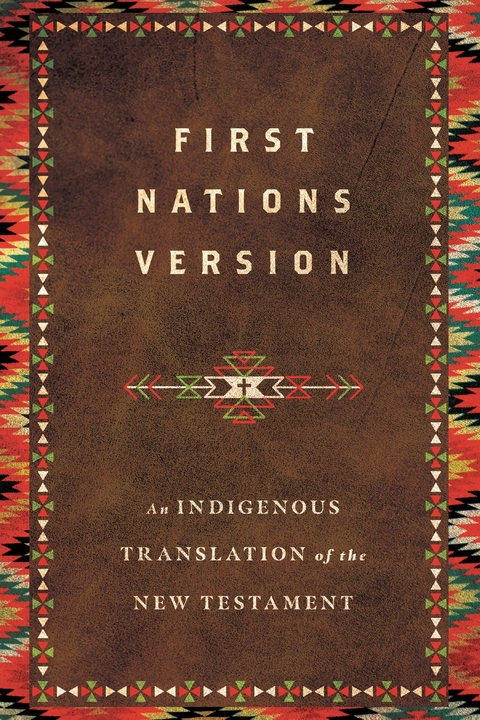
First Nations Version (eBook)
Terry M. Wildman (Ojibwe and Yaqui) is the lead translator, general editor, and project manager of the First Nations Version. He serves as the director of spiritual growth and leadership development for Native InterVarsity. He is also the founder of Rain Ministries and has previously served as a pastor and worship leader. He and his wife, Darlene, live in Arizona.
The First Nations Version (FNV) Translation Council consists of twelve First Nations individuals representing a cross-section of Native North Americans—elders, pastors, young adults, and men and women from differing tribes and diverse geographic locations. This council also represents a diversity of church and denominational traditions to minimize bias. The council determined the style and method of translation to be used and continues to be involved in ongoing translation, review, and cultural consultation. The FNV is a dynamic equivalence translation produced in partnership with Rain Ministries and OneBook Canada, with help from Wycliffe Associates. Terry M. Wildman (Ojibwe and Yaqui) is the lead translator, general editor, and project manager of the First Nations Version. He serves as the director of spiritual growth and leadership development for Native InterVarsity. He is also the founder of Rain Ministries and has previously served as a pastor and worship leader. He and his wife, Darlene, live in Arizona.
Introduction to the
First Nations Version
An Indigenous Translation
of the New Testament
The First Nations Version Translation Council humbly submits this new translation of the Sacred Scriptures as our gift to all English-speaking First Nations people and to the entire sacred family, which is the body of the Chosen One.
The First Nations Version New Testament was birthed out of a desire to provide an English Bible that connects, in a culturally relevant way, to the traditional heart languages of the over six million English-speaking First Nations people of North America.
The FNV is a retelling of Creator’s Story from the Scriptures, attempting to follow the tradition of the storytellers of our oral cultures. Many of our Native tribes still resonate with the cultural and linguistic thought patterns found in their original tongues. This way of speaking, with its simple yet profound beauty and rich cultural idioms, still resonates in the hearts of Native people.
The FNV takes into consideration contextual word choices, idiomatic expressions, and modifications in paragraph and sentence structure that clarify and facilitate understanding of the Scriptures. Our priority has been to maintain the accuracy of the translation and its faithfulness to the intended meaning of the biblical writers within a First Nations context. It is not a word-for-word translation, but rather it is a thought-for-thought translation, sometimes referred to as dynamic equivalence.
This translation was first envisioned by Terry M. Wildman. A while later the First Nations Version Translation Council was formed. Then with the help of OneBook and Wycliffe Associates, it expanded into a collaborative effort that included Native North Americans from over twenty-five tribes.
A small circle of interested Native pastors, church leaders, and church members gathered together under the leadership of Terry M. Wildman, OneBook, and Wycliffe Associates. They had input on the method of translation and the first biblical terms that would be used, and participated in the wording, reviewing, and editing of the Gospel of Luke.
Why the Name First Nations Version?
The term First Nations, while mostly used in Canada for the original inhabitants of the land, is increasingly being accepted and used by many Native Americans in the United States and by indigenous peoples worldwide. Following this trend, the name First Nations Version was chosen for this translation.
Why English?
It is conservatively estimated that over 90 percent of First Nations people do not speak their tribal language, and even fewer can read it. This is the result of several generations of governmental assimilation policies that attempted to eradicate over 250 languages spoken in North America.
This translation is not intended to be tribally specific but to present the Scriptures in a general way, attempting to represent some of the simple yet profoundly beautiful ways our languages can be expressed in English.
We aimed for a style that is easy to read, with an attempt to present, in writing, the cadence and feel of an oral storyteller. A contextual approach was adhered to, using English word choices and idiomatic phrases that are culturally relevant, with an effort to refrain from a stereotypical or culturally degrading simplicity.
Partnering Organizations
OneBook, a Canadian organization dedicated to helping indigenous peoples all over the world translate the Bible for themselves, provided financial support along with the tools and training needed for a high-quality translation. They partnered with Rain Ministries, located in the United States, to facilitate this translation. Wycliffe Associates of Orlando served this project in the beginning by providing technical support and funding for gathering the council together.
Church Engagement
The First Nations Version of the New Testament was produced in response to the consistently positive feedback given to the initial translation efforts. As samples were shared in churches and other venues, those who heard these samples began asking for more. Pastors, evangelists, missionaries, Native elders, and others began to ask whether a complete New Testament would be translated using this contextual approach. The FNV is for all the churches, and it is especially for those involved in contextual ministry with Native North Americans.
The Translation Council
A translation council was selected from a cross-section of Native North Americans. Elders, pastors, young adults, and men and women from different tribes and diverse geographic locations were chosen to sit on the council. This council also represents a diversity of church and denominational traditions to minimize bias.
Our council consisted of twelve (one remains anonymous) First Nations individuals with tribal heritages from diverse geographical regions. This council had input into the style and method of translation to be used. From this group, a smaller council was chosen to determine how the most important biblical terms would be translated.
The members of our council are listed below with their North American tribal heritages:
-
Barry D. Belindo—Kiowa/Navajo/Pawnee/Choctaw
-
Garland Brunoe—Wascoe/Ojibwe
-
Gordon Campbell—Kalispel/Spokane/Nez Perce
-
Sháńdíín Church—Diné/Pokagon Band Potawatomi
-
Alvin Deer—Kiowa/Creek
-
John GrosVenor—Cherokee
-
Antonia Belindo—Kiowa/Navajo/Pawnee/Choctaw
-
Bryan Jon Maciewski—Anishinabe/Ojibwe
-
Dale and Charlotte Tsosie—Diné (Navajo)
-
Terry M. Wildman—Ojibwe/Yaqui
The following ministries gave of their time to participate in this project: Rain Ministries, OneBook of Canada, Wycliffe Associates, Native InterVarsity, and Mending Wings.
Other Native People Involved
Besides the members of our council, many other First Nations people have had input into this translation as reviewers, cultural consultants, and community-feedback participants. All in all, the tribal heritages represented include but are not limited to Apache, Assiniboine, Blackfeet, Cherokee, Choctaw, Creek, Desert Cahuilla, Cayuga, Diné (Navajo), Hopi, Kalispel, Kiowa, Klickitat, Lakota, Mohawk, Métis, Miami, Muscogee, Nez Perce, Northern Cree, Odawa, Ojibwe, Pawnee, Plains Cree, Potawatomi, Tlingit, Tohono O’odham, Western Cree, Yankton Sioux, Spokane, Wascoe, Yakama, and Yaqui.
Consultants and Support
Alongside our translation council were a number of support people on this project. Our translation consultant was the former head of Wycliffe Canada and the founder of OneBook Canada, with over fifty years of biblical translation experience with indigenous cultures. State-of-the-art translation software called Paratext was provided by OneBook along with expertise and guidance. We also had volunteer help from a retired teacher in Canada for the initial punctuation on the entire project. These friends and support partners were committed to having the First Nations people do the actual work of translation, while they provided experience, expertise, help, and feedback.
Community Checking and Feedback
Our hope is that this translation will be used widely by the Native churches in North America. To facilitate this, about thirteen hundred draft versions of Luke were printed and distributed to Native churches, leaders, and many others both in Canada and the United States, asking for review and feedback. A number of pastors, church leaders, and members, along with some Bible scholars, participated in reviewing the draft version of Luke. Their input was valuable in improving this translation. Our translation council was instrumental in ensuring widespread community testing in Native communities. The feedback was overwhelmingly positive, and many great suggestions were incorporated.
For more information, visit firstnationsversion.com.
Reader Aids
Use of italics. In an attempt to present the Scriptures as a living and moving narrative, at times reasonably implied statements were added within, above, and below the text. For this, we used our imagination as we tried to picture what may have been the reaction in the voices and faces of the participants. These added statements are not intended to change the meaning of the text but rather to bring clarity. For further clarity, these additions are in italics to...
| Erscheint lt. Verlag | 31.8.2021 |
|---|---|
| Mitarbeit |
Berater: First Nations Version Translation Council |
| Verlagsort | Lisle |
| Sprache | englisch |
| Themenwelt | Religion / Theologie ► Christentum ► Bibelausgaben / Bibelkommentare |
| Sozialwissenschaften ► Ethnologie | |
| Sozialwissenschaften ► Soziologie | |
| Schlagworte | 365 days of walking the red road • a differrent mirror • ancient teachings • black elk speaks • Canon • Christian • Contemporary • cultural lens • Diverse • Diversity • Dynamic Equivalence • experiencing god • FNV • fresh retelling • God • Gospel • Great Spirit • Indigenous • indigenous bible translation • Indigenous peoples • Intercultural • Native American • native american bible • native american herbalist bible • one church many tribes • Oral storytelling tradition • rescuing the gospel from cowboys • Scripture • social context • spirits of the earth • Translation |
| ISBN-10 | 0-8308-2486-3 / 0830824863 |
| ISBN-13 | 978-0-8308-2486-1 / 9780830824861 |
| Informationen gemäß Produktsicherheitsverordnung (GPSR) | |
| Haben Sie eine Frage zum Produkt? |
 EPUB (Wasserzeichen)
DRM: Digitales Wasserzeichen
Dieses eBook enthält ein digitales Wasserzeichen und ist damit für Sie personalisiert. Bei einer missbräuchlichen Weitergabe des eBooks an Dritte ist eine Rückverfolgung an die Quelle möglich.
Dateiformat: EPUB (Electronic Publication)
EPUB ist ein offener Standard für eBooks und eignet sich besonders zur Darstellung von Belletristik und Sachbüchern. Der Fließtext wird dynamisch an die Display- und Schriftgröße angepasst. Auch für mobile Lesegeräte ist EPUB daher gut geeignet.
Systemvoraussetzungen:
PC/Mac: Mit einem PC oder Mac können Sie dieses eBook lesen. Sie benötigen dafür die kostenlose Software Adobe Digital Editions.
eReader: Dieses eBook kann mit (fast) allen eBook-Readern gelesen werden. Mit dem amazon-Kindle ist es aber nicht kompatibel.
Smartphone/Tablet: Egal ob Apple oder Android, dieses eBook können Sie lesen. Sie benötigen dafür eine kostenlose App.
Geräteliste und zusätzliche Hinweise
Buying eBooks from abroad
For tax law reasons we can sell eBooks just within Germany and Switzerland. Regrettably we cannot fulfill eBook-orders from other countries.
aus dem Bereich