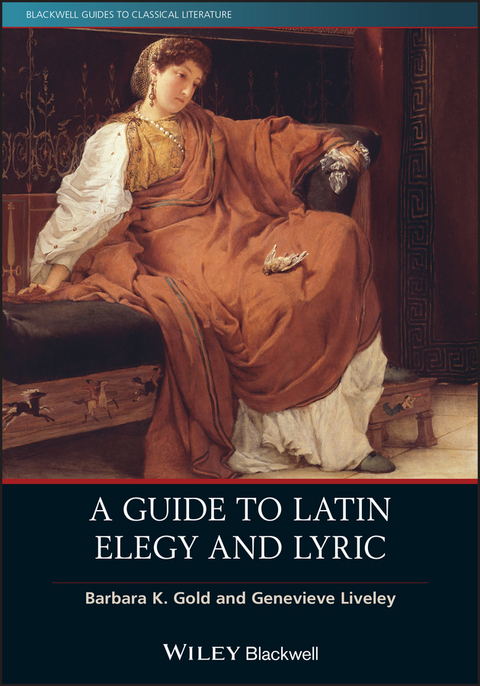
A Guide to Latin Elegy and Lyric (eBook)
John Wiley & Sons (Verlag)
978-1-119-22713-7 (ISBN)
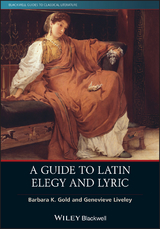
Provides the necessary context to read elegiac and lyric poetry, designed for novice and experienced Classics and Latin students alike
A Guide to Latin Elegy and Lyric explores the language of Latin poetry while helping readers understand the socio-cultural context of the remarkable period of Roman literary history in which the poetry was composed. With an innovative approach to this important area of classical scholarship, the authors treat elegy alongside lyric as they cover topics such as the Hellenistic influences on Augustan poetry, the key figures that shaped the elegiac tradition of Rome, the motifs of militia amoris ('the warfare of love') and servitium amoris ('the slavery of love') in Latin love elegy, and more.
Organized into ten chapters, the book begins with an introduction to the literary, political, and social contexts of the Augustan Age. The next six chapters each focus on an individual lyric and elegiac poet-Catullus, Horace, Tibullus, Propertius, Ovid, and Sulpicia-followed by a survey of several lesser-known poets and post-Augustan elegy and lyric. The text concludes with a discussion of major tropes and themes in Latin elegy and lyric, and an overview and analysis of key critical approaches in current scholarship. This volume:
- Includes full translations alongside the Latin throughout the text to illustrate discussions
- Analyzes recurring themes and tropes found in Latin poetry such as sexuality and gender, politics and patronage, myth and religion, wealth and poverty, empire, madness, magic, and witchcraft
- Reviews modern critical approaches to elegiac and lyric poetry including autobiographical realism, psychoanalysis, narratology, reception, and decolonization
- Includes helpful introductory sections: 'How to Read a Latin Elegiac or Lyric Poem' and 'How to Teach a Latin Elegiac and Lyric Poem'
- Provides information about each poet, an in-depth discussion of some of their poetry, and cultural and historical background
- Features a dedicated chapter on Sulpicia, offering readers an ancient female viewpoint on sex and gender, politics, and patronage
Part of the acclaimed Blackwell Guides to Classical Literature series, A Guide to Latin Elegy and Lyric is the perfect text for both introductory and advanced courses in Latin elegy and lyric, accessible for students reading the poetry in translation, as well as for those experienced in Latin with an interest in learning a different approach to the subject.
Barbara K. Gold is Edward North Professor Emerita at Hamilton College. She is the editor of Literary and Artistic Patronage in Ancient Rome, author of Literary Patronage in Greece and Rome, and co-editor of Sex and Gender in Medieval and Renaissance Texts: The Latin Tradition, and Roman Dining. She has published widely on satire, lyric and elegy, feminist theory, sex and gender, comedy, and late antiquity. Her Blackwell Companion to Roman Love Elegy was published in 2012, and Roman Literature, Gender and Reception: Domina Illustris (co-edited, Routledge) was published in 2013. Her latest book is Perpetua: Athlete of God (Oxford University Press, 2018).
Genevieve Liveley is Professor of Classics, RISCS Fellow, and Turing Fellow at the University of Bristol. She has particular research interests in ancient narratives and in narrative theories (both ancient and modern) and has published widely on this subject, mostly recently as the author of Narratology for OUP's Classics in Theory series. She is also the author of two books on Ovid: A Reader's Guide to Ovid's Metamorphoses and Ovid's Love Songs. She co-edited (with Patricia Salzman-Mitchell) Elegy and Narratology: Fragments of Story and her other publications include (among other topics) articles and essays on the classical tradition, chaos theory, and cyborgs.
Provides the necessary context to read elegiac and lyric poetry, designed for novice and experienced Classics and Latin students alike A Guide to Latin Elegy and Lyric explores the language of Latin poetry while helping readers understand the socio-cultural context of the remarkable period of Roman literary history in which the poetry was composed. With an innovative approach to this important area of classical scholarship, the authors treat elegy alongside lyric as they cover topics such as the Hellenistic influences on Augustan poetry, the key figures that shaped the elegiac tradition of Rome, the motifs of militia amoris ("e;the warfare of love"e;) and servitium amoris ( the slavery of love ) in Latin love elegy, and more. Organized into ten chapters, the book begins with an introduction to the literary, political, and social contexts of the Augustan Age. The next six chapters each focus on an individual lyric and elegiac poet Catullus, Horace, Tibullus, Propertius, Ovid, and Sulpicia followed by a survey of several lesser-known poets and post-Augustan elegy and lyric. The text concludes with a discussion of major tropes and themes in Latin elegy and lyric, and an overview and analysis of key critical approaches in current scholarship. This volume: Includes full translations alongside the Latin throughout the text to illustrate discussions Analyzes recurring themes and tropes found in Latin poetry such as sexuality and gender, politics and patronage, myth and religion, wealth and poverty, empire, madness, magic, and witchcraft Reviews modern critical approaches to elegiac and lyric poetry including autobiographical realism, psychoanalysis, narratology, reception, and decolonization Includes helpful introductory sections: "e;How to Read a Latin Elegiac or Lyric Poem"e; and "e;How to Teach a Latin Elegiac and Lyric Poem"e; Provides information about each poet, an in-depth discussion of some of their poetry, and cultural and historical background Features a dedicated chapter on Sulpicia, offering readers an ancient female viewpoint on sex and gender, politics, and patronage Part of the acclaimed Blackwell Guides to Classical Literature series, A Guide to Latin Elegy and Lyric is the perfect text for both introductory and advanced courses in Latin elegy and lyric, accessible for students reading the poetry in translation, as well as for those experienced in Latin with an interest in learning a different approach to the subject.
Barbara K. Gold is Edward North Professor Emerita at Hamilton College. She is the editor of Literary and Artistic Patronage in Ancient Rome, author of Literary Patronage in Greece and Rome, and co-editor of Sex and Gender in Medieval and Renaissance Texts: The Latin Tradition, and Roman Dining. She has published widely on satire, lyric and elegy, feminist theory, sex and gender, comedy, and late antiquity. Her Blackwell Companion to Roman Love Elegy was published in 2012, and Roman Literature, Gender and Reception: Domina Illustris (co-edited, Routledge) was published in 2013. Her latest book is Perpetua: Athlete of God (Oxford University Press, 2018). Genevieve Liveley is Professor of Classics, RISCS Fellow, and Turing Fellow at the University of Bristol. She has particular research interests in ancient narratives and in narrative theories (both ancient and modern) and has published widely on this subject, mostly recently as the author of Narratology for OUP's Classics in Theory series. She is also the author of two books on Ovid: A Reader's Guide to Ovid's Metamorphoses and Ovid's Love Songs. She co-edited (with Patricia Salzman-Mitchell) Elegy and Narratology: Fragments of Story and her other publications include (among other topics) articles and essays on the classical tradition, chaos theory, and cyborgs.
Preface vii
Introduction: How to Read and Teach a Latin Elegiac or Lyric Poem 1
1 The Literary, Political and Social Contexts of Latin Elegy and Lyric 7
2 Catullus 24
3 Horace 39
4 Tibullus 55
5 Propertius 70
6 Ovid 85
7 Sulpicia 100
8 Other Elegiac and Lyric Poets 110
9 Tropes and Themes in Elegy and Lyric 122
10 Critical Approaches to Elegiac and Lyric Poetry 137
Bibliography 152
Index 163
Preface
In our Guide to Latin Elegy and Lyric, we hope to reach both students of Classics and Latin poetry at various levels and those who are interested in the ancient world in an avocational way. When I (Barbara Gold) first reached out to Genevieve Liveley about being my co-author, I don’t think that either of us had any idea how hard it would be to write about Latin elegy and lyric for people who might not know any Latin. But now that we have tackled writers like Catullus, Horace, Tibullus, Propertius, Ovid, and Sulpicia with exactly that audience in mind, I think that the two of us understand Latin elegy and lyric in a different and exciting way. We hope that our readers will be equally excited about this fantastic poetry and might even be tempted to learn a bit of Latin so that they could have a different sort of entry into the poetry.
We have included lots of Latin to help illustrate our discussions and offer a pathway towards some deeper insights into this poetry, but we have included our own translations for everything. We have tried to give some historical and cultural context for each of the authors and then to open up the world of each author by looking at themes, language, and ideas in their poems as well as possible modes of reception. We are very aware that reception of this poetry or any literature will vary depending upon who is doing the reading, so we hope that our understanding of this poetry will allow other, different interpretations that will open up the poetry in interesting and unforeseen ways.
We have included ten chapters: seven are devoted to individual authors or a set of authors, one to contexts of the poetry, one to major themes, and one to critical approaches. We have also written a preliminary chapter of Introduction on “How to Read a Latin Lyric or Elegiac Poem” and a pedagogical section, “How to Teach Latin Lyric and Elegiac Poetry”.
Our first main chapter covers the literary, political, and social contexts of the turbulent period of history in which most of this poetry was composed. Because elegy and lyric respond immediately to their socio-cultural context, it is necessary to understand the events and cultural tides of the time period before we can understand the poetry produced in and from this context. Here we raise such questions as: How did Hellenistic poetry influence the later Augustan poetry? How did increasingly imperial policies influence writers like Tibullus, Propertius, Horace, and Ovid? What differences do we find in the elegists and the lyric poets in the ways they react to the political currents of their times? We also examine the influences of earlier Greek and Hellenistic poetry upon the later Roman lyric and elegiac poetry and consider the role of the early Augustan poet Gallus in shaping the elegiac tradition at Rome. Gallus, who is said by Quintilian to be the first of the elegists, is an important figure whose influence on elegy is clear but whose few extant lines give us only a small clue about exactly what kind of elegy he wrote and why he casts such a broad shadow over the later elegists.
Chapters 2 through 8 focus on the individual lyric and elegiac poets: Catullus, Horace, Tibullus, Propertius, Ovid, Sulpicia, and other elegists and lyric poets (Lygdamus, the “Amicus” poems from the Corpus Tibullianum, and post-Augustan elegy and lyric). Chapter 2 is focused on the first century BCE writer Catullus who wrote both lyric and elegiac poetry. Catullus’ poem 68 is often thought to be the first real elegiac poem; this subjective and intensely erotic poem, which contains mythological figures but is focused on a female beloved (Lesbia), holds within it the seeds of later elegy. Catullus occupies a liminal, awkward position as the first extant author of an elegiac poem but a poet who does not write solely in elegiac meter.
Chapter 3 brings us to another poet who also does not quite fit the same mold as the main group of poets studied in this book. Horace wrote entirely lyric poetry. He was apparently Rome’s first and last lyric poet. His lyric Odes draw on Greek and Hellenistic traditions to explore distinctively Roman and Italian themes as he adapts traditional motifs and meters to celebrate the Italian countryside, life at symposia or dinner parties, sex and friendship, time, politics and patronage. His relationships with Maecenas (his patron) and Augustus complicate the political and ideological character of his lyrics, but traces of the satiric and comic edge which characterizes his early work are also evident here.
Chapters 4 and 5 cover the elegists Tibullus and Propertius who were almost exact contemporaries. Both poets wrote only in elegiac couplets, and Quintilian counts them as among the major Roman elegists. Tibullus wrote two books of elegies with a third book, the Corpus Tibullianum, added on probably in the same period, but that book contained poems written by several other poets. Tibullus’ poems proceed not in a linear fashion but by association of ideas, often with no logical transition; they have been described as dreamlike. They are often addressed to two female lovers, Delia and Nemesis (both pseudonyms) and to a male lover, Marathus. Unlike Tibullus, Propertius writes in a less associative manner and engages more clearly with his Roman world, very often mentioning politics and political figures like Maecenas. Most of Propertius’ love poems are addressed to a lover he calls Cynthia, who plays a major role especially in Book 1. He describes her in such a way as to make her seem real, giving her a “reality factor,” but most people see her as a “written woman,” part of the poetry of Propertius’ text. Like Catullus and Tibullus, Propertius names Callimachus as his poetic ancestor, using Callimachean poetics as the underpinnings of his poetry.
Chapter 6 is devoted to Ovid, who wrote in the relatively stable period of the Augustan “golden age.” His considerable elegiac corpus (extant works comprising Amores, Heroides, Ars Amatoria, Remedia Amoris, Fasti, Tristia, and Epistulae ex Ponto) inventively reworks the model of love elegy popularized by his predecessors, “womanufacturing” a patently fictitious mistress (Corinna) to serve as the focus for his Amores, exaggerating established elegiac figures and tropes, and expanding the elegiac story-world to include more female voices and viewpoints, and a more cynical and ludic approach to life, love and literature. We focus this chapter on the evolution of core elegiac conceits and motifs across his seven elegiac works.
Chapter 7 is devoted to the only extant female elegiac poet, Sulpicia. Her poems are preserved as part of the Corpus Tibullianum. Sulpicia was a niece of the Augustan politician and literary patron, Messalla, and she was a contemporary of Horace and Tibullus. The six extant elegies written by Sulpicia (or so we think) offer the rare opportunity to experience an ancient female voice and viewpoint, and to witness the elegiac world from a unique perspective in which the mistress or puella speaks and tells her side of the story. Key elegiac motifs are therefore subject to radical revision as Sulpicia presents a very different view of sex and gender, politics (both sexual and imperial) and patronage, myth, and religion. The poetry of Sulpicia has given rise to heated critical debate in recent years concerning uncertainties about authorship, the constitution of literary canon, and (so called) “feminine Latin,” making her slender elegiac corpus particularly useful and interesting in re-evaluating modern approaches to ancient elegiac poetry.
Chapter 8 is devoted to other poets including the poets in the Corpus Tibullianum, and post-Augustan elegiac and lyric poets. These are poets who have reached us in fragmentary form or under the guise of pseudonyms and about whom we know far less than the poets discussed in Chapters 2–7. Here we look closely at the third book of the Tibullan corpus (the Corpus Tibullianum); this contains poems by Sulpicia and other poems by a supposed “friend” of Sulpicia (Amicus Sulpiciae), poems by a certain Lygdamus, by an anonymous author of a panegyric to Messalla and by another anonymous author of two poems about rumors and unfaithfulness. These poems have engendered discussion about the nature of originality, gender, aesthetics, and the nature of elegiacs; they give us further clues to understanding the genre of elegy even in their fragmentary or anonymous form.
Chapter 9 provides an overview and analysis of the key themes and topics, figures, and tropes that elegy and lyric typically incorporate; these include two “umbrella” tropes, militia amoris (“the warfare of love”) and servitium amoris (“the slavery of love”); sexuality and gender; poetic community and friendship; politics and patronage; myth and religion; Romanitas and masculinity; love as a disease, madness, or fire; magic, witchcraft, and the lena; speech and silence; time; wealth and poverty; empire and imperializing; the closed door (paraclausithyron) and the shut-out lover (exclusus amator); counting and numbers.
Chapter 10 gives an overview and analysis of the key critical approaches to elegy and lyric in current scholarship; these include autobiographical realism; psychoanalysis; gender and sexuality; narratology; reception; and decolonization. Various approaches have fallen in and out of fashion among critics and commentators, but these are the key critical and...
| Erscheint lt. Verlag | 12.7.2021 |
|---|---|
| Reihe/Serie | Blackwell Guides to Classical Literature |
| Blackwell Guides to Classical Literature | Blackwell Guides to Classical Literature |
| Sprache | englisch |
| Themenwelt | Geisteswissenschaften ► Geschichte |
| Geisteswissenschaften ► Sprach- / Literaturwissenschaft ► Latein / Altgriechisch | |
| Schlagworte | Ancient & Classical Literature • Antike • Antike u. klassische Literatur • Classical Studies • Humanistische Studien • Klassische lateinische Literatur • Kultur der römischen Antike • Lateinisch /Literatur, Literaturgeschichte • Latin Literature • Lyrik • Roman Culture |
| ISBN-10 | 1-119-22713-5 / 1119227135 |
| ISBN-13 | 978-1-119-22713-7 / 9781119227137 |
| Informationen gemäß Produktsicherheitsverordnung (GPSR) | |
| Haben Sie eine Frage zum Produkt? |
 EPUB (Adobe DRM)
Kopierschutz: Adobe-DRM
Adobe-DRM ist ein Kopierschutz, der das eBook vor Mißbrauch schützen soll. Dabei wird das eBook bereits beim Download auf Ihre persönliche Adobe-ID autorisiert. Lesen können Sie das eBook dann nur auf den Geräten, welche ebenfalls auf Ihre Adobe-ID registriert sind.
Details zum Adobe-DRM
Dateiformat: EPUB (Electronic Publication)
EPUB ist ein offener Standard für eBooks und eignet sich besonders zur Darstellung von Belletristik und Sachbüchern. Der Fließtext wird dynamisch an die Display- und Schriftgröße angepasst. Auch für mobile Lesegeräte ist EPUB daher gut geeignet.
Systemvoraussetzungen:
PC/Mac: Mit einem PC oder Mac können Sie dieses eBook lesen. Sie benötigen eine
eReader: Dieses eBook kann mit (fast) allen eBook-Readern gelesen werden. Mit dem amazon-Kindle ist es aber nicht kompatibel.
Smartphone/Tablet: Egal ob Apple oder Android, dieses eBook können Sie lesen. Sie benötigen eine
Geräteliste und zusätzliche Hinweise
Buying eBooks from abroad
For tax law reasons we can sell eBooks just within Germany and Switzerland. Regrettably we cannot fulfill eBook-orders from other countries.
aus dem Bereich