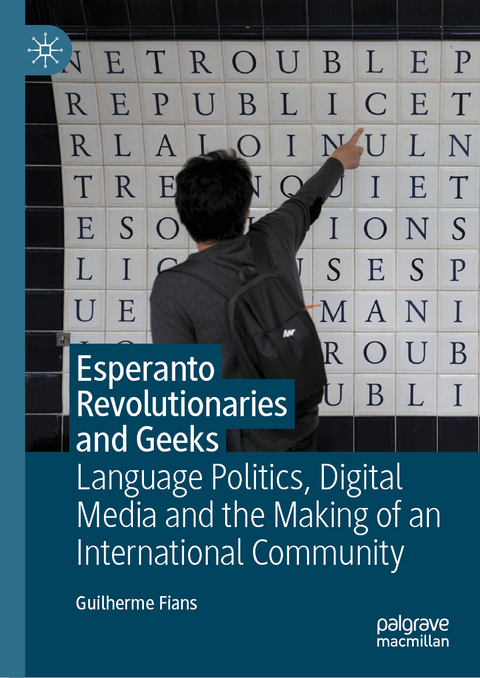
Esperanto Revolutionaries and Geeks
Springer International Publishing (Verlag)
978-3-030-84229-1 (ISBN)
lt;p>Guilherme Fians is Lecturer in Anthropology at the University of Brasília, Brazil and Co-Director of the Centre for Research and Documentation on World Language Problems, Netherlands/USA. He holds a PhD in Social Anthropology from the University of Manchester, UK. Committed to multilingualism in academia, he has published about themes such as prefigurative politics and digital media in several languages.
Chapter 1: Introduction: In the beginning was the word.- Chapter 2: And the word was made flesh, or how to narrate histories.- Chapter 3: Follow the (non-)native: Circulating, mapping and territorialising the Esperanto community.- Chapter 4: When Esperanto speakers meet, or what makes this community international?.- Chapter 5: Crocodiles, apples and owls: Language variation and standardisation in a no man's language.- Chapter 6: On moving and standing still: The movement from the standpoint of an Esperanto association.- Chapter 7: Communicating is freedom: human languages, programming languages and new technologies.- Chapter 8: Esperanto in the making, making through Esperanto: prefiguration and the building of alternative presents.- Chapter 9: Conclusion, or how not to put an end to the conversation.
"My curiosity turned to pleasure as I read on, since Fians' writing is both ethnographically rich ... and theoretically sound ... . Thorough and easy to read, with material from real speakers and situations, Fians' book would make an excellent text for courses dealing with sociolinguistics and multilingualism - and, of course, for those focused on constructed languages. It could also serve as a model for those conducting research in constructed-language settings and, more generally, for those working with international and dispersed communities." (Christine Schreyer, Journal of Multilingual and Multicultural Development, July 31, 2022)
| Erscheinungsdatum | 06.01.2022 |
|---|---|
| Zusatzinfo | XXIV, 267 p. 8 illus., 7 illus. in color. |
| Verlagsort | Cham |
| Sprache | englisch |
| Maße | 148 x 210 mm |
| Gewicht | 508 g |
| Themenwelt | Geisteswissenschaften ► Sprach- / Literaturwissenschaft ► Sprachwissenschaft |
| Schlagworte | constructed languages • Esperantists • freedom of speech • Modern languages • Nationalism • Online Language Learning • open-source software • planned languages • Social Anthropology • universal language |
| ISBN-10 | 3-030-84229-0 / 3030842290 |
| ISBN-13 | 978-3-030-84229-1 / 9783030842291 |
| Zustand | Neuware |
| Informationen gemäß Produktsicherheitsverordnung (GPSR) | |
| Haben Sie eine Frage zum Produkt? |
aus dem Bereich