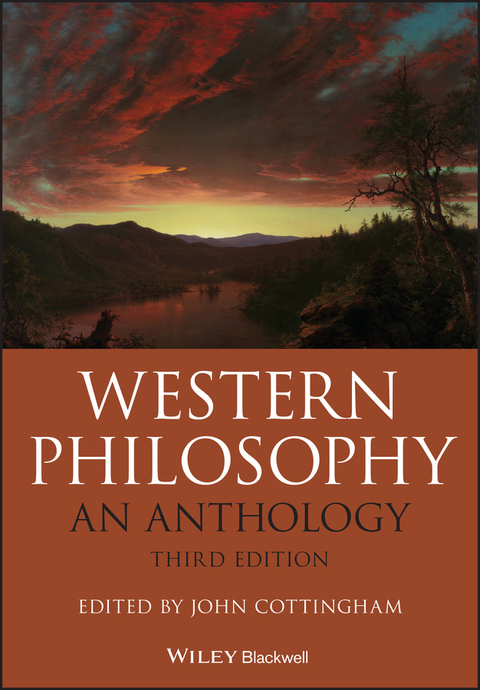
Western Philosophy (eBook)
John Wiley & Sons (Verlag)
978-1-119-16574-3 (ISBN)

The new edition of this celebrated anthology surveys the Western philosophical tradition from its origins in ancient Greece to the work of today's leading philosophers
Western Philosophy: An Anthology?provides?an authoritative guided tour through the great tradition of Western philosophical thought. The seminal writings of the great philosophers along with more recent readings of contemporary interest are explored in 144 substantial and carefully chosen extracts, each preceded by a lucid introduction, guiding readers through the history of a diverse range of key arguments, and explaining how important theories fit into the unfolding story of Western philosophical inquiry. Broad in scope, the anthology covers all the main branches of philosophy: theory of knowledge and metaphysics, logic and language, philosophy of mind, the self and freedom, religion?and science, moral philosophy, political theory, aesthetics, and the meaning of life, all in self-contained parts which can be worked on by students and instructors independently.
The third edition of the?Anthology?contains newly incorporated classic texts from thinkers such as Aquinas, Machiavelli, Descartes, William James, and Wittgenstein.?Each of the 144 individual extracts is now followed by?sample?questions focusing on the key philosophical problems raised by the excerpt,?and?accompanied by?detailed further reading suggestions that include up-to-date links to online resources.?Also new to this edition is an?introductory essay written by John Cottingham, which offers advice to students on?how to read?and write about?a philosophical text.
Part of the?Blackwell Philosophy?Anthologies?series,?Western Philosophy: An Anthology, Third Edition?remains an indispensable collection of classic source materials?and expert insights?for both?beginning and advanced?university?students in a wide range of philosophy courses.
JOHN COTTINGHAM is Professor Emeritus of Philosophy at the University of Reading, and an Honorary Fellow of St John's College, Oxford University. He is the author of numerous books including Descartes, The Rationalists, On the Meaning of Life, and In Search of the Soul. He is co-translator of The Philosophical Writings of Descartes, and has published numerous articles on the history of philosophy, moral philosophy, and the philosophy of religion. Professor Cottingham is former Chairman of the British Society for the History of Philosophy and President of the British Society for the Philosophy of Religion, and was for many years editor of Ratio, the international journal of analytic philosophy.
The new edition of this celebrated anthology surveys the Western philosophical tradition from its origins in ancient Greece to the work of today s leading philosophers Western Philosophy: An Anthology provides an authoritative guided tour through the great tradition of Western philosophical thought. The seminal writings of the great philosophers along with more recent readings of contemporary interest are explored in 144 substantial and carefully chosen extracts, each preceded by a lucid introduction, guiding readers through the history of a diverse range of key arguments, and explaining how important theories fit into the unfolding story of Western philosophical inquiry. Broad in scope, the anthology covers all the main branches of philosophy: theory of knowledge and metaphysics, logic and language, philosophy of mind, the self and freedom, religion and science, moral philosophy, political theory, aesthetics, and the meaning of life, all in self-contained parts which can be worked on by students and instructors independently. The third edition of the Anthology contains newly incorporated classic texts from thinkers such as Aquinas, Machiavelli, Descartes, William James, and Wittgenstein. Each of the 144 individual extracts is now followed by sample questions focusing on the key philosophical problems raised by the excerpt, and accompanied by detailed further reading suggestions that include up-to-date links to online resources. Also new to this edition is an introductory essay written by John Cottingham, which offers advice to students on how to read and write about a philosophical text. Part of the Blackwell Philosophy Anthologies series, Western Philosophy: An Anthology, Third Edition remains an indispensable collection of classic source materials and expert insights for both beginning and advanced university students in a wide range of philosophy courses.
JOHN COTTINGHAM is Professor Emeritus of Philosophy at the University of Reading, and an Honorary Fellow of St John's College, Oxford University. He is the author of numerous books including Descartes, The Rationalists, On the Meaning of Life, and In Search of the Soul. He is co-translator of The Philosophical Writings of Descartes, and has published numerous articles on the history of philosophy, moral philosophy, and the philosophy of religion. Professor Cottingham is former Chairman of the British Society for the History of Philosophy and President of the British Society for the Philosophy of Religion, and was for many years editor of Ratio, the international journal of analytic philosophy.
Preface
An anthology can serve many different purposes. Anthologies of poetry usually leave readers to make their own way, sampling the flowers arranged for their delight. With philosophy things are rather different. Many of the arguments of the great philosophers rest on a daunting array of presuppositions and concealed premises, and careful guidance is needed if many readers are not to be overwhelmed. The texts included in this volume, and the linking passages of introduction and commentary, offer a guided tour through the main branches of the subject, introducing the ideas in sequence, and uncovering the main outlines of that complex interplay of arguments which forms the Western philosophical tradition. The central aim, as with all anthologies, is to put the reader in touch with the texts themselves. Those embarking on the subject can sometimes find it hard even to grasp just what philosophy is, and there is no better way of discovering than to read the writings of the great philosophers at first hand. This volume is designed to present some of the most important extracts from those writings in a way that will enable the individual to achieve a clear overview of how the subject developed, and how the most important theories fit into the overall picture. It is, I hope, a book which individuals will be able to keep by them, for pleasure and profit, as they set out on the quest for philosophical understanding.
The book also has the more specific aim of being serviceable to university students undertaking a formal course of study in philosophy. Philosophy is a wide-ranging subject, and there is no single template for an ideal introductory course (and even if there were, philosophy departments worth their salt would not wish to grind out exactly the same syllabus year after year). There are many ways into philosophy, and no good reason why one particular branch of the subject should always form the chosen route. One of the objects of this book is to provide, within the compass of a single volume, a set of key introductory materials for the widest possible range of courses, covering all the main branches of the subject (or at least all those suitable for teaching at a basic undergraduate level). Fundamental issues in epistemology are dealt with in Part I (‘Knowledge and Certainty’). Part II (‘Being and Reality’) is concerned with general metaphysics and ontology, and Part III (‘Language and Meaning’) deals with central philosophical concerns about how language is related to thought and to the world. The philosophy of mind is covered in Part IV (‘Mind and Body’), and the important issues of personal identity and the freedom of the will receive separate treatment in Part V (‘The Self and Freedom’). The philosophy of religion and the philosophy of science are dealt with in Part VI (‘God and Religion’) and Part VII (‘Science and Method’) respectively. The next two parts deal with moral philosophy: Part VIII (‘Morality and the Good Life’) tackles theoretical and systematic issues in normative ethics, while Part IX (‘Problems in Ethics’) covers a selection of key issues in applied moral philosophy. Part X (‘Authority and the State’) and Part XI (‘Beauty and Art’) deal respectively with political philosophy and aesthetics, and, to conclude the volume, Part XII (‘Human Life and its Meaning’) covers some of the various ways in which great thinkers, ancient and modern, have tackled the old puzzle of what significance, if any, attaches to human existence.
Although the first three parts of the volume are devoted to epistemology, meta-physics and philosophy of language, traditionally considered as having a ‘foundational’ role in philosophy, the issues raised here are among the most demanding in the book, and there is no compelling reason why any given introductory course should have to begin with them. Each part of the volume is intended to be self-contained, and students and teachers are invited to work on the various parts of the book in any order they see fit, or indeed to concentrate on any particular part or parts in isolation. That said, given the nature of philosophy there is inevitably a fair amount of overlap between the topics raised in various parts; where this happens footnotes are provided to draw attention to connections with relevant texts or commentary in other parts of the volume.
The passages of introduction and commentary which link the extracts have been kept as concise and clear as possible. They are, of course, no substitute for the interpretations and evaluations which lecturers and instructors will themselves wish to provide. This book is designed to be serviceable for both teachers and students, not to eliminate the need for hard work by either group. So what is provided here is a basic scaffolding on which courses can be constructed, and a supportive framework for those coming to the texts for the first time. There is always a danger of oversimplification when writing with the principal aim of helping the student reader. Philosophy is not an easy subject, and spoon-feeding is often counterproductive; in the end there is no alternative to readers wrestling with the arguments for themselves. But without a clear initial overview, the whole philosophical enterprise can seem dauntingly obscure. Qualifications, objections, reinterpretations – these can always be added later; but if there is no initial understanding, the enthusiasm for making these further efforts will simply ebb away before any progress has been made.
These points notwithstanding, there may still be some who may have certain reservations about the very idea of introducing students to philosophy by way of an anthology, as opposed to through the intensive study of complete texts. Those who (like the present writer) were taught by this latter method will know that it has a very great deal to recommend it. Nevertheless, the vast expansion in numbers in tertiary education during the late twentieth century has required many philosophy teachers to rethink their approach. This has been particularly true in the United Kingdom. A typical annual philosophy intake in most British universities used to comprise a relatively small number of students who, even in their first year, could be taught in specialized classes and tutorials. But nowadays introductory classes can run to hundreds, and for groups of this size no library, however well equipped, can furnish enough copies of books and articles to support the traditional tutorial system based on the weekly reading list. Many teachers in Britain have thus had to accept what their counterparts in North America and elsewhere have long taken as given: the need for a single compendious volume of readings which will supply the materials for an entire introductory course in philosophy. Such volumes do not, of course, preclude students from reading more widely (as every good teacher will want to encourage them to do); but they at least ensure that some of the basic textual materials are to hand.
Although the volume is a stout one, the constraints of space are nevertheless such that many hard choices have been necessary. To begin with, this is a collection based on ‘classic’ texts, and this means that only a relatively small percentage of the extracts are taken from the work of philosophers from the recent past. To have given a representative selection of today’s proliferating philosophical theories and debates would have required virtually an entire volume corresponding to each of the divisions of the present book. The classic materials featured here are nevertheless designed to provide a good base for understanding more recent developments, and the commentary accompanying each part of the volume often includes brief glances forward to later theories. Even within the terms of its chosen framework, however, the selection presented here cannot make any claim to completeness: the schema of twelve extracts in each of the twelve parts yields that pleasingly duodecimal aggregate traditionally termed a ‘gross’ (which gives the book a considerably wider scope than most recent anthologies); but I am well aware of the very many candidates for inclusion that have had to be omitted. If specialists, turning to their chosen authors, are shocked by the brevity of the extracts, or the severity of the abridgements, I can only plead that they bear in mind that nothing in the present project is designed to stop students going on to make a more detailed and thorough study of the authors represented here. On the contrary, it is my earnest hope that students who might have been overwhelmed by stern injunctions to read ‘all or nothing’ will be sufficiently excited by some of the extracts here to turn to the full texts, and to the suggestions for further reading which are provided at the end of each Part.
As well as the abridging noted in the previous paragraph, in preparing the extracts for inclusion in this volume I have not hesitated to modify spelling, punctuation and layout to make the material more readily accessible to the modern reader. It is of course vital that critical editions should preserve the original texts for scholarly use, but the aims of an anthology such as this are rather different; and since so many long-dead Greek, Latin, French and German writers are in any case presented here in modern English translations, it seemed over-exacting to insist on antiquated spelling and grammar just for those philosophers who wrote in English. I did indeed at one point consider ‘translating’ the extracts from such writers as Locke...
| Erscheint lt. Verlag | 2.7.2021 |
|---|---|
| Reihe/Serie | Blackwell Philosophy Anthologies |
| Blackwell Philosophy Anthologies | Blackwell Philosophy Anthologies |
| Sprache | englisch |
| Themenwelt | Geisteswissenschaften ► Philosophie ► Allgemeines / Lexika |
| Geisteswissenschaften ► Philosophie ► Geschichte der Philosophie | |
| Geisteswissenschaften ► Philosophie ► Philosophie der Neuzeit | |
| Schlagworte | Einführungen in die Philosophie • Geschichte der westlichen Philosophie • Historical Western Philosophy • Introductions to Philosophy • Philosophie • Philosophy • Western Philosophy • Western philosophy anthology • Western philosophy collection • Western philosophy excerpts • Western philosophy guide • Western philosophy introduction • Western philosophy reader • Western philosophy textbook • Western philosophy texts • Westliche Welt |
| ISBN-10 | 1-119-16574-1 / 1119165741 |
| ISBN-13 | 978-1-119-16574-3 / 9781119165743 |
| Informationen gemäß Produktsicherheitsverordnung (GPSR) | |
| Haben Sie eine Frage zum Produkt? |
 EPUB (Adobe DRM)
Kopierschutz: Adobe-DRM
Adobe-DRM ist ein Kopierschutz, der das eBook vor Mißbrauch schützen soll. Dabei wird das eBook bereits beim Download auf Ihre persönliche Adobe-ID autorisiert. Lesen können Sie das eBook dann nur auf den Geräten, welche ebenfalls auf Ihre Adobe-ID registriert sind.
Details zum Adobe-DRM
Dateiformat: EPUB (Electronic Publication)
EPUB ist ein offener Standard für eBooks und eignet sich besonders zur Darstellung von Belletristik und Sachbüchern. Der Fließtext wird dynamisch an die Display- und Schriftgröße angepasst. Auch für mobile Lesegeräte ist EPUB daher gut geeignet.
Systemvoraussetzungen:
PC/Mac: Mit einem PC oder Mac können Sie dieses eBook lesen. Sie benötigen eine
eReader: Dieses eBook kann mit (fast) allen eBook-Readern gelesen werden. Mit dem amazon-Kindle ist es aber nicht kompatibel.
Smartphone/Tablet: Egal ob Apple oder Android, dieses eBook können Sie lesen. Sie benötigen eine
Geräteliste und zusätzliche Hinweise
Buying eBooks from abroad
For tax law reasons we can sell eBooks just within Germany and Switzerland. Regrettably we cannot fulfill eBook-orders from other countries.
aus dem Bereich