


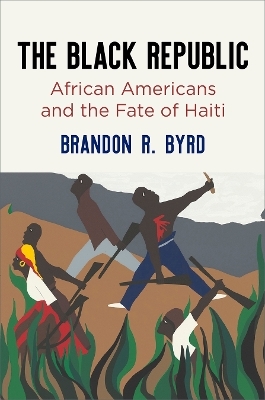
The Black Republic
African Americans and the Fate of Haiti
Seiten
2022
University of Pennsylvania Press (Verlag)
978-0-8122-2519-8 (ISBN)
University of Pennsylvania Press (Verlag)
978-0-8122-2519-8 (ISBN)
In The Black Republic, Brandon R. Byrd explores the ambivalent attitudes that African American leaders in the post-Civil War era held toward Haiti, the first and only black republic in the Western Hemisphere. Following emancipation, African American leaders of all kinds-politicians, journalists, ministers, writers, educators, artists, and diplomats-identified new and urgent connections with Haiti, a nation long understood as an example of black self-determination. They celebrated not only its diplomatic recognition by the United States but also the renewed relevance of the Haitian Revolution.
While a number of African American leaders defended the sovereignty of a black republic whose fate they saw as intertwined with their own, others expressed concern over Haiti's fitness as a model black republic, scrutinizing whether the nation truly reflected the "civilized" progress of the black race. Influenced by the imperialist rhetoric of their day, many African Americans across the political spectrum espoused a politics of racial uplift, taking responsibility for the "improvement" of Haitian education, politics, culture, and society. They considered Haiti an uncertain experiment in black self-governance: it might succeed and vindicate the capabilities of African Americans demanding their own right to self-determination or it might fail and condemn the black diasporic population to second-class status for the foreseeable future.
When the United States military occupied Haiti in 1915, it created a crisis for W. E. B. Du Bois and other black activists and intellectuals who had long grappled with the meaning of Haitian independence. The resulting demand for and idea of a liberated Haiti became a cornerstone of the anticapitalist, anticolonial, and antiracist radical black internationalism that flourished between World War I and World War II. Spanning the Reconstruction, post-Reconstruction, and Jim Crow eras, The Black Republic recovers a crucial and overlooked chapter of African American internationalism and political thought.
While a number of African American leaders defended the sovereignty of a black republic whose fate they saw as intertwined with their own, others expressed concern over Haiti's fitness as a model black republic, scrutinizing whether the nation truly reflected the "civilized" progress of the black race. Influenced by the imperialist rhetoric of their day, many African Americans across the political spectrum espoused a politics of racial uplift, taking responsibility for the "improvement" of Haitian education, politics, culture, and society. They considered Haiti an uncertain experiment in black self-governance: it might succeed and vindicate the capabilities of African Americans demanding their own right to self-determination or it might fail and condemn the black diasporic population to second-class status for the foreseeable future.
When the United States military occupied Haiti in 1915, it created a crisis for W. E. B. Du Bois and other black activists and intellectuals who had long grappled with the meaning of Haitian independence. The resulting demand for and idea of a liberated Haiti became a cornerstone of the anticapitalist, anticolonial, and antiracist radical black internationalism that flourished between World War I and World War II. Spanning the Reconstruction, post-Reconstruction, and Jim Crow eras, The Black Republic recovers a crucial and overlooked chapter of African American internationalism and political thought.
Brandon R. Byrd is Associate Professor of History at Vanderbilt University.
Prologue
Introduction. The Ideas of Haiti and Black Internationalism
Chapter 1. Emancipation, Reconstruction, and the Quandary of Haiti
Chapter 2. The Reinventions of Haiti After Reconstruction
Chapter 3. The Vexing Inspiration of Haiti in the Age of Imperialism and Jim Crow
Chapter 4. Haiti, the Negro Problem, and the Transnational Politics of Racial Uplift
Chapter 5. W. E. B. Du Bois, the Occupation, and Radical Black Internationalism
Epilogue
Notes
Index
Acknowledgments
| Erscheinungsdatum | 09.03.2022 |
|---|---|
| Reihe/Serie | America in the Nineteenth Century |
| Zusatzinfo | 15 illus. |
| Verlagsort | Pennsylvania |
| Sprache | englisch |
| Maße | 152 x 229 mm |
| Themenwelt | Sachbuch/Ratgeber ► Geschichte / Politik ► Allgemeines / Lexika |
| Geisteswissenschaften ► Geschichte ► Regional- / Ländergeschichte | |
| ISBN-10 | 0-8122-2519-8 / 0812225198 |
| ISBN-13 | 978-0-8122-2519-8 / 9780812225198 |
| Zustand | Neuware |
| Informationen gemäß Produktsicherheitsverordnung (GPSR) | |
| Haben Sie eine Frage zum Produkt? |
Mehr entdecken
aus dem Bereich



aus dem Bereich
Handbuch zum Lesen des Himmels
Buch | Hardcover (2025)
Harpercollins (Verlag)
CHF 30,80
historische Porträts von George Washington bis Donald Trump
Buch | Softcover (2025)
C.H.Beck (Verlag)
CHF 33,55


