Dial It Down (eBook)
298 Seiten
Bookbaby (Verlag)
978-1-0983-7467-9 (ISBN)
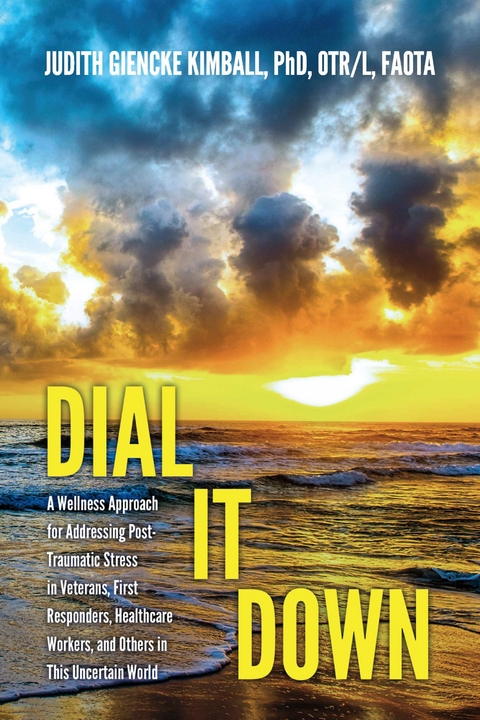
Trauma is perhaps the defining feature of our time. Millions of Americans have recently experienced trauma through their work as military servicemembers, first responders, and frontline medical workers. Millions more have faced unprecedented levels of loss and traumatic stress due to the COVID-19 pandemic. But very little has been written that directly speaks to these trauma survivors, offering proven daily strategies and hope for reclaiming a sense of safety, connectedness, and self. Dial It Down offers innovative yet simple ways for readers to understand and recover from post-traumatic stress. It is also an invaluable resource for the practitioners who treat these individuals. Dr. Judith Kimball draws on the latest scientific research and on her years of experience working with trauma survivors to reveal that while trauma is often seen purely as a mental health issue, it also leads to physical changes in how the brain reacts to stimuli from the environment, creating a bias toward a fight-or-flight response. This fight-or-flight hyperarousal is important for "e;staying alive"e; during trauma, but it can persist when the trauma is over, severely limiting the ability to participate fully in life, including in relationships with family and friends. The book includes client histories to demonstrate the often-subtle effects of trauma. An Iraq War veteran who'd become hyper-alert to things "e;out of place"e; as signs of danger is ashamed to find himself suddenly "e;losing it"e; with his children over cluttered toys when he returns home. A nurse, after months of working on a COVID-19 ward, finds herself being strongly startled by noises at home such as beeping household appliances that had never bothered her before. Countless husbands and wives face unexpected issues with physical intimacy after trauma, as fight-or-flight hyperarousal can change patterns of sexual response and lead to misunderstandings, self-doubt, and a heightened sense of isolation. Along with each of these stories and many more, Dr. Kimball offers inspiring examples and strategies for personal transformation. Dial It Down will reshape how individuals understand their responses to life after trauma, and will provide the tools needed to heal. The book offers proven methods for assessing fight-or-flight hyperarousal, and for designing self-treatment programs using common activities-some as brief as 5 minutes-with specific tips to fit them into busy lives and increase their effectiveness. As people suffering from traumatic stress regain a sense of control over their own daily responses, they will also regain a sense of connectedness to others. Dial It Down offers new ways of talking about experiences, empowering individuals to take steps toward repairing the intimate relationships that often suffer most in the aftermath of trauma. Dial it Down shows that post-traumatic healing and growth are possible, for individuals, families, and communities.
INTRODUCTION:
Coming Home
Chris came back from his 2018 deployment in Afghanistan excited to be home, wanting to finally spend time beyond the limits of Skype and phone calls with his 10-year-old son, his 5-year-old daughter, and his wife, Emily. But things didn’t go as he expected them to. His family threw him a big welcome home party. He enjoyed the barbecue and beer, but after 45 minutes, the music on the stereo speakers sounded too loud and the happy crowd of friends and relatives felt “too big” for his comfort level. There was too much movement, too much color in the decorations and bright spring clothes, and everyone wanted to touch him and ask him questions. It all felt like “too much,” and he was glad when the celebration finally ended because he was anxious about “losing it.” Emily wanted to know why he’d seemed so angry during the party. But he couldn’t find the words to explain.
Jane, a nurse at a long-term care facility that experienced an outbreak of COVID-19 in the spring of 2020, described feeling “stressed” and “unsafe” even when at home with her family. She contracted COVID-19 from a patient, and after her recovery, she was able to return to work, but she continued to feel “very alert” in ways that included being strongly startled by noises at home that had never bothered her before, such as beeping household appliances.
Roy was a detective in a large urban police department. He’d been called to numerous active shooting situations, including one involving mass casualties. His wife was a retired police officer who experienced physical limitations due to an on-the-job injury. The couple decided to move out of the city to a horse farm in the country so that they could have a calm, low-stress home to return to each day. But Roy found that even in this quiet setting, he was still “on edge” and often not able to relax.
Dawn, returning home after working as a respiratory therapist in an overcrowded COVID-19 ICU apart from her family for two months, found herself responding in unexpected ways to her children. She’d been looking forward to relaxing evenings with them, but instead she often found herself agitated by their movement and noise and yelling at them to be quiet, when all they were doing was happily chasing each other around the house and laughing.
Steve, a Vietnam-era veteran, attended a Fourth of July picnic with his grandson and was embarrassed when he “hit the ground” as the first fireworks went off.
Marcus’s family decided to go out to dinner several months after he’d returned from military deployment to a combat zone, but when they got to the restaurant, there were no tables where he could sit with his back to the wall to scan for every possible threat and escape route, so he insisted on leaving. He couldn’t find the right words to tell his disappointed parents and sisters why.
These stories are all based on experiences described to me in the context of my work as an occupational therapist (OT) with veterans, first responders, and medical personnel. Your behavior at home may be very different than it was before your military service or frontline work. Is this simply due to increased anxiety from having been “under fire”? You probably don’t think so because you were able to function very well while on duty in highly stressful situations. Why are you having problems adjusting to life at home where there’s much less serious stress? What’s different?
The answer is that you are. The trauma of active duty and frontline work—of experiences faced as a soldier, first responder, or medical professional—can actually change how your brain processes everyday sensations from the world around you. Your reactions to common sensations may have been fundamentally altered in ways that are just now being researched. Ways that respond to a physical solution, not just a psychological one—ways that are the subject of this book.
During active duty or frontline work, you needed to be vigilant to stay alive and effective, and the military or other training programs you completed (such as first-responder physical training and live drills, and medical residency with its stresses and repeated protocols) did an excellent job of preparing you to use your vigilance skills. You found that you were able to control your anxiety, stay focused, and get the job done even in difficult circumstances. How and why? In part because you knew that your military, first responder, or medical peers “had your back” and you had theirs. Additionally, members of the military and first responders must all meet physical fitness requirements. These often-daily physical workouts keep your body in top shape; but even more importantly, you may be surprised to learn that this physical training also keeps your brain focused for optimal decision-making, which can have a major effect on your behavior.
How do you see yourself now that you’ve returned from active duty or frontline work and aren’t under the same training regime, facing the same demands and threats? Rather than reacting only to certain real danger situations, you may find yourself over-reacting in daily life. The responses that trouble you may often be related to the strange feeling that there’s “too much” going on to keep track of—too much noise, too many smells, too much light touch, too much clutter (things out of place), and/or too much activity (too many things moving). What do these experiences have in common? They’re all reactions to common sensations from the environment. But why is your nervous system reacting to them more intensely than it did before?
When you returned from active duty or rotated off your shift, you may have been told to control and reduce your vigilance responses (to “just calm down”), but most likely you weren’t told how to do this. And you weren’t told exactly what was going on in your body and brain as you tried, because science is only just starting to map how our brains change when exposed to the stress and trauma of war and sustained physical threats like those experienced by first responders and medical personnel. The military has taken the lead in describing some reactions to look for when its soldiers return from deployment, and it is working on ways to help soldiers cope (see BATTLEMIND, the Comprehensive Soldier and Family Fitness Program, and the Performance Triad P3 Program, discussed in Chapter 3). Programs throughout the country have been developed to help veterans reintegrate (see Chapter 13), and many police and fire departments and hospital systems have also started programs to help their members cope with the stress and dangers of their jobs.
But this book is about a crucial missing piece of the puzzle, offering hope and proven ways for you to help yourself respond more calmly and consistently to the issues of daily life after active duty, first responder work, or frontline medical work.
There’s a Name for That Missing Piece of the Puzzle
It’s called sensory modulation challenges (SMC), and you may have developed it due to the stress and trauma of your job. It’s the reason you might find yourself overloaded by common sensory input from the environment that doesn’t seem to bother other people, leading to hypervigilance and anxiety. It’s why you may feel calm one minute but then “very anxious” or “very angry” the next. And why you may react to many things that “didn’t bother you” before active duty or frontline work.
What Are Sensory Modulation Challenges?
Sensory modulation challenges are an over-reaction to common sensory input, and this over-reaction can negatively affect daily functioning. The prime directive of our brains is to keep us alive. This is accomplished by what I call the “staying alive reflex,” the fight-or-flight response. It appears that trauma can change the way in which our brains respond to sensations, resulting in over-alerting us to danger too often and keeping us alerted for too long.
We’re constantly bombarded in daily life by sensory input from all aspects of our environments—sight, sound, touch, smell, the shifting movements of our own bodies through space, and internal bodily sensations. For those with an “even” or “less reactive” nervous system, these sensory experiences enter our conscious awareness and alert us to danger only if they’re out of the ordinary. For those of us with sensory modulation challenges, many sensory inputs result in more intense reactions, and these can have a profound effect on our lives and functioning.
Sensory modulation challenges have been well-documented in scientific studies and are now widely known as they relate to people (estimated at 10% of the population) who are born with these challenges. But little research has been conducted on people who acquire these specific neurological challenges through trauma as adults—those who suddenly find themselves at odds with places and people, even in their own homes and with close family members, where and with whom they’ve always felt comfortable and safe before. For the people like those mentioned...
| Erscheint lt. Verlag | 18.8.2021 |
|---|---|
| Sprache | englisch |
| Themenwelt | Geisteswissenschaften ► Psychologie |
| ISBN-10 | 1-0983-7467-3 / 1098374673 |
| ISBN-13 | 978-1-0983-7467-9 / 9781098374679 |
| Informationen gemäß Produktsicherheitsverordnung (GPSR) | |
| Haben Sie eine Frage zum Produkt? |
 EPUB (Adobe DRM)
Größe: 7,5 MB
Kopierschutz: Adobe-DRM
Adobe-DRM ist ein Kopierschutz, der das eBook vor Mißbrauch schützen soll. Dabei wird das eBook bereits beim Download auf Ihre persönliche Adobe-ID autorisiert. Lesen können Sie das eBook dann nur auf den Geräten, welche ebenfalls auf Ihre Adobe-ID registriert sind.
Details zum Adobe-DRM
Dateiformat: EPUB (Electronic Publication)
EPUB ist ein offener Standard für eBooks und eignet sich besonders zur Darstellung von Belletristik und Sachbüchern. Der Fließtext wird dynamisch an die Display- und Schriftgröße angepasst. Auch für mobile Lesegeräte ist EPUB daher gut geeignet.
Systemvoraussetzungen:
PC/Mac: Mit einem PC oder Mac können Sie dieses eBook lesen. Sie benötigen eine
eReader: Dieses eBook kann mit (fast) allen eBook-Readern gelesen werden. Mit dem amazon-Kindle ist es aber nicht kompatibel.
Smartphone/Tablet: Egal ob Apple oder Android, dieses eBook können Sie lesen. Sie benötigen eine
Geräteliste und zusätzliche Hinweise
Buying eBooks from abroad
For tax law reasons we can sell eBooks just within Germany and Switzerland. Regrettably we cannot fulfill eBook-orders from other countries.
aus dem Bereich