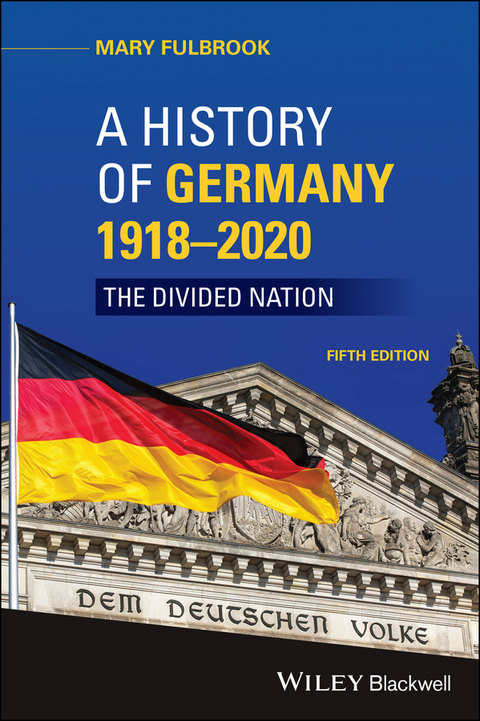
A History of Germany 1918 - 2020 (eBook)
John Wiley & Sons (Verlag)
978-1-119-57424-8 (ISBN)
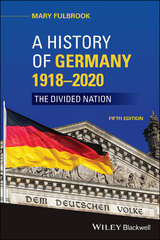
The new edition of the acclaimed textbook on modern German history, written by a leading scholar in the field
Now in its fifth edition, A History of Germany 1918-2020 provides a clear and well-balanced survey of German history from the creation of the Weimar Republic to the era of Angela Merkel's Chancellorship. Guiding readers through the complex patterns of the nation's historical development using clear and compelling narrative, this classic textbook introduces readers to the key themes of modern German history while tracing the social, cultural, and political tensions that have challenged German stability and unity across more than a century.
Fully updated for the next generation of readers, A History of Germany 1918-2020 extends its framework for exploring legacies of the past into the 21st century. The fifth edition includes enhanced coverage of the extremes of nationalism, military aggression, and genocide under Nazism, as well as an expanded analysis of the Berlin Republic and the changing character of Germany in the Europe of 2020. Presenting readers with a panoramic overview of the past 100 years of German history, this compelling textbook:
- Provides a concise yet thorough account of the turbulent history of Germany from the end of the First World War to the present
- Examines the character and consequences of World War II and the Holocaust
- Explores the development of a capitalist democracy in West Germany and a communist dictatorship in East Germany during the Cold War
- Covers East and West German history in equal depth from the perspectives of instability, division, and reunification
- Analyses the fall of Communism and the unification of an enlarged Federal Republic in 1989-90
- Traces unified Germany's development as a globally respected state playing a pivotal role in Europe today
A History of Germany 1918-2020: The Divided Nation, Fifth Edition remains the ideal text for undergraduate students in courses on modern German or European history, as well as for general readers with interest in the subject.
Mary Fulbrook, FBA is Professor of German History at University College London (UCL), UK. A graduate of Cambridge and Harvard Universities, she is the author or editor of numerous books, including Reckonings: Legacies of Nazi Persecution and the Quest for Justice, for which she won the 2019 Wolfson History Prize, and A Small Town Near Auschwitz: Ordinary Nazis and the Holocaust, winner of the 2012 Fraenkel Prize. Professor Fulbrook has served as Executive Dean of the UCL Faculty of Social and Historical Sciences, Academic Director of the UCL European Institute, founding Joint Editor of the journal German History, and Chair of the German History Society.
The new edition of the acclaimed textbook on modern German history, written by a leading scholar in the field Now in its fifth edition, A History of Germany 1918-2020 provides a clear and well-balanced survey of German history from the creation of the Weimar Republic to the era of Angela Merkel s Chancellorship. Guiding readers through the complex patterns of the nation s historical development using clear and compelling narrative, this classic textbook introduces readers to the key themes of modern German history while tracing the social, cultural, and political tensions that have challenged German stability and unity across more than a century. Fully updated for the next generation of readers, A History of Germany 1918-2020 extends its framework for exploring legacies of the past into the 21st century. The fifth edition includes enhanced coverage of the extremes of nationalism, military aggression, and genocide under Nazism, as well as an expanded analysis of the Berlin Republic and the changing character of Germany in the Europe of 2020. Presenting readers with a panoramic overview of the past 100 years of German history, this compelling textbook: Provides a concise yet thorough account of the turbulent history of Germany from the end of the First World War to the present Examines the character and consequences of World War II and the Holocaust Explores the development of a capitalist democracy in West Germany and a communist dictatorship in East Germany during the Cold War Covers East and West German history in equal depth from the perspectives of instability, division, and reunification Analyses the fall of Communism and the unification of an enlarged Federal Republic in 1989-90 Traces unified Germany s development as a globally respected state playing a pivotal role in Europe today A History of Germany 1918-2020: The Divided Nation, Fifth Edition remains the ideal text for undergraduate students in courses on modern German or European history, as well as for general readers with interest in the subject.
Mary Fulbrook, FBA is Professor of German History at University College London (UCL), UK. A graduate of Cambridge and Harvard Universities, she is the author or editor of numerous books, including Reckonings: Legacies of Nazi Persecution and the Quest for Justice, for which she won the 2019 Wolfson History Prize, and A Small Town Near Auschwitz: Ordinary Nazis and the Holocaust, winner of the 2012 Fraenkel Prize. Professor Fulbrook has served as Executive Dean of the UCL Faculty of Social and Historical Sciences, Academic Director of the UCL European Institute, founding Joint Editor of the journal German History, and Chair of the German History Society.
List of Plates vii
List of Maps ix
Preface to the Fifth Edition x
Preface to the Fourth Edition xi
Preface to the Third Edition xii
Preface to the Second Edition xiii
Acknowledgments xv
1 The Course of German History 1
Part I A Divided Society: The Weimar Republic and the Third Reich 13
2 The Weimar Republic: Origins and Orientations 15
3 The Collapse of Democracy and the Rise of Hitler 42
4 A 'National Community'? State, Economy and Society, 1933-1939 60
5 War, Extermination and Defeat 85
Part II The Divided Nation: The Two Germanies, 1945-1990 119
6 Occupation and Division, 1945-49 121
7 Crystallization and Consolidation, 1949-61 152
8 Transformation and the 'Established Phase', 1961-88 175
9 Diverging Societies 195
10 Politics and the State 214
11 Dissent and Opposition 231
12 Diverging Cultures and National Identities? 252
13 The East German Revolution and the End of the Postwar Era 274
Part III The Divided Century 297
14 The Berlin Republic 299
15 Tension and Transformation in Twentieth-Century Germany 325
Notes 344
Select Bibliography of English-Language Works 362
Index 371
1
The Course of German History
In those extraordinary months after the fall of the Berlin Wall in November 1989, when discussion of the unification of the two Germanies was for the first time in forty years back on the serious political agenda, many voices were raised giving views on ‘the German question’. From a variety of quarters, prejudices were aired which had lain dormant – along with the memories, gas masks and other relics of the Second World War – over the years when the Cold War and the balance of terror had seemed to ensure a fragile peace in a divided Europe. Suddenly, the prospect of a united, economically powerful, and politically sovereign Germany, active again in central Europe and in a position to mediate between East and West, aroused strong emotions among those whose view of Germany had been largely confined to an ill-assorted combination of images of Hitler and sleek West German capitalist competitors. Who were the Germans? What was their national character, if they had one? Who were those people who also called themselves Germans, from the other, Eastern, side of the rapidly crumbling Iron Curtain, who in many ways seemed not a bit like their Western brothers and sisters? Provoked into having to make a rapid response to the collapse of communist rule in Eastern Europe, many people outside Germany found they had a serious deficit of knowledge and understanding. Many Germans, too – both East and West – found that the Iron Curtain, and the proclaimed ‘zero hour’ of 1945, had raised barriers to informed interpretation. History – although it did not come to an end in 1989, as some pundits, like the American scholar Fukuyama, wished to proclaim – had indeed seemed to have stopped, as far as many textbooks were concerned, in 1945. Thereafter, politics and sociology took over – to provide partial snapshots of an apparently eternal present, unconnected with the radically different past.
But prejudices based on partial perceptions of Hitler’s rule, more than half a century earlier, combined with limited impressions of a rapidly changing present, can scarcely provide a secure basis of understanding. The ‘land in the centre of Europe’, Germany, had for decades held an uneasy position in the European and world balance of power – as well as being an extraordinary powerhouse of creativity, in cultural and intellectual as well as economic respects. The complexities of German history demand serious and detailed engagement – and many observers have seen it as a most peculiar history, thus provoking heated debates on interpretation.
Over the centuries, there has been a ‘German question’. Some analysts have seen its beginnings – somewhat anachronistically – in the ‘failure’ to establish a unified state in the Middle Ages. In the days of the politically decentralized ‘Holy Roman Empire of the German Nation’, the multiplicity of German lands – ranging from the more important secular and ecclesiastical principalities and city states through to the minuscule fiefdoms of ‘independent imperial knights’ – formed an interdependent system over which the emperors (often pursuing dynastic interests outside the empire) never quite gained central control. The cultural and political conflicts involved in the Reformation of the sixteenth century helped to institutionalize the decentralization of the German lands. Religious differences coincided and overlapped with political conflicts to confirm this diversity in the course of the seventeenth century, in the series of conflicts which formed the so-called Thirty Years War (1618–48). Yet the Peace of Westphalia in 1648 was effectively able only to seal a stalemate: neither religious uniformity nor political centralization was achieved. The territorial rulers enjoyed sovereignty within their own states while still remaining formally subordinate to the Emperor. Clashes among states competing for domination in the emerging European state system continued in the ‘age of absolutism’ of the later seventeenth and eighteenth centuries. While, from myriad small states which made up ‘Germany’, the ever growing composite state of Brandenburg–Prussia emerged as a powerful rival to Austria, the relatively weak German lands were still easily overrun by an expansionist post-revolutionary France under Napoleon.
Under the impact of Napoleonic aggression, a fundamental reorganization of the domestic and external affairs of the German states was begun. In 1806 the Holy Roman Empire was abolished. Legal, social and economic reforms were introduced, either as a direct result of Napoleonic rule or in a form of ‘defensive modernization’. After the eventual defeat of Napoleon, the formation of a German Confederation in 1815 included a strengthened and enlarged Prussia as an intended bulwark against France in the west and tsarist Russia in the east. At the same time, with territorial reorganization and a great reduction in the number of German states, other states too had increased in size and importance, many duchies having achieved the status of kingdom for the first time with the demise of the old empire.
In the course of the nineteenth century it proved to be the economically more advanced Prussia which was able to gain the edge over Austria in competition for domination over the medium-sized German states. Prussia was in the forefront of moves towards economic integration in the Customs Union, in the century which was to see those dramatic processes of transformation associated with industrialization. Attempts to achieve political unification of the German states under liberal auspices failed in 1848, and it was ultimately the Prussian Chancellor Bismarck’s policies of ‘blood and iron’ that produced the unification, fraught with tensions, of a ‘small Germany’ (Kleindeutschland), excluding Austria, in the second German Empire founded in 1871. First seeking to secure its place in Europe, and then to gain a position among the imperial powers of the world, Imperial Germany proved to be an unstable entity. It came to an end, following defeat in the First World War, in the revolutionary autumn of 1918. After Germany’s brief and ill-fated attempt at democracy in the Weimar Republic, the initial denouement was to be the genocidal rule of Adolf Hitler and his Third Reich, an empire which was supposed to last a thousand years but in the event collapsed in ruins after a mere dozen, characterized by arguably unequalled evil. It was this outcome – this Götterdämmerung – which provides a unique twist to the problem of explaining German history. And it was often under the lengthy shadow of this past that subsequent developments in Germany were perceived.
Many observers puzzled over the apparently peculiar pattern of German history – the allegedly unique German path, or Sonderweg. In the later decades of the twentieth century, diverse attempts were made to explain its course. Broadly, whether they wanted to or not, historians of Germany writing after Hitler felt they had to engage in a long-running battle, characterized by local skirmishes over particular periods and issues, on the questions of ‘what went wrong?’ and ‘when did it go wrong?’ A rearguard action was mounted by those who wanted to say that not everything did go wrong, or at least, it did not go wrong so early, or it could have been prevented. However far serious historians tried to step outside this sort of framework, the shadow of Hitler stretched a long way back, shaping even counterarguments about the diversity of trends and the non-inevitability of historical outcomes. Moreover, Nazi rule not only had a major impact on subsequent developments in Cold War Europe, divided under the superpowers but also affected the ways in which history after 1945 was viewed and interpreted, from a variety of perspectives.
Given this context, there was a widespread (although far from universal) tendency to castigate Germany’s past for what it was not: German history was frequently written in terms of its alleged distortions, failures, ‘turning-points where Germany failed to turn’ (to use A. J. P. Taylor’s phrase). Thus, for example, Germany ‘failed’ to become a centralized state in the Middle Ages. The ‘early bourgeois revolution’ of the 1525 Peasants’ War ‘failed’, because Germany lacked a ‘mature’ bourgeoisie at this very early date (in the view of Marxists following Friedrich Engels). The ‘failure’ to resolve the religious and political conflicts associated with the Reformation led to the petty backwater, Kleinstaaterei pattern of the eighteenth century, when a sleepy Germany produced, to be sure, some elevated cultural spirits, but remained at one remove from the real driving forces of history evident in Britain’s industrial revolution or the bourgeois revolution which put an end to the ancien régime in France. The pattern of small states allegedly nurtured the bureaucratic, subject mentality displayed by many Germans. Lutheran doctrines of obedience to worldly authority were compounded by Kantian and Hegelian philosophy in a context of absolutist rule over weak civil societies. In her rude awakening of the nineteenth century, Germany became a ‘belated’ nation, with the contradictions between an archaic sociopolitical structure and a rapidly modernizing economy ultimately proving too great to bear without unleashing domestic and eventually international conflicts....
| Erscheint lt. Verlag | 28.6.2021 |
|---|---|
| Sprache | englisch |
| Themenwelt | Geisteswissenschaften ► Geschichte ► Allgemeine Geschichte |
| Geisteswissenschaften ► Geschichte ► Regional- / Ländergeschichte | |
| Schlagworte | 20th Century & Contemporary European History • 20th century german history • Berlin Republic history • Deutschland • Deutschland (Bundesrepublik) /Neuere Geschichte • Deutschland (DDR) /Geschichte • East German history • Europäische Geschichte • European History • Geschichte • Geschichte u. Zeitgeschichte des 20./21. Jahrhunderts • History • Modern German history • modern German history textbook • modern Germany history • nazi history • survey of modern German history • Twentieth Century & Contemporary History • Weimar Republic history • West German history • Zeitgeschichte • Zeitgeschichte Europas im 20./21. Jhd. |
| ISBN-10 | 1-119-57424-2 / 1119574242 |
| ISBN-13 | 978-1-119-57424-8 / 9781119574248 |
| Informationen gemäß Produktsicherheitsverordnung (GPSR) | |
| Haben Sie eine Frage zum Produkt? |
 EPUB (Adobe DRM)
Kopierschutz: Adobe-DRM
Adobe-DRM ist ein Kopierschutz, der das eBook vor Mißbrauch schützen soll. Dabei wird das eBook bereits beim Download auf Ihre persönliche Adobe-ID autorisiert. Lesen können Sie das eBook dann nur auf den Geräten, welche ebenfalls auf Ihre Adobe-ID registriert sind.
Details zum Adobe-DRM
Dateiformat: EPUB (Electronic Publication)
EPUB ist ein offener Standard für eBooks und eignet sich besonders zur Darstellung von Belletristik und Sachbüchern. Der Fließtext wird dynamisch an die Display- und Schriftgröße angepasst. Auch für mobile Lesegeräte ist EPUB daher gut geeignet.
Systemvoraussetzungen:
PC/Mac: Mit einem PC oder Mac können Sie dieses eBook lesen. Sie benötigen eine
eReader: Dieses eBook kann mit (fast) allen eBook-Readern gelesen werden. Mit dem amazon-Kindle ist es aber nicht kompatibel.
Smartphone/Tablet: Egal ob Apple oder Android, dieses eBook können Sie lesen. Sie benötigen eine
Geräteliste und zusätzliche Hinweise
Buying eBooks from abroad
For tax law reasons we can sell eBooks just within Germany and Switzerland. Regrettably we cannot fulfill eBook-orders from other countries.
aus dem Bereich