


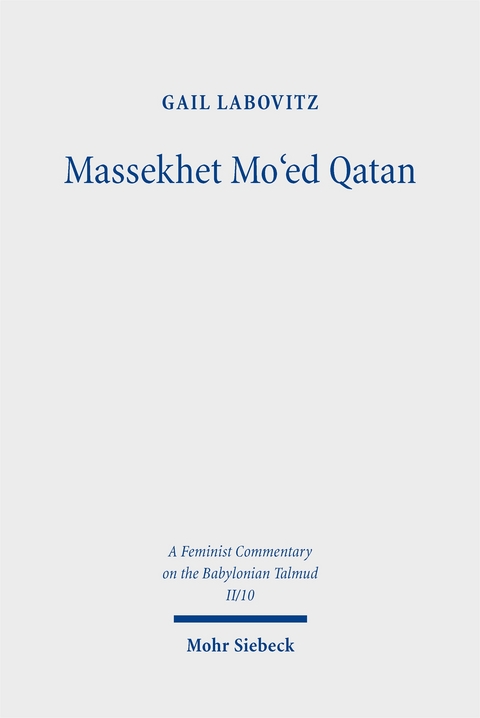
Massekhet Mo'ed Qatan
Volume II/10
Seiten
2021
Mohr Siebeck (Verlag)
978-3-16-158282-0 (ISBN)
Mohr Siebeck (Verlag)
978-3-16-158282-0 (ISBN)
Der Traktat Mo'ed Qatan ist neben der Erörterung der Zwischenfestspiele von Pessach und Sukkot die wichtigste Quelle zu rabbinischen Trauergesetzen und -ritualen. Gail Labovitz' Kommentar beleuchtet die Funktionsweise von Geschlecht und die Verpflichtung und Beteiligung von Frauen an diesen Praktiken.
Tractate Mo'ed Qatan, in addition to discussing the mid-festivals of Passover and Sukkot, is the primary source on rabbinic mourning laws and rituals. In her commentary Gail Labovitz thus considers such questions as: when considering whether particular forms of labour should or should not take place during the mid-festival or when one is in mourning, which gender's labour is considered significant, which is overlooked or taken for granted? How are practices that are meant to engender certain emotional states - joy in the festival, grief over a death - impacted by gender? How does gender guide who is mourned, and in what ways? She also explores women's unusually conspicuous and public role in funerals and mourning procedures as lamenters. Although Mo'ed Qatan is a short tractate, women, female characters both biblical and rabbinic, and issues of gender feature prominently throughout.
Tractate Mo'ed Qatan, in addition to discussing the mid-festivals of Passover and Sukkot, is the primary source on rabbinic mourning laws and rituals. In her commentary Gail Labovitz thus considers such questions as: when considering whether particular forms of labour should or should not take place during the mid-festival or when one is in mourning, which gender's labour is considered significant, which is overlooked or taken for granted? How are practices that are meant to engender certain emotional states - joy in the festival, grief over a death - impacted by gender? How does gender guide who is mourned, and in what ways? She also explores women's unusually conspicuous and public role in funerals and mourning procedures as lamenters. Although Mo'ed Qatan is a short tractate, women, female characters both biblical and rabbinic, and issues of gender feature prominently throughout.
Born 1966; 2002 PhD in Talmud and Rabbinics from the Jewish Theological Seminary of America; 1992 Rabbinic Ordination; currently Professor of Rabbinic Literature, American Jewish University.
| Erscheinungsdatum | 17.07.2021 |
|---|---|
| Reihe/Serie | A Feminist Commentary on the Babylonian Talmud |
| Verlagsort | Tübingen |
| Sprache | englisch |
| Maße | 165 x 237 mm |
| Gewicht | 950 g |
| Themenwelt | Literatur ► Klassiker / Moderne Klassiker |
| Geisteswissenschaften ► Religion / Theologie ► Judentum | |
| Geisteswissenschaften ► Sprach- / Literaturwissenschaft ► Anglistik / Amerikanistik | |
| Geisteswissenschaften ► Sprach- / Literaturwissenschaft ► Literaturwissenschaft | |
| Schlagworte | Gender • Holidays • Mourning • Women |
| ISBN-10 | 3-16-158282-9 / 3161582829 |
| ISBN-13 | 978-3-16-158282-0 / 9783161582820 |
| Zustand | Neuware |
| Informationen gemäß Produktsicherheitsverordnung (GPSR) | |
| Haben Sie eine Frage zum Produkt? |
Mehr entdecken
aus dem Bereich
aus dem Bereich


