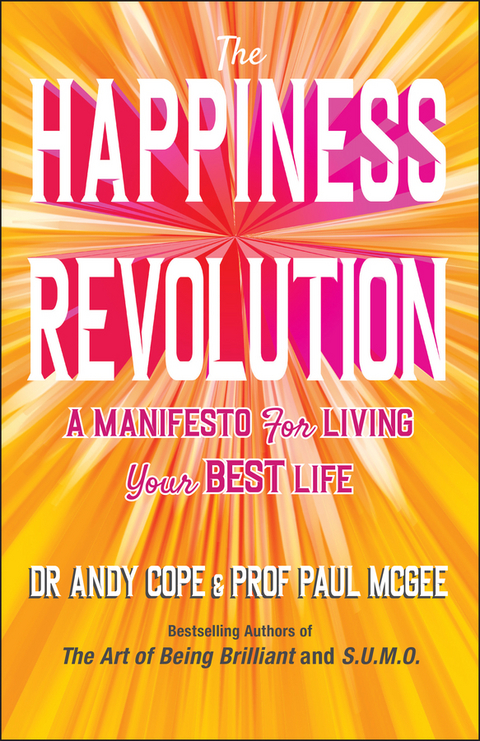
The Happiness Revolution (eBook)
John Wiley & Sons (Verlag)
978-0-85708-894-9 (ISBN)
A new book by two of the biggest powerhouses in positive psychology and personal development - Dr Andy Cope and Professor Paul McGee
Happiness. We chase it, we crave it...it's so in demand... yet so scarce and fleeting.
But here's the good news. In The Happiness Revolution: A Manifesto For Living Your Best Life, bestselling authors Dr Andy Cope and Professor Paul McGee deliver a page-turning self-help book of the times, for the times. As the world wakes up to a new kind of normal, The Happiness Revolution challenges readers to sign up to an uprising of wellbeing and to making the most of the privilege of being on this planet.
The book outlines a 10-point Happiness Manifesto. Grounded in the science of human flourishing and the reality of life, the principles are simple, do-able and above all make a difference not only to yourself but to others too. Let the fight back to mental wealth start right here.
Welcome to global domination of the happiness kind!
Discover:
- How to regain your sanity, clarity, and wellbeing, even when your smartphone, kids, spouse, job, and possessions seem to be conspiring to keep you from doing just that.
- Why it can be so hard to maintain a happy outlook when the outside world has never been so fast, complex, and unpredictable.
- How to be at your best in a world that is doing its worst.
Happiness is the #1 thing you want for yourself and your family. The Happiness Revolution is an indispensable guide for everyone trying to live their best life and to spread some happiness whilst doing so.
Rise Up and Be Happy! Vive la revolution!
ABOUT ANDY
Despite being described by his mother as 'not even the best writer in this family', ANDY COPE is a best-selling author, wellbeing expert and 'recovering academic'. Andy is a keynote speaker on themes of wellbeing and human flourishing. His flagship programme The Art of Being Brilliant has been delivered to rave reviews across the world.
www.artofbrilliance.co.uk
andy@artofbrilliance.co.uk
@beingbrilliant
ABOUT PAUL
Paul McGee is a Sunday Times bestselling author. He is the author of S.U.M.O. (Shut Up, Move On), How Not to Worry, How to Succeed with People, Self-Confidence, and How to Have a Great Life. He is an internationally sought-after keynote speaker and performance coach.
www.theSUMOguy.com
Paul.McGee@thesumoguy.com
@TheSumoGuy
A new book by two of the biggest powerhouses in positive psychology and personal development Dr Andy Cope and Professor Paul McGee Happiness. We chase it, we crave it it s so in demand yet so scarce and fleeting. But here s the good news. In The Happiness Revolution: A Manifesto For Living Your Best Life, bestselling authors Dr Andy Cope and Professor Paul McGee deliver a page-turning self-help book of the times, for the times. As the world wakes up to a new kind of normal, The Happiness Revolution challenges readers to sign up to an uprising of wellbeing and to making the most of the privilege of being on this planet. The book outlines a 10-point Happiness Manifesto. Grounded in the science of human flourishing and the reality of life, the principles are simple, do-able and above all make a difference not only to yourself but to others too. Let the fight back to mental wealth start right here. Welcome to global domination of the happiness kind! Discover: How to regain your sanity, clarity, and wellbeing, even when your smartphone, kids, spouse, job, and possessions seem to be conspiring to keep you from doing just that. Why it can be so hard to maintain a happy outlook when the outside world has never been so fast, complex, and unpredictable. How to be at your best in a world that is doing its worst. Happiness is the #1 thing you want for yourself and your family. The Happiness Revolution is an indispensable guide for everyone trying to live their best life and to spread some happiness whilst doing so. Rise Up and Be Happy! Vive la revolution!
ABOUT ANDY Despite being described by his mother as 'not even the best writer in this family', ANDY COPE is a best-selling author, wellbeing expert and 'recovering academic'. Andy is a keynote speaker on themes of wellbeing and human flourishing. His flagship programme The Art of Being Brilliant has been delivered to rave reviews across the world. www.artofbrilliance.co.uk andy@artofbrilliance.co.uk @beingbrilliant ABOUT PAUL Paul McGee is a Sunday Times bestselling author. He is the author of S.U.M.O. (Shut Up, Move On), How Not to Worry, How to Succeed with People, Self-Confidence, and How to Have a Great Life. He is an internationally sought-after keynote speaker and performance coach. www.theSUMOguy.com Paul.McGee@thesumoguy.com @TheSumoGuy
Part 1 Happiness, Missing in Action 1
i. Vive la révolution 3
ii. Learn Latin 11
iii. Watering your weeds 19
iv. All aboard the struggle bus 27
v. Presumed guilty 37
vi. New tricks 43
vii. Flip it 51
viii. The eff -word 61
Part 2 Happiness Manifesto: The Pledges 67
i. Solemnly swear to be your own bestie 69
ii. Vow to relight your fire 85
iii. Make an oath to your physical self 95
iv. Commit to acknowledging the small print 113
v. Promise to value your values 129
vi. Dare to stand out by being much less SMART 137
vii. Remember that words can change worlds 151
viii. Call off the search 167
ix. Engage with the only moment in time 181
x. Sign up for the Everyday Olympics 193
Part 3 Tales of the Unexpected (and Unexplained) 197
i. Life lag 201
ii. The parable of Cotton Candy 205
iii. A window on the world 213
iv. Big apple, big heart 215
v. Uber uncool 221
vi. The grapes of wrath 225
vii. Renting or owning? 231
viii. The fluffy tale of Babbity Rabbit 235
More books by Andy Cope and Paul McGee 247
About the Authors 249
Index 251
We call my wife ‘the plant whisperer’. She's very handy with a trowel and a bag of manure and can literally coax lettuce from between the paving stones of our patio. I followed her around our vegetable patch one time, watching, learning and listening to her whisperings.
She was so encouraging of the courgettes; ‘You guys are doing so well. I'm so proud of how far you've come.’ She slipped them a slug pellet, almost surreptitiously, as though it was a banned substance. ‘And this'll help you grow even bigger.’
She clapped her hands in glee at the runner beans. ‘Oh my giddy aunt, just look at you little rascals, all tall and slender and handsome.’
Is it right that I felt a twinge of jealousy? About runner beans?
But the plant whisperer is not all sweetness and light. The cabbages got a right telling off; ‘You lazy things. You should be ashamed of yourselves. You've really let yourselves go this year.’
Then we came across a rather sad and forlorn-looking rose bush, and the plant whisperer stopped in her tracks, sniffed one of the half-open buds and her face fell. ‘Well you're not a happy bunny.’ I'm no expert but I'm assuming ‘bunny’ was the Latin term for that particular rose.
While I admit to not knowing my dahlias from my marigolds, I do know the ins and outs of personal development and ‘not a happy bunny’ put me in mind of Carol Dweck's fixed and growth mindsets.1 This is common language in schools but in case you're not familiar, let me remind you of the basics. Dweck conducted research on hundreds of 11 year olds in which she set a series of puzzles at the end of which she gave them scores and praise. Half were given praise which suggested they were gifted and talented, hence she used phrases along the lines of ‘you are so smart at this’. The others were given praise that reflected the effort they'd put in, so for example; ‘you must have worked really hard’.
Then, in what sounds like an experiment in child cruelty, she gave them another test – a much sterner test – in fact so tough it was impossible. Of course, none of the kids did very well but she discovered that those who'd been given praise for their intelligence soon capitulated. It's as though they'd decided, en masse, they weren't so clever after all, whereas those who were praised for effort did ‘a Billy Ocean’ (my words not Professor Dweck's). Basically, when the going got tough, these ‘growth mindset kids’ got going. Against the odds, they improved their scores by 30%.
Academia works on a whack-a-mole principle, so no matter how in vogue your theory, someone with a bigger forehead will eventually peer review your work, pick it to bits and propose their own ‘new improved theory’. That's how knowledge inches forward. Hence Dweck's ideas have been kicked from pillar to post but sometimes it's best to ignore the noise and focus on the main point. You don't need a PhD in anything to see that Dweck's basic principle holds water. A top tip that arises directly from her work is simply to praise your children for effort rather than talent.
But what's this got to do with my wife's roses? The ‘not a happy bunny’ comment reflected that the plant was not growing. It was trying hard enough but for some reason the rose wasn't flourishing and its buds didn't look like they would blossom. We had no desire to bend down and smell its fragrance. It was taking up space in our borders, but even I could tell it wasn't growing in the way roses are meant to grow.
Dweck talks about dandelion and orchid characters. If you have a garden, you'll notice that dandelions are hardy and perennial. Basically, they crop up everywhere. They don't require watering or feeding. You can mow them and they're back in a day or two, shrugging off the recent beheading calamity, their yellowness tilting towards the sun. Orchids on the other hand… if you've ever tried to get one to bloom you'll appreciate that it requires a lot of love, effort and a wheelbarrow full of luck. Orchids require perfect soil conditions, just the right amount of feeding, a Goldilocks amount of sunshine and, even then, they might only bloom for a day or two.
The point is that some humans are like dandelions. They just seem to flourish in whatever situation/job/environment you put them in. Knock ’em down and they spring back up. But most of us (and by ‘us’ we include the majority of readers and both your authors) are trying our best to bloom in an environment that's against us. And when we do bloom, it's a quick blast of wonderfulness, and then our petals drop.
You see, unlike when buying a plant, we don't come with a small plastic card highlighting when to prune and water us, and how much sunshine we prefer. Nope, we enter this world naked, screaming, and solely reliant on people who would have more background checks made on them if they were adopting a cat than bringing a human life into the world.
Whatever upbringing we have and whatever environment we find ourselves in, we do our best to flourish. We fight off being strangled by the weeds of negativity and we do our best to stand tall when the world does its worst. The shifting seasons are a reminder that nothing's designed to bloom all the time. It's a blessed relief to know that even Mother Nature has down time where she rests and replenishes.
We all understand the mantra: it's okay NOT to be okay. But there are times when ‘not a happy bunny’ doesn't do justice to the depth of our despair. If we're continually being pruned and mowed and flooded there may come a time when the unhappy bunny really starts to struggle. So before we go any further, it's worth pausing to reflect on those times. The COVID-19 pandemic blighted the lives of millions but it's small fry in comparison to the billions who've been affected by the pandemic of mental illness.
The mental ill-health statistics are staggering. We'll spare you the details and just scare you with the headlines. The rise and rise of the problem is hard to plot exactly. It's a recent phenomenon that the medical profession has been tracking for a couple of decades, but go back any further than that and mental health wasn't deemed serious enough to warrant any gathering of data. A rough trawl of the research hints that pre-World War I about 1 in 10,000 people suffered from one of the various mental illnesses. PTSD or ‘shell shock’ took its toll and post-World War II, it was 1 in 100. In the 1980s, about 1 in 20 people suffered some form of diagnosable wellbeing disorder and by the early 21st century it was 1 in 4.2
Today? In any given year almost 30 per cent of the adult population will suffer from a recognised psychological disorder. The World Health Organization has recently stated that depression is now the biggest, costliest, and most debilitating disease in the world.3
From a standing start to a crippling mental health pandemic in the space of three generations. If you extrapolate the figures, by 2050 it will be unusual NOT to have some sort of diagnosable mental health disorder and by 2080 almost everyone will be suffering.
This book aims to help you find the pot of happiness gold at the end of the rainbow, but we can't ignore the fact that the emotional spectrum has a dark side. If you go to the depression end of the rainbow you'll find no sunshine and instead of a pot of gold, there's a black dog with no wag. There is a spectrum, with colours ranging from light grey, to darker grey to even darker grey and noir. The gloom feels pervasive and permanent. When happiness is extinguished, hope goes with it. Your past seems dark, your present bleak and your future appears as monotonous grey pointlessness.
Your author tag team are in the same corner as Russ Harris4 (author of The Happiness Trap) who couldn't be any clearer when he says that having a depressive disorder is NOT:
- Being sad about a bad situation
- Grieving the loss of a loved one
- All in a person's head
- Overreacting or being over emotional
- Something that a person just ‘gets over’
- A pity party
- Being stuck in a rut
- Laziness
- A choice
- A sign of weakness
- A character flaw
There's a saying that pain is inevitable but suffering is optional. The first half is bang on. It's nailed on that everyone will get ill, lose loved ones, experience relationship breakups, have arguments, lose their job, miss out on a promotion and work their way through pandemics.
But what about the second half of the sentence – suffering is optional? That might be true if you're a cold, emotionless psychopath. but for the majority of us suffering isn't something we can take or leave. We suffer because we care. It's built into the fabric of our lives. Suffering is a recurring theme.
There are plenty of plausible explanations for the rise and rise of worry, anxiety, panic, self-harm and suicide. Devil's advocate, just for a second, it could be that we've been birthing a batch of faulty human beings. Like a 1970s...
| Erscheint lt. Verlag | 9.6.2021 |
|---|---|
| Sprache | englisch |
| Themenwelt | Sachbuch/Ratgeber ► Gesundheit / Leben / Psychologie ► Lebenshilfe / Lebensführung |
| Sachbuch/Ratgeber ► Gesundheit / Leben / Psychologie ► Psychologie | |
| Geisteswissenschaften ► Psychologie ► Angst / Depression / Zwang | |
| Schlagworte | andy cope • Gesundheits- u. Sozialwesen • Happiness • Happiness guide • happiness manifesto • Happiness Techniques • Health & Social Care • Mental Health • mental well-being • Mindfulness • Motivational • Paul McGee • positive behaviors • positive psychology • Positivity • Psychische Gesundheit • Psychology of Happiness • Ratgeber • Ratgeber Motivation • Self-Help • Wirtschaft /Ratgeber |
| ISBN-10 | 0-85708-894-7 / 0857088947 |
| ISBN-13 | 978-0-85708-894-9 / 9780857088949 |
| Informationen gemäß Produktsicherheitsverordnung (GPSR) | |
| Haben Sie eine Frage zum Produkt? |
 EPUB (Adobe DRM)
Kopierschutz: Adobe-DRM
Adobe-DRM ist ein Kopierschutz, der das eBook vor Mißbrauch schützen soll. Dabei wird das eBook bereits beim Download auf Ihre persönliche Adobe-ID autorisiert. Lesen können Sie das eBook dann nur auf den Geräten, welche ebenfalls auf Ihre Adobe-ID registriert sind.
Details zum Adobe-DRM
Dateiformat: EPUB (Electronic Publication)
EPUB ist ein offener Standard für eBooks und eignet sich besonders zur Darstellung von Belletristik und Sachbüchern. Der Fließtext wird dynamisch an die Display- und Schriftgröße angepasst. Auch für mobile Lesegeräte ist EPUB daher gut geeignet.
Systemvoraussetzungen:
PC/Mac: Mit einem PC oder Mac können Sie dieses eBook lesen. Sie benötigen eine
eReader: Dieses eBook kann mit (fast) allen eBook-Readern gelesen werden. Mit dem amazon-Kindle ist es aber nicht kompatibel.
Smartphone/Tablet: Egal ob Apple oder Android, dieses eBook können Sie lesen. Sie benötigen eine
Geräteliste und zusätzliche Hinweise
Buying eBooks from abroad
For tax law reasons we can sell eBooks just within Germany and Switzerland. Regrettably we cannot fulfill eBook-orders from other countries.
aus dem Bereich