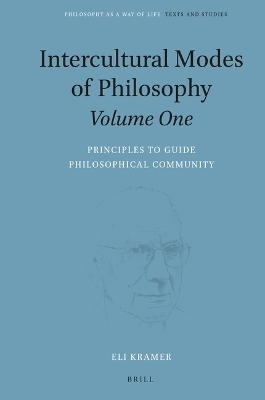
Intercultural Modes of Philosophy, Volume One
Brill (Verlag)
978-90-04-46897-9 (ISBN)
Until rather recently, philosophy, when practiced as a way of life, was, for most, a communal enterprise of mutually reinforced personal cultivation. In these times of social isolation, including in academic philosophy itself, it is time, yet again, to revitalize this lost, but vital, intercultural mode of philosophy. This volume characterizes a neglected communal mode of philosophy — the philosophical community — by describing the constellation of metaethical principles (general, axiological, cultural, and dialectical) that cultivates its values. The book draws on examples from across the globe and history, including interviews of adherents of living philosophical communities.
Eli Kramer is an assistant professor at the Department of Ethics of the Institute of Philosophy, University Wrocław. He has a PhD in philosophy (5/12/2018) from Southern Illinois University Carbondale.
Acknowledgments
part 1: Method and Historical Precedent
Preface
Introduction
Intercultural Modes of Philosophy
Philo-Dynamic Images
Philosophical Community as an Intercultural Mode of Philosophy – Some Brief Historical Sketches
The Emergence of Professional Philosophy
Living Philosophical Communities
The Logic of the “Principles” for the Method of Radically Empirical Philosophy of Culture
part 2: The Principles
1 The Peculiar General Principles of Philosophical Community
1 The Order of Exhibition
2 Overview of the Peculiar General Principles of Philosophical Community
3 Philosophical Community Ought to Enrich Life through Praxis
4 Philosophical Community Ought to Have Ethics as First Philosophy
5 Philosophical Community Ought to Have as Its Purpose Dialectical Adherence to the Beloved Community
6 Philosophical Community Ought Actively to Include a Reflective Imperative of Loyalty to Its Way of Life
7 Philosophical Community Ought to Postulate the Ontological Distance between Experience and Existence
8 Philosophical Community Ought to Have a Tragicomic Sensibility
9 Philosophical Community Ought to Sankofa
10 Philosophical Community Ought to Be a Cosmopolitan Place
11 Overview of Dialectics
12 Dialectics I (Sankofa and Place)
2 The Personal Axiological Principles of Philosophical Community
1 Overview of the Personal Axiological Principles of Philosophical Community
2 Philosophical Community Ought to Develop Mutually Reinforced Enkrateia
3 Philosophical Community Ought to Strive to Be an Intelligible Symbol of Ethical Exemplarity
4 Philosophical Community Ought to Cultivate Value and Determine “Better” Persons
5 Philosophical Community Ought to Tend to the Care of Oneself
6 Philosophical Community Ought to Quest for a Good Existence
7 Philosophical Community Ought to the Cultivate the Leisure of Punakawan
8 Philosophical Community Ought to Incite Communal Errantry
9 Philosophical Community Ought to Democratically Enhouse
10 Dialectics II (Errantry and Enhousing)
3 The Concrete Cultural Principles of Philosophical Community
1 Overview of the Concrete Cultural Principles of Philosophical Community
2 Philosophical Community Advances Eudaimonia
3 Philosophical Community Attends to Its Present Situation
4 Philosophical Community Is Small
5 Philosophical Community Produces Lingua Francas for Iconoclasm
6 Philosophical Community Has an Oikonomia
4 The Dialectically Propitiated Principles of Philosophical Community (the Nature of Rhizomatic Wandering)
1 Overview of the Dialectically Propitiated Principles of Philosophical Community and the Nature of Rhizomatic Wandering
2 Philosophical Community Performs Polyrhythmic Philia
3 Philosophical Community Leads Culture by the Reconstruction of Experience
4 Philosophical Community Is Impoverished
5 Philosophical Community Ripens Cosmological Contemplation
6 Philosophical Community Engages in Eutopian Politics
Conclusion: The Constellation of Principles at a Turning Point in Culture and Nature
Appendices
Appendix 1: The Systemic Scheme and Glossary
Appendix 2: Research Plan, Methods for Site Visits, and Primary Source Research
Bibliography
Index
| Erscheinungsdatum | 13.08.2021 |
|---|---|
| Reihe/Serie | Philosophy as a Way of Life ; 1 |
| Verlagsort | Leiden |
| Sprache | englisch |
| Maße | 155 x 235 mm |
| Gewicht | 781 g |
| Themenwelt | Geisteswissenschaften ► Philosophie ► Ethik |
| ISBN-10 | 90-04-46897-8 / 9004468978 |
| ISBN-13 | 978-90-04-46897-9 / 9789004468979 |
| Zustand | Neuware |
| Informationen gemäß Produktsicherheitsverordnung (GPSR) | |
| Haben Sie eine Frage zum Produkt? |
aus dem Bereich