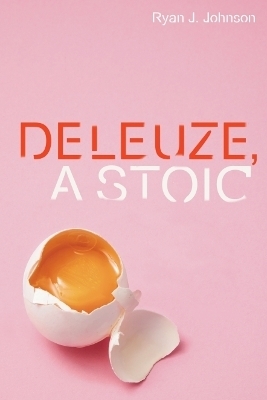
Deleuze, A Stoic
Edinburgh University Press (Verlag)
978-1-4744-6216-7 (ISBN)
Deleuze dramatises the story of ancient philosophy as a rivalry of four types of thinkers: the subverting pre-Socratics, the ascending Plato, the interiorising Aristotle and the perverting Stoics. Deleuze assigns the Stoics a privileged place because they introduced a new orientation for thinking and living that turns the whole story of philosophy inside out. Ryan Johnson reveals Deleuze’s provocative reading of ancient Stoicism produced many of his most singular and powerful ideas. For Deleuze, the Stoics were innovators of an entire system of philosophy which they structured like an egg. Johnson structures his book in this way: Part I looks at physics (the yolk), Part II is logic (the shell) and Part III covers ethics (the albumen). Including previously untranslated French Stoic scholarship, Johnson unearths new possibilities for bridging contemporary and ancient philosophy.
Ryan J. Johnson is Associate Professor and Chair of the Philosophy Department at Elon University, in North Carolina. Ryan’s early books include The Deleuze-Lucretius Encounter (Edinburgh UP 2016) and Deleuze, A Stoic (Edinburgh UP 2020), as well as the co-edited collections Contemporary Encounters with Ancient Metaphysics (Edinburgh UP 2018) and Nietzsche and Epicurus (Bloomsbury 2020). His recent work includes the co-written Phenomenology of Black Spirit (Edinburgh UP 2023) and the monograph Three American Hegels (Rowman & Littlefield 2024). His future work is on the radical abolitionist John Brown, Spinoza, and John Coltrane.
INTRODUCTION
What Comes before the Study of Deleuze
Stoic Perversion
The Three Parts of Philosophy
The Sage and the Egg
The Yolk, The Shell, and The Albumen
French Stoicism
PART I: PHYSICS
The Yolk A: Stoic Metaphysics
Introduction
Something
The Giants
Subsistence
The System and the Surface
Intensive and Extensive Faces
Integration and Difference
Conclusion
The Yolk B: Incorporeals
Introduction
Corporeal Causes and Incorporeal Effects
Clement of Alexandria and the Quasi-Cause
Static Genesis
Double Causality
Twisting the Table of Judgments
Transcendental Logic
Formal Logic of Bodies
Transcendental Logic of Incorporeals
Conclusion
The Yolk C: Space
Introduction: The Canonical Incorporeals
A Heterodox Reading: Three Reasons and Three Advantages
The Whole, the All, and Infinite Divisibility
Place
Atomic Void
Stoic Void
Something Unnamed
Space: The First Frontier
Intensive and Extensive Space
Counter-Actualisation
Conclusion: The Structure of the Three Incorporeals
PART II: LOGIC
The Shell A: Λεκτα
Introduction: Cracking Open the Shell
Origin of Λεκτα
The Voice
Three stages of the Genesis of Language
Dynamic and Static Geneses
Phases of Dynamic and Static Geneses
Epicurean and Stoic Philosophies of Language
The Two Faces of Λεκτα
The Shell B: The Paradoxes
Introduction
A Forgotten Logic
Perverting Good and Common Sense
A New Logic in Antiquity
Why Propositional Logic?
Genesis of the Contradictory
Three Dimensions of Absurdity
Structure and Purpose of Paradoxes
The Paradoxes
1. The Heap
2. The Liar
3. The Master
4. The Nobody
Structure of Ambiguity
The Aleatory Point
Ergo and Igitur
Standing on the Shore
The Shell C: Living Logic
Introduction
Handbooks For Thinking
Constructing Concepts for Living
Preparing our Handbook
Handbook of Paradoxes
1. Infinite Act
2. Singular Act
3. Disjunctive Act
4. Problematic Act
Conclusion: A Profound Link
PART III: ETHICS
The Albumen A: Time
Introduction: Goldschmidt and the Idea of Time
Three Ancient Theories of Time
The Adventures of the Present
The Present of Aion
The Present of Chronos
The Now and the Instant
A Twisted Genealogy
Chronos and Aion in Stoicism
The Greatness of Stoic Thought
Intensive Aion and Extensive Chronos
The Third Incorporeal
Conclusion: The Instant of the Act
The Albumen B: The Act
Introduction: ‘The Event of Death’
Divination
Cosmological Perspective
Use of Representations
Singular Perspective
Stoic Sage
The Act
Counter-Actualization
How to Make Yourself a Stoic
Conclusion: Amor Fati
The Albumen C: Eternal Return
Introduction
Friedrich Nietzsche, Author of the Eternal Recurrence
Death and the Compass
Paradox of Action
Providence without Teleology
Fitzgerald’s Crack-Up
Conclusion: A Laughing Stoicism
CONCLUSION
Four Forms of Philosophical Comedy
Pre-Socratic Slapstick
Socratic Irony
Cynic Sarcasm
Aristotelian Wit
Stoic Humor
| Erscheinungsdatum | 06.03.2022 |
|---|---|
| Reihe/Serie | Plateaus - New Directions in Deleuze Studies |
| Zusatzinfo | 19 black and white illustrations |
| Verlagsort | Edinburgh |
| Sprache | englisch |
| Maße | 156 x 234 mm |
| Themenwelt | Geisteswissenschaften ► Philosophie ► Geschichte der Philosophie |
| Geisteswissenschaften ► Philosophie ► Philosophie der Neuzeit | |
| ISBN-10 | 1-4744-6216-2 / 1474462162 |
| ISBN-13 | 978-1-4744-6216-7 / 9781474462167 |
| Zustand | Neuware |
| Informationen gemäß Produktsicherheitsverordnung (GPSR) | |
| Haben Sie eine Frage zum Produkt? |
aus dem Bereich