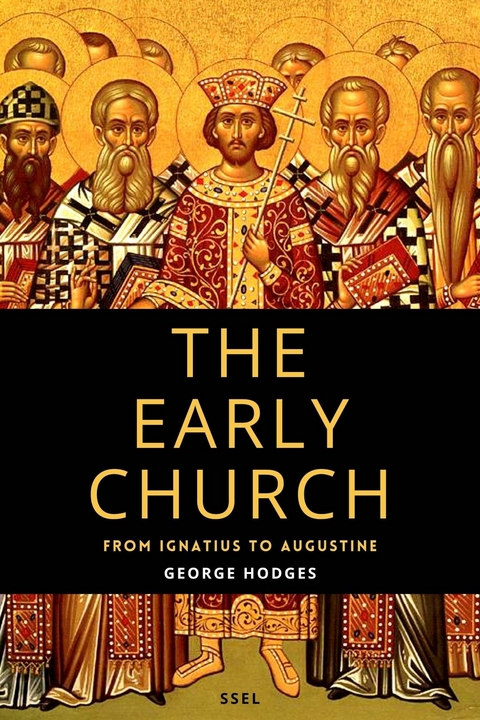
The Early Church (eBook)
298 Seiten
Ssel (Verlag)
979-10-299-1259-7 (ISBN)
George Hodges (1856-1919) was a very influential Episcopal clergyman and a prolific author.
George Hodges (1856-1919) was a very influential Episcopal clergyman and a prolific author.
Religion
The Roman world, thus constituted politically and socially, was filled with interest in religion. There had been a time of scepticism, when the sacred institutions of Numa had been discredited and neglected. The philosophers had resolved the gods into ancient heroes magnified, or into personifications of the powers of nature. The temples had been deserted and the venerable liturgies forgotten. But this was only one of the ebb-tides in the ever-moving sea of human life. The years of spiritual dearth were followed by years of spiritual plenty. The first three centuries of the Christian era were marked by a general enthusiasm of religion. Christianity began in the midst of a religious revival.
One of the manifestations of this religious spirit was a widespread interest in Greek philosophy.
The Epicureans, indeed, denied the essential propositions of religion—the providence of God and the immortality of the soul. The gods, they said, dwell serenely aloof from human life, having no interest in our concerns; and the soul is perishable.
But the Stoics vindicated the everlasting reality of religion. They believed in a living God, immanent in the world. All things are therefore good, and the wise man will so regard them, no matter how bad they seem to be. "Everything," says Marcus Aurelius, "is harmonious with me which is harmonious to thee, O universe. Nothing for me is too early or too late, which is in due time for thee." All men are brethren, having one divine father. The artificial distinctions which divide society, even the differences which appear in nations and in races, have no real existence. We are all members of one body. It is the divine intention that we shall love one another. The highest good in human life is to live virtuously and to serve our neighbor. Stoic teachers were going about making converts to these excellent doctrines, preaching sermons, comforting the sad, directing the perplexed, and giving counsel to disturbed consciences.
Plutarch, who rejected the philosophy of the Epicureans because of their materialism, and the philosophy of the Stoics because of their pantheism, believed in the personality of God, following the revived philosophy of Pythagorians. The Pythagoreans realized the difference between good and evil, attributing evil not to God but to matter. Thus they distinguished between the spirit and the flesh in man, holding that the spirit is in bondage to the flesh and can attain its freedom only by abstinence and purification and the subduing of the senses. They had their saints, by whose example they are inspired. While the Christians were reading the lives of Christ, the pagans were reading the lives of Pythagoras and of Apollonius of Tyana. They found a place for all the ancient gods, who entered their monotheistic system as angels and archangels.
Another manifestation of the contemporary religious interest was the welcome which was given in the Roman world to religions from the East.
From Phrygia came the religion of Cybele, the Magna Mater, the Mother of the Gods. Her Asiatic priests came with here, bringing their strange language and strange ceremonies, worshipping a meteoric stone. With Cybele came Attis, a god who being violently put to death had come to life again. On the 24th of March, called Sanguis, the day of blood, the votaries of this religion mourned the death of Attis, as the Hebrew women in the vision of Ezekiel had mourned the death of Tammuz. They lamented with wild cries, and horns and drums and flutes, with mad dances. On the 25th of March, called Hilaria, they celebrated the resurrection of Attis, with rejoicings equally unrestrained, with feasts and masquerades and revelry.
From Egypt came the religion of Isis and Osiris ( = Serapis). After a baptismal initiation, the disciple passed through successive grades of approach to a central secret which was disclosed to those only who had thus made themselves ready to receive it. Daily services of litanies and hymns, matins and vespers, following immemorial usage, attended the opening and the closing of the shrine. On the 28th of October was enacted in a kind of passion play the death of Osiris, killed by Set the god of evil, with weeping and mourning. Three days after, the lamentation was changed to cries of joy: "We have found him, let us rejoice together!" Osiris had risen from the dead.
These religions, together with that of Mithra, which we will consider later, were mystery religions. The led their disciples on from grade to grade till they were taught at last a doctrine too sacred to be told to the common world. This doctrine, connected with the nature myth of the dying and reviving god, was a doctrine of redemption. It was at the hart of these religions as it was also at the heart of the Orphic mysteries of Dionysus, and of the Eleusinian mysteries of Demeter. Attis, Osiris, Dionysus, Demeter,—each is a god who dies, and rises from the dead. Each is a symbol of the great course of nature wherein vegetation dies from off the face of the earth in the winter and appears again alive in the spring. Each represents a primitive belief that man must somehow enact this necessary order, by his mourning and rejoicing, in order to make sure that, after the winter, spring will follow. Each religion lifted this physical idea to a spiritual significance, and from the miracle of the resurrection of the plants inferred the miracle of the resurrection of the plants inferred the miracle of the resurrection of the body, and the immortality of the soul. These were, accordingly, redemption religions, helping men out of the slavery of sin, and promising them life everlasting.
But the philosophers—Epicurean, Stoic, Pythagorean—and the priests, with their mysteries from Phrygia and Egypt, touched only a few of the people. In the main the Roman world continued in the old religion.
The old religion was indeed attacked by the influences of foreign conquest. The victors brought back in triumph to Rome not only the kings of vanquished peoples but their gods. It was discovered that they were many in number, with perplexing similarities and dissimilarities. Also the old religion was attached by the invasion of knowledge. The boundaries of the region of mystery in which the gods dwelt were set back. The world was better understood. It was perceived that some of the events of life could be explained by other reasons than those which were pronounced by priests.
It was perceived, also, that whole tracts of life were beyond the range of the conventional religion, which took no account of sin and made no provision for salvation. The old religion was prosaic and practical. The purpose of it was to secure the favor or avert the anger of the gods, and this was done by mercantile transactions—so much paid and so much obtained in return. Spiritual needs were not considered, spiritual blessings were not asked nor desired. The contention between light and darkness, between summer and winter, between life and death, which in the East symbolized the contention between good and evil in the soul of man, was indeed represented in the mythology of Greece and Rome, but it was only faintly reflected in religious aspiration. When the sense of sin and the consciousness of the necessity of salvation awoke in the Western mind they found no satisfaction in the official religion.
Nevertheless, the ancient ways remained. The creeds and rites of the old time continued to be observed by ignorant persons, by peasants on farms and in villages, and by those who were naturally conservative, to whom any change from the traditional order involved the probability of some sort of bad luck. They continued to be observed also by cultivated persons, by whom they were associated with art and letters, with the refinements of society, and with the long past. Among these people the ceremonies of religion were family customs, connected with distinguished and revered ancestors. In spite of all the criticisms of sceptics, and the discontent of devout souls, the old religion dominated the Roman world. Christianity found it everywhere in control. Everywhere it pervaded the whole of life.
It was a domestic religion, associated with every detail in the conduct of the household. The door was consecrated to Janus, and the hearth to Vesta. The house was under the protection of the Lares, the contents of it were guarded by the Penates. Ceres presided over the growth of the grain; Flora attended to the blossoms, and Pomona to the fruit in the orchard. There was a divinity for every act of life from birth to death. And neglect of the invocation of the proper god at the proper time was likely to involve serious consequences. There is an ancient instinct, which we formally discredit and call superstition, which whispers to the soul of man that he would better do what his fathers did before him. It is one of the silent forces which they who were converted out of paganism had to defy. When things actually did go wrong, in those days when the relation of effect to cause was very imperfectly perceived, even the Christian was tempted to think that the old gods were taking their revenge.
The Roman religion pervaded all the affairs of business. Not only were the transactions of exchange and barter, the occupations of industry, and the administration of law, conducted in the language of religion, under the patronage of the gods, but it touched all manner of employment. With its shrines and temples and images and liturgies, it engaged the services of the mason, the...
| Erscheint lt. Verlag | 30.5.2021 |
|---|---|
| Verlagsort | Vachendorf |
| Sprache | englisch |
| Themenwelt | Sachbuch/Ratgeber ► Geschichte / Politik |
| Geisteswissenschaften ► Geschichte | |
| Geisteswissenschaften ► Religion / Theologie ► Christentum | |
| Schlagworte | Apostles • Christian Church • Christian History • chrysostom • religion history • Saints |
| ISBN-13 | 979-10-299-1259-7 / 9791029912597 |
| Informationen gemäß Produktsicherheitsverordnung (GPSR) | |
| Haben Sie eine Frage zum Produkt? |
 EPUB (Wasserzeichen)
DRM: Digitales Wasserzeichen
Dieses eBook enthält ein digitales Wasserzeichen und ist damit für Sie personalisiert. Bei einer missbräuchlichen Weitergabe des eBooks an Dritte ist eine Rückverfolgung an die Quelle möglich.
Dateiformat: EPUB (Electronic Publication)
EPUB ist ein offener Standard für eBooks und eignet sich besonders zur Darstellung von Belletristik und Sachbüchern. Der Fließtext wird dynamisch an die Display- und Schriftgröße angepasst. Auch für mobile Lesegeräte ist EPUB daher gut geeignet.
Systemvoraussetzungen:
PC/Mac: Mit einem PC oder Mac können Sie dieses eBook lesen. Sie benötigen dafür die kostenlose Software Adobe Digital Editions.
eReader: Dieses eBook kann mit (fast) allen eBook-Readern gelesen werden. Mit dem amazon-Kindle ist es aber nicht kompatibel.
Smartphone/Tablet: Egal ob Apple oder Android, dieses eBook können Sie lesen. Sie benötigen dafür eine kostenlose App.
Geräteliste und zusätzliche Hinweise
Buying eBooks from abroad
For tax law reasons we can sell eBooks just within Germany and Switzerland. Regrettably we cannot fulfill eBook-orders from other countries.
aus dem Bereich